Thinkaholic
- 19
- 6
Hi! I know all of you might know what I'm about to post, but I just discovered it for myself, and I want to share my enthusiasm.
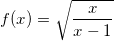
Let
and
 (here, I'll be restricting the domain of f(x) to the positive real numbers.)
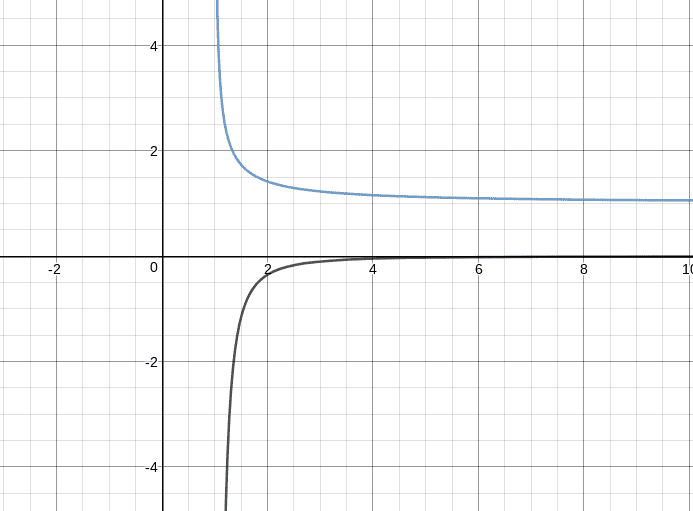
Here is a graph of the two, with f(x) in blue and F(x) in black:
1st question: Where does f(x) intersect with the line y=x?
you could write

squaring both sides of the equation, multiplying both sides by x-1, and subtracting x from both sides gives

Factoring x from the LHS and dividing both sides by x leaves you with

This is the minimal polynomial for the golden ratio, or φ, and the minimal polynomial for -φ^-1, or -Φ. This means that the quadratic above has two solutions at φ and -Φ. -Φ cannot be the solution we are looking for, as, as stated above, I am only dealing with f(x) within the domain of the positive real numbers (positive x values only). So, the intersection of f(x) and y=x is at (φ,φ)!
Question 2: What is the value of
 ?
Using L'Hospital's Rule, we obtain that

calling the limit as x approaches infinity of f(x) "L", then this becomes

and obviously L=1. So
 .
Question 3: What is the derivative of f(x) at (φ,φ)?
If we take the derivative of f(x), plug in φ for x, and make sure to remember that φ-1=Φ and that φ^-1=Φ, we simplify:
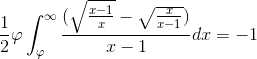
 Question 4 (finale): What is
 ?
From the fundamental theorem of calculus

So we could rewrite this as:
 Hope I made no typos! Sorry if this is too long, but I want to share these interesting facts with y'all. Also, hopefully the type doesn't mess up, I used rendered LaTeX and pasted the images here. Also, the prefix is beginner, as most of the calculus stuff is taught in high school, but I really don't know what this is, so sorry if that is wrong.
Let
and
Here is a graph of the two, with f(x) in blue and F(x) in black:
1st question: Where does f(x) intersect with the line y=x?
you could write
squaring both sides of the equation, multiplying both sides by x-1, and subtracting x from both sides gives
Factoring x from the LHS and dividing both sides by x leaves you with
This is the minimal polynomial for the golden ratio, or φ, and the minimal polynomial for -φ^-1, or -Φ. This means that the quadratic above has two solutions at φ and -Φ. -Φ cannot be the solution we are looking for, as, as stated above, I am only dealing with f(x) within the domain of the positive real numbers (positive x values only). So, the intersection of f(x) and y=x is at (φ,φ)!
Question 2: What is the value of
Using L'Hospital's Rule, we obtain that
calling the limit as x approaches infinity of f(x) "L", then this becomes
and obviously L=1. So
Question 3: What is the derivative of f(x) at (φ,φ)?
If we take the derivative of f(x), plug in φ for x, and make sure to remember that φ-1=Φ and that φ^-1=Φ, we simplify:
From the fundamental theorem of calculus
So we could rewrite this as:
Attachments
-
 upload_2018-5-9_19-1-12.png3.4 KB · Views: 534
-
 gif.gif560 bytes · Views: 837
-
 gif.gif1.2 KB · Views: 734
-
 gif.gif423 bytes · Views: 516
-
 gif.gif351 bytes · Views: 508
-
 gif.gif323 bytes · Views: 514
-
 gif.gif467 bytes · Views: 508
-
 gif.gif2.6 KB · Views: 512
-
 gif.gif248 bytes · Views: 530
-
 gif.gif520 bytes · Views: 530
-
 gif.gif2.1 KB · Views: 527
-
 gif.gif623 bytes · Views: 502
-
 gif.gif1.4 KB · Views: 505
-
 gif.gif1.2 KB · Views: 518
Last edited: