Why Isn't My Sonoluminescence Experiment Working?

Click For Summary
SUMMARY

The sonoluminescence experiment described follows the procedure outlined by 'The Thought Emporium' but utilizes a single transducer instead of two. The user successfully traps a bubble but fails to observe any glow, leading to speculation that the emitted light may be too dim for the naked eye. Suggestions from other users include using peripheral vision and long exposure photography to detect the glow, although attempts with a low-quality camera have not yielded results. The user is considering using a stereo microscope to examine the bubble more closely.

PREREQUISITES
  • Understanding of sonoluminescence principles
  • Familiarity with transducer operation and placement
  • Knowledge of photography techniques, specifically long exposure
  • Experience with microscopy, particularly stereo microscopes
NEXT STEPS
  • Research advanced sonoluminescence techniques and setups
  • Learn about the effects of transducer positioning on bubble behavior
  • Explore high-quality camera options for capturing low-light phenomena
  • Investigate the use of stereo microscopes in observing sonoluminescence
USEFUL FOR

Amateur scientists, physics enthusiasts, and researchers interested in sonoluminescence experiments and bubble dynamics.

Beekeeper
Messages
15
Reaction score
2
TL;DR
I am working on a sonoluminescence experiment and am having trouble with it. The problem is that although I can trap a bubble, I cannot get it to glow.
Hi, I am working on a sonoluminescence experiment and am having trouble with it. The problem is that although I can trap a bubble, I cannot get it to glow.

I am following the same procedure described by 'The Thought Emporium' and you can see a video about it here: .

In a nutshell the procedure is similar to the standard one described here: http://techmind.org/sl/ but rather than having two transducers on either side of the flask, I just have one transducer at the bottom.

Below is a picture of my flask with the trapped bubble. I wonder if anyone else has attempted the experiment following this procedure and been successful or can offer me any advice?

Thanks.
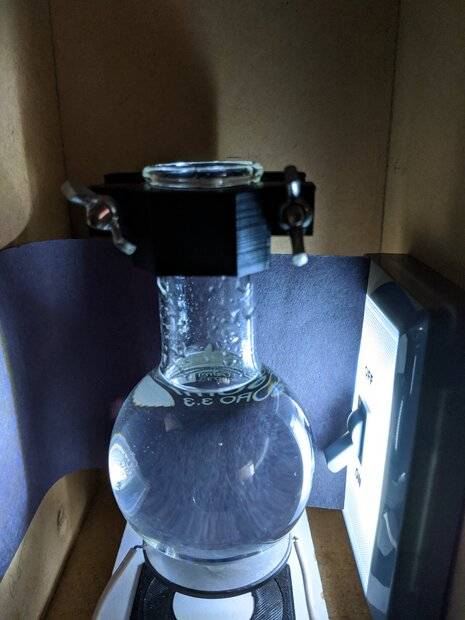
Trapped Bubble in Flask.jpg
 
Last edited by a moderator:
Physics news on Phys.org
I remember doing this a long time ago in school and being frustrated by it. Turned out that we did it correctly but we couldn't see it by looking at it directly - we had to use peripheral vision. You could try that, or try taking a long exposure photograph if possible.
 
  • Informative
Likes   Reactions: berkeman
Thanks for your reply.

I have been wondering for a while if it was working but simply the glow was too dim to be noticed by the naked eye.

I have tried taking a photo with a long exposure as suggested however have been unsuccessful capturing any glow. Admittedly the camera I am using is not great.

I was thinking to look at the bubble in the dark through a stereo microscope or similar. Anyone tried this or is it a bad idea?
 

Similar threads

  • · Replies 1 ·
Replies
1
Views
1K
  • · Replies 3 ·
Replies
3
Views
3K
  • · Replies 6 ·
Replies
6
Views
2K
Replies
2
Views
3K
Replies
2
Views
2K
Replies
7
Views
2K
  • · Replies 5 ·
Replies
5
Views
2K
  • · Replies 8 ·
Replies
8
Views
3K
  • · Replies 1 ·
Replies
1
Views
2K
  • · Replies 5 ·
Replies
5
Views
4K