Why does my inductor coil have no effect on my circuit

Click For Summary

Discussion Overview

The discussion revolves around the effectiveness of an inductor coil in a circuit designed for sonoluminescence. Participants explore the relationship between inductance, capacitance, and resonance in the context of an AC circuit, examining the expected behavior of the inductor and its impact on voltage and frequency readings.

Discussion Character

  • Exploratory
  • Technical explanation
  • Debate/contested

Main Points Raised

  • The original poster describes their circuit setup and the role of the inductor coil in achieving electrical resonance, citing specific values for capacitance and resonant frequency.
  • Some participants question the method used to estimate the inductance of the coil, suggesting that if the inductance is too small, it may not have a significant effect on the circuit.
  • One participant provides a formula for calculating inductance based on physical parameters of the coil, prompting a request for the result of that calculation.
  • There is a discussion about the relationship between capacitance and inductance, with one participant noting that a higher capacitance should lead to a lower inductance requirement.
  • Another participant explains the concept of a series resonant circuit, emphasizing the need for the inductive reactance to match the capacitive reactance for optimal current flow and voltage amplification.
  • Concerns are raised about the efficiency of the inductor due to potential losses, suggesting that the material used for the core may be a factor in its performance.

Areas of Agreement / Disagreement

Participants express differing views on the effectiveness of the inductor coil and the calculations related to inductance and capacitance. There is no consensus on the reasons for the inductor's lack of effect, and multiple competing explanations are presented.

Contextual Notes

Participants mention various inductance values and methods of calculation, but there are unresolved questions regarding the accuracy of these estimates and their implications for circuit performance. The discussion also highlights the importance of material properties in the design of inductors.

Who May Find This Useful

Individuals interested in circuit design, particularly in applications involving resonance and sonoluminescence, as well as those exploring the interplay between inductance and capacitance in AC circuits.

nst.john
Messages
163
Reaction score
1
I have the circuit with a drawing below, to create sonoluminescence. One of the steps needed was an inductor coil in order to achieve electrical resonance within the circuit. The link provided here: http://www.macgeisler.de/nld/sbsl-howto.html told me to find the inductance needed through the equation L=1/C(6.28(f)2) Where L is inductance, C is the capacitance of my transducers, he said to look at them as a parallel plate capacitor, but I just found the static capacitance on the website I bought it from which on the website said the static capacitance was 3650pF, and the resonant frequency which was 42kHz. When I made the inductor coil for this, using an iron nail covered in electrical tape and coated copper wire, I am getting all the same results on my voltage and frequency from the oscilloscope hooked up. This is AC electricity by the way. So why is my inductor coil not working or having any effect on my circuit? A physics professor from a college I visited said it was because my frequency generator was already pumping out the tuned electricity, but shouldn't the inductor atleast raise the voltage or something? The inductance says 28mH on my picture but I made a new one that is around 80mH now. But even if the inductance is off shouldn't it still have an effect on the voltage? Thanks for the help!
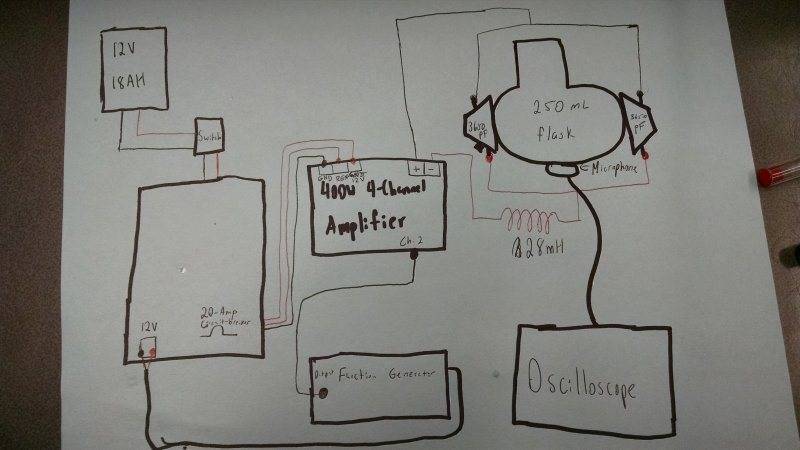
IMG_20150204_163247003 (2).jpg
 
Physics news on Phys.org
How did you estimate the inductance of your coil? If it is way too small (and your description sounds like that), it won't have a relevant effect.
 
I measured it through the equation L=((the magnetic permetivity)(turns)^2(area of coil))/length of coil
 
What was the result?

You can also check its voltage over time with the oscilloscope. If it is small compared to the source voltage, then the coil is too small.
 
I can check over time. About how much time would be sufficient? And other projects had ones of only around 20mH
 
You have the formula to compute the required inductance in post 1. If you hit that, it should help.
Note that C is the combined capacitance from both capacitors.
 
If C is the capacitance of both though shouldn't my coil still work since it would be larger than needed, because a higher capacitance in the formula means a lower inductance. I calculated the capacitance as a parallel plate capacitor too and got a really high ~35H when other experiments used ~35mH
 
The inductor is in series with the capacitance of the transducers, and forms a series resonant circuit. With no inductor, the current in the circuit will be limited by the capacitive reactance of the transducers. With the correct inductor, the circuit will have zero reactance plus a small resistance and will allow a large current to flow. Due to the resonant action, when this happens, a magnified voltage will appear across the transducers. The coil you have made is probably inefficient due to eddy current losses in the iron.nail, and the inductive reactance must equal the combined capacitive reactance of the transducers. So you need a better inductor - maybe ferrite.
 
OK. That helps a lot. Thank you!
 

Similar threads

Replies
152
Views
8K
  • · Replies 6 ·
Replies
6
Views
2K
  • · Replies 21 ·
Replies
21
Views
2K
  • · Replies 9 ·
Replies
9
Views
2K
  • · Replies 30 ·
2
Replies
30
Views
4K
  • · Replies 5 ·
Replies
5
Views
2K
  • · Replies 51 ·
2
Replies
51
Views
4K
  • · Replies 2 ·
Replies
2
Views
3K
  • · Replies 1 ·
Replies
1
Views
2K
  • · Replies 11 ·
Replies
11
Views
4K