Sound between two rooms - closing which door affects the sound most?

  • Context: Undergrad 
  • Thread starter Thread starter NEWBIE1212
  • Start date Start date
  • Tags Tags
    Sound
Click For Summary

Discussion Overview

The discussion revolves around the effects of closing doors in two identical rooms on the audibility of sound emitted from one room to another. Participants explore the implications of door closure on sound transmission, considering theoretical and practical aspects of sound propagation and reciprocity principles.

Discussion Character

  • Exploratory
  • Technical explanation
  • Debate/contested
  • Mathematical reasoning

Main Points Raised

  • Some participants propose that closing the door of the listening room would have a greater effect on sound reduction than closing the door of the emitting room.
  • Others argue that reciprocity, as described by the Rayleigh-Carson Reciprocity Theorem, suggests that the overall sound loss should be the same regardless of which door is closed.
  • A later reply questions the applicability of reciprocity under certain real-world conditions, particularly with high-frequency sounds and sound-absorbing walls.
  • One participant suggests that ambient noise levels at the two locations could influence perceived audibility, even if the received sound power remains constant.
  • Another participant discusses the importance of the order of door closure in relation to sound power levels and attenuation, indicating that the first door may be more critical in certain scenarios.
  • Mathematical examples are provided to illustrate how sound power levels change with different door attenuations, highlighting the complexity of sound transmission between the rooms.

Areas of Agreement / Disagreement

Participants express differing views on the impact of closing each door, with some supporting the reciprocity principle while others challenge its applicability in practical scenarios. The discussion remains unresolved, with multiple competing perspectives on the topic.

Contextual Notes

Participants note that assumptions about sound frequency, door attenuation, and ambient noise levels are critical to the discussion, and these factors may influence the outcomes in real-world applications.

NEWBIE1212
Messages
1
Reaction score
1
Imagine you have two identical rooms opposite each other with some space in between. (Ie two rooms across from the passage or two rooms leading off of another room). Sound is being emitted from one room only. Would closing the door in the room where the sound is being emitted from or would closing the door of the other room (listening room) result in less sound being heard?

My logic is that closing the door of the listening room would have a greater effect than closing the door of the sound emitting room.
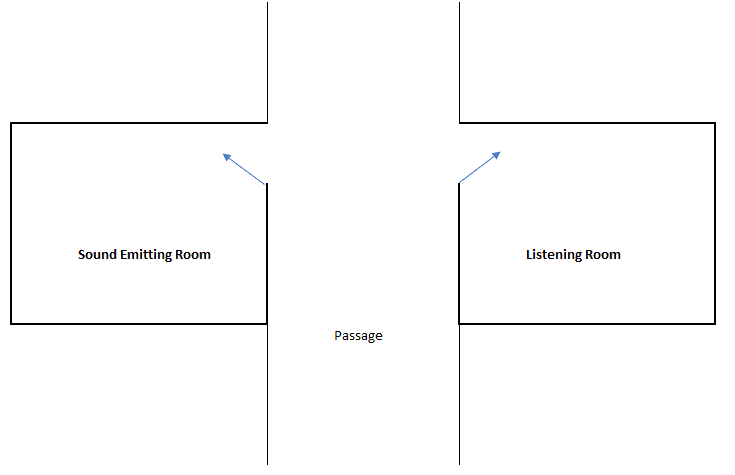
Capture.PNG
 
  • Like
Likes   Reactions: Delta2
Physics news on Phys.org
Welcome to PF. :smile:
NEWBIE1212 said:
My logic is that closing the door of the listening room would have a greater effect than closing the door of the sound emitting room.
Why do you say that? (you may be right, but why?)
 
  • Like
Likes   Reactions: davenn
berkeman said:
Welcome to PF. :smile:

Why do you say that? (you may be right, but why?)
It cannot be any different, because if you interchange the source and receiver you must always have the same overall loss. In radio engineering this is known as the Rayleigh-Carson Reciprocity Theorem.
 
For the idealized problem, reciprocity should answer the question. It might be fun to think about whether there exist any real-world conditions under which reciprocity might break down in across the two rooms. :oldsmile:
 
I think you need to be more precise about where in the rooms the emitter and listener are located.

If the sound is high frequency so that the ray approximation is valid, and the walls are sound absorbing, I don't think reciprocity applies.
 
  • Like
Likes   Reactions: hutchphd
Would the answer be in question if we were talking about light?? Why should there be a difference? I think you shut the door to your room. More good places for dissipation that way.
 
I suggest reference to the Rayleigh Reciprocity Theorem. In practice, if the ambient noise differs at the two locations then we will notice a difference in audibility, but the received sound power will be the same.
 
Assuming the door is blocking the sound in a mount relative to it volume. For example x% or yDB if so the first door would be more important because it will reduce part of higher number . That why we usually put the amplifier in the beginning of the circle for not increasing the noise
 
Let us assume a sound power of 1W, a first door attenuation of 10dB and a second door attenuation of 20dB. The sound power in the second room is then 0 - 10 - 20 = -30 dBW. If we reverse the situation the sound power reaching room 1 is also 0 -20 - 10 = -30dBW. However, if there is a noise source of -30dBW in room 2, then it will be seen that communication is only possible in the direction Room 2 to Room 1. So I agree that any amplifier should in this case go at the sending end , but notice that it might have to deliver a lot of power.
 

Similar threads

  • · Replies 15 ·
Replies
15
Views
3K
  • · Replies 23 ·
Replies
23
Views
4K
  • · Replies 8 ·
Replies
8
Views
2K
  • · Replies 3 ·
Replies
3
Views
3K
  • · Replies 3 ·
Replies
3
Views
4K
  • · Replies 9 ·
Replies
9
Views
2K
  • · Replies 1 ·
Replies
1
Views
3K
  • · Replies 4 ·
Replies
4
Views
4K
  • · Replies 8 ·
Replies
8
Views
3K
  • · Replies 2 ·
Replies
2
Views
2K