Rasmus Nielsen said:
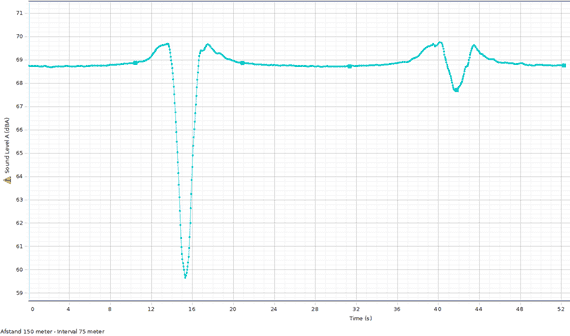
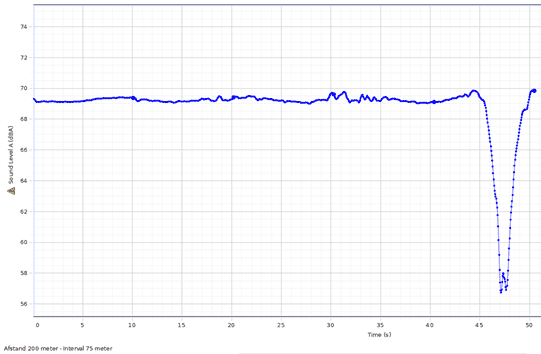
I collected this data by moving a sound level meter slowly through a total length of 0,75 meter between two speakers pointing towards each other. The wavelength of the sine waves was 0,343 meters and the frequency was 1000 Hz. The sound level meter measured the sound in dbA 20 times a second.
Can anyone explain why there's no constructive interference at all?
View attachment 224988
View attachment 224989
I have contemplated this experiment before, but never carried it out. My thoughts were that IF you could find a point of total destructive interference then the sound level should dip to zero - a large drop from nearby readings.(the difficulty being that the input of the sound meter has more than a single point size, so some "not quite destructive" input will get in)
However, IF you could find a point of perfect, constuctive interference, the sound should be "twice as loud" as we expect with just one speaker, which represents a mere 3dB increase. If that point is not in the centre, then the sound from each speaker may be at different intensity, so the increase would be less than 3dB.
If you ever get a chance to repeat this experiment, I would suggest you establish where a pair of nodes are (low sound level), indicating the antinode should be midway between them.
Then, at each node and the (assumed) antinode, take a reading with only the left speaker, then the right, then both connected.
I have always imagined the results should be of the type 60dB, 60dB, 0dB at the nodes, but 60dB, 60dB, 63dB at the antinode. ie. a large drop at the node, but a minimal rise at the antinode.