SpaceX: First stage landed Satellites in orbit

Click For Summary
SUMMARY

The SpaceX Falcon 9 1.1 "Full Thrust" successfully launched and delivered 11 OrbComm satellites to Earth orbit, marking a historic achievement with the first recovery of a rocket stage after an orbital launch. The first stage accelerated the second stage to approximately 1.5 km/s before separating and landing back at Cape Canaveral. This mission demonstrated significant advancements in rocket reusability, although the long-term viability of reusing the first stage remains contingent on refurbishment costs and operational efficiency.

PREREQUISITES
  • Understanding of rocket propulsion systems
  • Familiarity with orbital mechanics and launch profiles
  • Knowledge of SpaceX's Falcon 9 specifications
  • Awareness of satellite deployment processes
NEXT STEPS
  • Research the Falcon 9 1.1 specifications and improvements over previous versions
  • Explore the economics of rocket reusability and refurbishment costs
  • Learn about orbital mechanics, particularly stage separation and reentry trajectories
  • Investigate the implications of onshore versus offshore landing strategies for rocket stages
USEFUL FOR

Aerospace engineers, space enthusiasts, satellite operators, and anyone interested in advancements in rocket technology and space exploration.

Messages
37,404
Reaction score
14,238
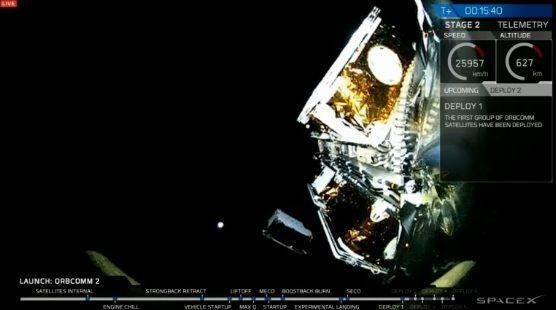
A great launch, everything worked as expected, delivering 11 OrbComm satellites to Earth orbit (they all got deployed in the minutes after reaching orbit). But that was the routine part... although it was the first flight of an improved version of Falcon 9 1.1 ("Full thrust" version).
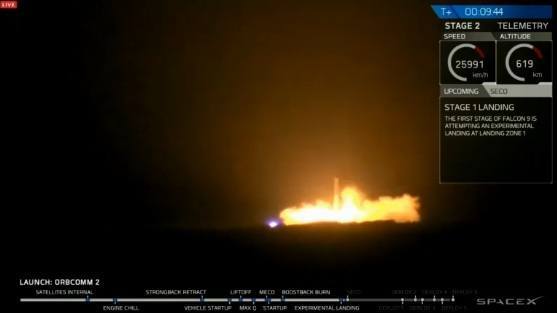
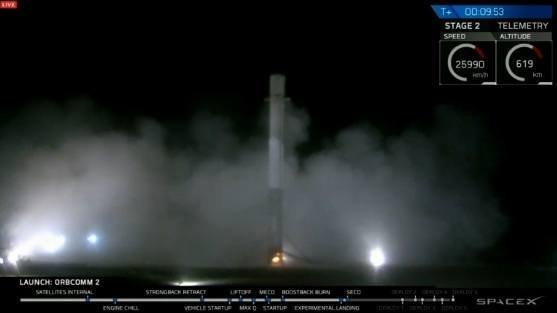
The first stage accelerated the second stage to about 1.5 km/s, then separated, turned around, flew back, and landed. It is the first time a rocket stage used for going to orbit has been recovered like that. Certainly a remarkable day in the history of spaceflight.


helicopter view

Full launch, landing and satellite deployment video

Two pictures from the stream (the numbers in the upper right corner are the second stage speed and height).
falcon1.jpg


falcon2.jpg
One satellite gets deployed, the box in the lower middle part of the image:
falcon3.jpg
 
Last edited:
  • Like
Likes   Reactions: Oleg Melnichuk, Stendarpaval, HyperTechno and 5 others
Physics news on Phys.org
Finally!
 
Aye. First time in history, right, from a full orbital launch?

e
gettyimages-502234980_custom-32a756627383c1e97ae7c4620bdb407694835886-s800-c85.jpg
 
  • Like
Likes   Reactions: Oleg Melnichuk, HyperTechno, 1oldman2 and 1 other person
The first stage didn't get into orbit, it's purpose is to get the second stage moving at a sufficient velocity and great enough altitude prior to orbit insertion.
It's impressive engineering though.
Whether or not it pays off in the end depends on whether the soft landed booster stage is in fact re-usable fairly quickly, or whether the refurbishing costs are not very different to building a new one.
 
  • Like
Likes   Reactions: Whyndham_UCL
Using this stage again will certainly be interesting. I didn't see specific plans yet.

The first stage didn't get into orbit, but at least it reached space due to the target orbit of ~650 km - significantly above the ISS, for example.
 
I guess this particular one probably will not be re-used, well not as a whole, maybe parts of it.
More likely a lot of it will be taken apart and examined very carefully to see how components had performed, potential stress failures identified, and so on that could be improved.
 
  • Like
Likes   Reactions: Whyndham_UCL and mfb
rootone said:
The first stage didn't get into orbit, it's purpose is to get the second stage moving at a sufficient velocity and great enough altitude prior to orbit insertion.
It's impressive engineering though.
Whether or not it pays off in the end depends on whether the soft landed booster stage is in fact re-usable fairly quickly, or whether the refurbishing costs are not very different to building a new one.
I know. I'm drawing a distinction between the Falcon mission which reached orbit and landed the 1st stg, and the recent Amazon funded mission which also landed but was only a suborbital mission.
 
  • #10
mfb said:
Using this stage again will certainly be interesting. I didn't see specific plans yet.

The first stage didn't get into orbit, but at least it reached space due to the target orbit of ~650 km - significantly above the ISS, for example.
Yes I think I recall from the video that the 1st stage separation occurs at about 10% of the final payload velocity.
 
  • #11
Stage separation happened at 6000 km/h (and 77 km height), satellite deployment at 26000 km/h. That is 23%.
Full launch video
Vertical velocity seems to be more than 1km/s at that point. A very steep launch profile, but one that helps to get the first stage back to the launch pad.
 
  • Like
Likes   Reactions: mheslep
  • #12
I've not seen any comment yet on why SpaceX abandoned the barge for landing, or how they gained permission for a landing attempt at the Cape. A demolition charge could not have completely avoided tons of misguided 1st stage raining on the Cape.
 
  • #13
My guess is that a barge is essentially a boat and it can tilt and move unpredictably due to weather and sea conditions.
Landing on land eliminates the risk that something moves in a weird way that the onboard guidance systems can't cope with.
 
  • #14
The landing platform is also much larger than the barge.
The previous missions all came very close to the drone ship, I guess the risk of the rocket going completely wrong was not that large. There is also the risk of the launch going wrong, with much more fuel.
 
  • #15
mfb said:
... There is also the risk of the launch going wrong, with much more fuel.
Sure, and launches fail occasionally on the pad with all that fuel, but none the less on the pad which is secured for that eventuality. Shortly after launch the vehicle is downrange over the Atlantic.

On more consideration, I imagine that since the 1st stage is also returning from over the ocean the high speed portion of the descent is safe enough, and if there's a deviation from profile in the last ~mile they still have time to destroy it. The Cape is well named; I had opportunity recently to travel down the FL coast close offshore, which is otherwise remarkably straight for hundreds of miles except for the Cape jutting out into the ocean. Its a kind of giant land barge for the FL coast.
 
  • Like
Likes   Reactions: Whyndham_UCL
  • #16
Here is a graphic that I found very interesting to demonstrate the ability of SpaceX
ATkpdAX.png
 
  • Like
Likes   Reactions: Oleg Melnichuk, HyperTechno, davidbenari and 3 others
  • #17
mfb said:
Stage separation happened at 6000 km/h (and 77 km height), satellite deployment at 26000 km/h. That is 23%.
Full launch video
Vertical velocity seems to be more than 1km/s at that point. A very steep launch profile, but one that helps to get the first stage back to the launch pad.
This video is fantastic. I love the timeline at the bottom.
 
  • Like
Likes   Reactions: Oleg Melnichuk
  • #18
mheslep said:
I've not seen any comment yet on why SpaceX abandoned the barge for landing, or how they gained permission for a landing attempt at the Cape. A demolition charge could not have completely avoided tons of misguided 1st stage raining on the Cape.

The ballistic return trajectory is such that it would land in water. Shortly before landing one engine fires and changes the trajectory so it intersects the landing pad.
 
  • #19
Great stuff. I have a good friend who works for SpaceX.
 
  • #20
newjerseyrunner said:
Here is a graphic that I found very interesting to demonstrate the ability of SpaceX ...

Blue Origin-Amazon's Bezos from doesn't agree there's a credit worthy distinction between the Falcon 1st stage and his suborbital flight. The twitter verse didn't take it well.
jeff-bezos-tweet.png
 
  • #21
I heard that the barge could still be used to support missions which need more fuel, by avoiding the need to fly back to the launch point.
 
  • #22
mheslep said:
Blue Origin-Amazon's Bezos from doesn't agree there's a credit worthy distinction between the Falcon 1st stage and his suborbital flight. The twitter verse didn't take it well.
I think this makes for a great competition that will only help advance the mission
 
  • Like
Likes   Reactions: BiGyElLoWhAt, Monsterboy, 1oldman2 and 1 other person
  • #23
mheslep said:
Blue Origin-Amazon's Bezos from doesn't agree there's a credit worthy distinction between the Falcon 1st stage and his suborbital flight. The twitter verse didn't take it well.
jeff-bezos-tweet.png
I disagree, Blue Origin's launch was a proof of concept, SpaceX's was a secondary feature of a fully functional payload delivery, both insanely impressive. I would liken it to the difference between Yuri Gragarian's full orbital flight vs Alan Shepard's suborbital.

Greg Bernhardt said:
I think this makes for a great competition that will only help advance the mission
Agreed, we are entering a very very interesting time in human history, I'm glad I'm alive to witness what will probably lead us to Mars in my lifetime. My impression that Elon Musk secretly hopes that his legacy to humanity will be Mars, and everything leading up to it will be forgotten.
 
  • Like
Likes   Reactions: BiGyElLoWhAt
  • #24
How is this better then the parachute system used by the SRBs from the space shuttle?

There are the obvious benefits...
No cost associated with a recovery ship
No salt water

And the downside...
Additional fuel for the return trip and landing.

Does that about sum it up? What other benefits and downsides are there to this system vs the previous SRB recovery system?
 
  • #28
mrspeedybob said:
Umm...
That's a link to the pageant fiasco video. Was that an error, or are you trying to say this sort of recovery is just sexier?

Perhaps the inclusion of "sexier" came from the rumor that upon the successful landing, Elon Musk yelled "In your falcon face, Bezos!" ;)
 
  • #29
The barges are intended to be used for recovering the center booster of the Falcon Heavy, as it will be too far from land to backtrack without severely impacting the payload. They were used for the first trial landings, because SpaceX was having trouble getting permission to do onshore landings; if you read the notes leading up to Sunday's launch, you'll see that permission was up in the air as recently as prior Thursday.
 
  • #30
mrspeedybob said:
And the downside...
Additional fuel for the return trip and landing.

Fuel cost is almost negligible from what I understand. Someone mentioned the entire first stage fuel cost was just 0.7% of the total first stage cost. I can imagine a controlled landing at a pad being much more beneficial than a parachute wayer landing. Hot engine into salty ocean does not sound healthy.
 

Similar threads

  • · Replies 14 ·
Replies
14
Views
5K
  • · Replies 30 ·
2
Replies
30
Views
10K
  • · Replies 43 ·
2
Replies
43
Views
8K
  • · Replies 271 ·
10
Replies
271
Views
28K
  • · Replies 2 ·
Replies
2
Views
3K
  • · Replies 24 ·
Replies
24
Views
5K
  • · Replies 19 ·
Replies
19
Views
4K
  • · Replies 6 ·
Replies
6
Views
4K
  • · Replies 3 ·
Replies
3
Views
3K
Replies
11
Views
4K