'Special' fourth order Feynman diagram Compton Scattering - Why is it allowed?

Click For Summary
SUMMARY

The forum discussion centers on the validity of a specific fourth order Feynman diagram related to Compton scattering, represented by the equation e^- + γ → e^- + γ. Participants assert that the diagram is not allowed, referencing Griffith's "Introduction to Elementary Particles" for clarification. A printing error is suspected regarding the representation of a virtual propagator, which should be depicted as a curly line rather than a solid line. The discussion concludes that the diagram's validity hinges on the proper interpretation of virtual particles and their contributions to the overall calculation.

PREREQUISITES
  • Understanding of Feynman diagrams and their components
  • Familiarity with quantum electrodynamics (QED)
  • Knowledge of virtual particles and propagators
  • Proficiency in particle physics terminology and notation
NEXT STEPS
  • Study Griffith's "Introduction to Elementary Particles" for foundational concepts
  • Learn about the role of virtual particles in quantum field theory
  • Research the mathematical techniques for calculating Feynman diagram contributions
  • Explore the implications of photon propagators in particle interactions
USEFUL FOR

This discussion is beneficial for particle physicists, students of quantum electrodynamics, and anyone interested in the intricacies of Feynman diagrams and their applications in scattering processes.
unscientific
Messages
1,728
Reaction score
13
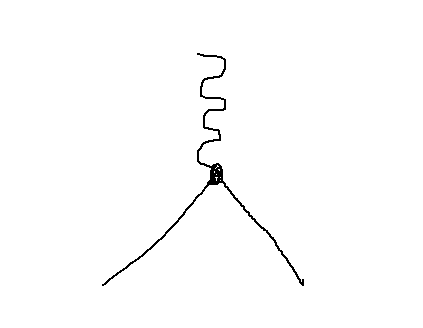
I thought the fundamental electromagnetic vertex is

fundamentalem1.png


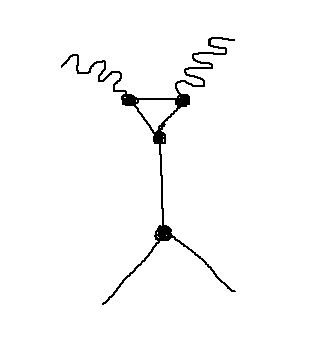
Why is the following diagram below allowed? The 'special' feynman diagram for compton scattering ##e^- + \gamma \rightarrow e^- + \gamma## is

fundamentalem2.png
 
Physics news on Phys.org
It is not.
 
Orodruin said:
It is not.

This is taken straight from Griffith's book: "Introduction to Elementary Particles".
 
It is still not allowed, assuming the solid lines actually represent electron propagators.
 
Orodruin said:
It is still not allowed, assuming the solid lines actually represent electron propagators.

True. I think there is a printing error. The long vertical line is supposed to be a virtual propagator (curly line) I think.

Check http://hep.uchicago.edu/~pilcher/p237-06/hw8_sol.pdf
 
Curly line means photon propagator, not necessarily a virtual particle.
 
  • Like
Likes   Reactions: unscientific
unscientific said:
True. I think there is a printing error. The long vertical line is supposed to be a virtual propagator (curly line) I think.

Check http://hep.uchicago.edu/~pilcher/p237-06/hw8_sol.pdf
I don't see your diagram there. The last one on page 1 (rotated by 90 degrees) has a curly line = photon at the place where your diagram has an error.

It is certainly virtual independent of its type because it has two ends in the diagram.
 
Assuming its a photon connecting the bottom to the triangle loop, its the last diagram in that list. This diagram and the one with the loop's arrows in the opposite direction exactly cancel. (Write it out, take the trace, add it up). So it is not the diagram that is zero, but the sum of the two.
 
  • Like
Likes   Reactions: vanhees71

Similar threads

  • · Replies 39 ·
2
Replies
39
Views
5K
  • · Replies 15 ·
Replies
15
Views
3K
  • · Replies 6 ·
Replies
6
Views
4K
  • · Replies 1 ·
Replies
1
Views
2K
  • · Replies 3 ·
Replies
3
Views
4K
  • · Replies 3 ·
Replies
3
Views
2K
  • · Replies 7 ·
Replies
7
Views
5K
  • · Replies 1 ·
Replies
1
Views
2K
  • · Replies 26 ·
Replies
26
Views
4K
  • · Replies 2 ·
Replies
2
Views
4K