Speed of the light and dilation of time

Click For Summary
Traveling at near-light speed on a train around the Earth would result in significant time dilation, meaning the traveler would age much less than their son, who remains stationary. While the train could complete a vast number of revolutions in Earth time, the traveler's experience of time would be drastically shorter, potentially just a few hours or days. The onboard watch would show minimal time elapsed compared to the 30 years experienced by the son outside the train. This phenomenon illustrates the twin paradox, where differential aging occurs due to the effects of relativity. Ultimately, the traveler would not be the same age as their son upon reuniting, having aged significantly less during the journey.
  • #241
ghwellsjr said:
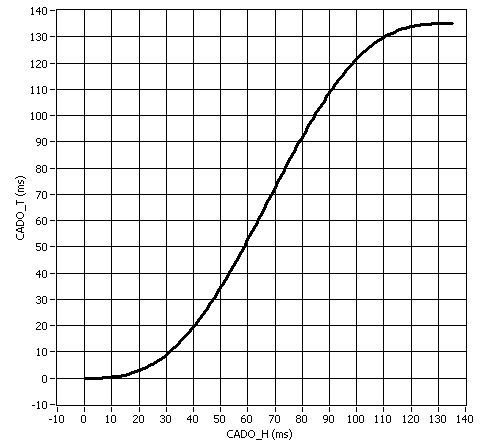
If I did it right, here is a graph depicting what I think you described as the CADO scheme. It will take the father 135 milliseconds to go around the Earth once. But according to CADO, he will not determine that his son is aging hardly at all as he departs him and as he approaches him at the end of the loop. He determines that his son ages most quickly when he is on the opposite side of the Earth and it is just enough so that when he gets back to his son, they agree that he has aged 135 milliseconds.

attachment.php?attachmentid=48919&stc=1&d=1341612403.png


Does this look correct?

Looks fine . What was your procedure for calculating L and v ??
 
Physics news on Phys.org
  • #242
Austin0 said:
Looks fine . What was your procedure for calculating L and v ??
I just followed GrammawSally's super clear directions:
GrammawSally said:
L is the vector position of the traveler, relative to the inertial person, according to the inertial person. v is the vector velocity of the traveler, relative to the inertial person, according to the inertial person.
I still don't know if this is the same as Michael Fontenot's scheme. Can anybody confirm that?
 
  • #243
ghwellsjr said:
I just followed GrammawSally's super clear directions:

I still don't know if this is the same as Michael Fontenot's scheme. Can anybody confirm that?
Super clear to you :smile: but much less so to me. Hopefully you will help shed some light.
GrammawSally said:
If the inertial home twin is located somewhere on the circular track, then the traveler can compute the dot product of v and L at any point on his circuit, and then use the CADO equation to compute the home twin's age at that instant in his (the traveler's) life.
Here she is talking about calculations from the traveler frame
She doesn't detail how v and L are determined.
I am just starting to study dot products so could you help put the use here in a geometric conceptual context?
In a linear situation vL is a simple product of values.

GrammawSally said:
L is the vector position of the traveler, relative to the inertial person, according to the inertial person. v is the vector velocity of the traveler, relative to the inertial person, according to the inertial person.

Here she is now talking about calculations from the inertial frame.
When she says vector velocity is this the direction of the tangent to the circle at that point and the magnitude of speed relative to the inertial observer ?
If not what?
Is L the direct line distance along the vector connecting them according to the inertial observer??

GrammawSally said:
So if the inertial person's position on the circle is taken as zero degrees, and if the traveler's position is momentarily at 90 degrees (CCW), then the L and v vectors will be neither perpendicular nor parallel, and L will have a magnitude greater than the radius of the circle. The dot product of L and v will be nonzero, and will have a magnitude less than the product of the magnitudes of L and v.

since she outlined two apparently different approaches which one did you use?
Any clarification would be appreciated.
 
  • #244
Austin0:

In Euclidean geometry, dot product of two vectors is simply product of their lengths with cosine of angle between them. If two vectors are parallel, it is thus the product of their lengths; if perpendicular, it is zero. More generally (in non-Euclidean geometry, e.g. for 4-vectors in SR spacetime), it is contraction of both vectors with the metric tensor. The CADO website specifies that L, v, and CADO_H are all as measured by the distant inertial observer. The CADO website requires only the Euclidean definition.
 
  • #245
Austin0 said:
Super clear to you :smile: but much less so to me. Hopefully you will help shed some light.

Here she is talking about calculations from the traveler frame
She doesn't detail how v and L are determined.
I am just starting to study dot products so could you help put the use here in a geometric conceptual context?
It seems from your comments below, along with PAllen's explanation of the dot product, that you should have a good handle on this.
Austin0 said:
In a linear situation vL is a simple product of values.
In Michael Fontenot's CADO paper, he first discusses the "standard twin paradox":
The traveler then instantaneously reverses course, and spends the next 20 years of his life returning to his home-twin. The magnitude of his velocity is still 0.866 ly/y, but since he is now moving toward his twin, by convention his velocity is now negative, -0.866 ly/y.
I couldn't find where he explained why the velocity takes on a negative value at the turn-around point but GrammawSally's explanation of the dot product makes it automatic because the velocity vector points in the opposite direction so it isn't merely "a simple product of values".
Austin0 said:
Here she is now talking about calculations from the inertial frame.
Yes, she made that very clear. They're all from the inertial frame. If Michael ever says the same thing, it is not clear at all, partly because he is doing the same calculation for the "standard twin paradox" in the conventional way from the frame of the home twin where he introduces gamma but as far as I can tell, it is never used in his CADO equation. I could never tell whether he was discussing the home twin's frame just for the conventional explanation or also for the CADO explanation.
Austin0 said:
When she says vector velocity is this the direction of the tangent to the circle at that point and the magnitude of speed relative to the inertial observer ?
Yes.
Austin0 said:
Is L the direct line distance along the vector connecting them according to the inertial observer??
Yes. You then have to take the difference between the two vector angles to use in the dot product which simply means you multiply the magnitudes of the two vectors together and then multiply by the cosine of the delta angle.
Austin0 said:
GrammawSally said:
So if the inertial person's position on the circle is taken as zero degrees, and if the traveler's position is momentarily at 90 degrees (CCW), then the L and v vectors will be neither perpendicular nor parallel, and L will have a magnitude greater than the radius of the circle. The dot product of L and v will be nonzero, and will have a magnitude less than the product of the magnitudes of L and v.
since she outlined two apparently different approaches which one did you use?
I don't know why you think this is a different approach. She is simply providing some background to the setup of the scenario and then pointing out why you cannot just multiply L and v together (as Michael Fontenot implies, if not directly states, that you can) but rather why you need to treat L and v as vectors and use the dot product.
Austin0 said:
Any clarification would be appreciated.
Hopefully this has helped but if you need more clarification, just ask.
 
Last edited:
  • #246
ghwellsjr said:
In Michael Fontenot's CADO paper, he first discusses the "standard twin paradox":

I couldn't find where he explained why the velocity takes on a negative value at the turn-around point but GrammawSally's explanation of the dot product makes it automatic because the velocity vector points in the opposite direction so it isn't merely "a simple product of values".

the velocity takes on a negative value because of direction.
Relative clock desynchronization is direction dependent. The clocks ahead in the other frame are running ahead,
and vise versa. So as the traveler is moving away from the inertial position the clock at that position is running behind , so the vL is subtracted . After turnaround the inertial position is now ahead so the vL is added -(-vL)
As that is standard convention I didn't mention it .Other than the change of sign it is just a simple product.

Yes, she made that very clear. They're all from the inertial frame. If Michael ever says the same thing, it is not clear at all, partly because he is doing the same calculation for the "standard twin paradox" in the conventional way from the frame of the home twin where he introduces gamma but as fall as I can tell, it is never used in his CADO equation. I could never tell whether he was discussing the home twin's frame just for the conventional explanation or also for the CADO explanation.

In the linear case you can simply take measurements from the traveler frame and transform them to inertial values.

In the circular situation, using your approach, it might not be so simple. It seems like contraction of the circle would complicate the geometry.if done from the traveler frame


Yes. You then have to take the difference between the two vector angles to use in the dot product which simply means you multiply the magnitudes of the two vectors together and then multiply by the cosine of the delta angle.

I am starting to get this. Did you use a constant velocity magnitude or did that also vary with angle relative to the inertial observer?

I don't know why you think this is a different approach. She is simply providing some background to the setup of the scenario and then pointing out why you cannot just multiply L and v together (as Michael Fontenot implies, if not directly states, that you can) but rather why you need to treat L and v as vectors and use the dot product.

I said two approaches because in her initial post she clearly said calculated from the traveling frame. As I said I am quite sure Mike is right for linear motion.
It is just the circular path and this approach that prevents the simple product from applying
Haven't you ever calculated explicit value for a line of simultaneity intersecting some point?

Hopefully this has helped but if you need more clarification, just ask.
yes it has helped ,, thank you
 
  • #247
PAllen said:
Austin0:

In Euclidean geometry, dot product of two vectors is simply product of their lengths with cosine of angle between them. If two vectors are parallel, it is thus the product of their lengths; if perpendicular, it is zero. More generally (in non-Euclidean geometry, e.g. for 4-vectors in SR spacetime), it is contraction of both vectors with the metric tensor. The CADO website specifies that L, v, and CADO_H are all as measured by the distant inertial observer. The CADO website requires only the Euclidean definition.

It is starting to sink in ,,, Thanks

Yes they can be measured by the inertial observer but CADO_T=gamma dt (traveler) -gamma (v times dx(traveler)) works just the same in the linear case.
 
  • #248
Austin0 said:
yes it has helped ,, thank you
Your method of replying makes it impossible for me to automatically grab your quotes so I'll just respond to your post by copying and pasting:

I'm rapidly coming to the conclusion that GrammawSally's method using the dot product is not Michael Fontenot's scheme. It just happens to work in this case (and in the linear "standard twin paradox" case) because the father is traveling at a constant speed in the son's frame so there's always a linear relationship between the son's age (or time) and the father's age (or time) which is the factor gamma.
the velocity takes on a negative value because of direction.
Relative clock desynchronization is direction dependent. The clocks ahead in the other frame are running ahead,
and vise versa. So as the traveler is moving away from the inertial position the clock at that position is running behind , so the vL is subtracted . After turnaround the inertial position is now ahead so the vL is added -(-vL)
As that is standard convention I didn't mention it .Other than the change of sign it is just a simple product.
This "explanation" works fine for the "standard twin paradox" case since the traveler is always moving directly away from or towards the inertial observer but what does Michael expect us to do when the direction is at an angle?
In the linear case you can simply take measurements from the traveler frame and transform them to inertial values.

In the circular situation, using your approach, it might not be so simple. It seems like contraction of the circle would complicate the geometry.if done from the traveler frame
Yes, this is why I now think the dot product scheme is not the CADO scheme.
I am starting to get this. Did you use a constant velocity magnitude or did that also vary with angle relative to the inertial observer?
Yes, because in the son's frame, the father is traveling at a constant speed just under the speed of light. I didn't bother to use the actual speed of 0.9999999999c, I just used 1. It will make no noticeable difference in a plot and I could not calculate to the required degree of precision to show a difference anyway.
I said two approaches because in her initial post she clearly said calculated from the traveling frame. As I said I am quite sure Mike is right for linear motion.
It is just the circular path and this approach that prevents the simple product from applying
I'm not sure that she ever implied that she was using the traveling frame but maybe we'll have to await her response. However, as I mentioned earlier, I don't think her approach is the same as the CADO scheme except in those cases where the speed of the traveler is constant.
Haven't you ever calculated explicit value for a line of simultaneity intersecting some point?
No. I don't bother with spacetime diagrams if that is what you are referring to. I just specify a scenario in terms of its co-ordinates. If the t co-ordinates for two events are the same, then they are simultaneous in that frame. If I want to see the what the co-ordinates look like in a different frame, I use the Lorentz Transformation.
 
  • #249
ghwellsjr said:
I'm rapidly coming to the conclusion that GrammawSally's method using the dot product is not Michael Fontenot's scheme.
[...]
this is why I now think the dot product scheme is not the CADO scheme.
They are the same. The Physics Essays paper gives the generalization of the CADO equation to two or three spatial dimensions. For the more familiar one dimensional twin paradox scenarios, the generalized CADO equation (with the dot product, and vectors for v and L) still works, but the paper and the webpage simplify the wording of the CADO equation in that case, probably just to make it simpler for non-physicists to understand and to use, and also to eliminate the need to specify the details of the spatial axis definitions for the typical simple twin paradox one dimensional problems.

(I've been spending a lot of time lately slowly working my way through that paper, so I'm more familiar with it than with the webpage. When I earlier stated the generalization of the CADO equation to two (or three) dimensions, I was assuming that it was also described on the webpage, but maybe it's not included there.)

I'm not sure that she ever implied that she was using the traveling frame but maybe we'll have to await her response.

All of the quantities on the right-hand-side of the CADO equation are according to the inertial person (because they are relatively easy to determine, and are widely understood). Once those quantities are known (for any given age of the traveler), the CADO equation then allows CADO_T (the current age of the inertial person, according to the traveler) to be easily calculated.
 
  • #250
GrammawSally said:
All of the quantities on the right-hand-side of the CADO equation are according to the inertial person (because they are relatively easy to determine, and are widely understood). Once those quantities are known (for any given age of the traveler), the CADO equation then allows CADO_T (the current age of the inertial person, according to the traveler) to be easily calculated.
Yes, but unless there is a constant time relationship between them, such as in this case, I don't understand how it works.

By the way, I'm still if the CADO scheme as depicted in my plot is what you meant when you said:
GrammawSally said:
A person who is accelerating is still entitled to his own "point of view" about how other people are aging.
 
  • #251
GrammawSally said:
They are the same. The Physics Essays paper gives the generalization of the CADO equation to two or three spatial dimensions.

It's a bit silly to call this the "CADO equation", and to attribute it to Mr. Fontenot. It is very standard and well known. See for example the discussion toward the end of this web page:

http://mathpages.com/rr/s2-09/2-09.htm
 
  • #252
Russell E said:
It's a bit silly to call this the "CADO equation", and to attribute it to Mr. Fontenot. It is very standard and well known. See for example the discussion toward the end of this web page:

http://mathpages.com/rr/s2-09/2-09.htm
I didn't see anything on that webpage that looked like the CADO equation:

CADO_T = CADO_H - v * L

Can you point out exactly where that is?
 
  • #253
ghwellsjr said:
I didn't see anything on that webpage that looked like the CADO equation:
CADO_T = CADO_H - v * L
Can you point out exactly where that is?

Sure. The formula following the words "so the above formula reduces to".
 
  • #254
Russell E said:
ghwellsjr said:
I didn't see anything on that webpage that looked like the CADO equation:
CADO_T = CADO_H - v * L
Can you point out exactly where that is?
Sure. The formula following the words "so the above formula reduces to".
The formula from your paper is:

τ2 = t1 - rv

It superficially looks similar to GrammawSally's interpretation of the CADO formula (r replacing L and taking the dot product) but it doesn't look the same beyond that.

The commentary associated with the formula expresses to me that t1 is the time of the traveler (the father) while τ2 is the time of the inertial observer (the son). Did I get that wrong?

But in the CADO formula, the two variables that are multiplied have the same meaning as your formula but CADO_H is the inertial observer's time and "CADO_T denotes the traveler's conclusion about the home-twin's age" (or the time for the inertial observer). So in CADO, both times are for the inertial observer, it's just that they are the two different observer's opinion of that time, whereas in your paper, each time is for a different observer. If this isn't right, please point out where the errors are.
 
  • #255
ghwellsjr said:
The commentary associated with the formula expresses to me that t1 is the time of the traveler (the father) while τ2 is the time of the inertial observer (the son). Did I get that wrong?

You got it incompletely. The value of t1 is indeed the coordinate time of an event on the traveler's worldline that we are trying to correlate with a time on the "home's" worldline, which is the spatial origin of the inertial coordinates. So, according to the home reference frame, the home time that corresponds to the traveler's event at t1 is simply t1. This is what you and Sally call "CADO_H". The value of t2 is the home time that corresponds to the traveler's event at t1 according to the traveler's instantaneous inertial frame of reference. This is what you and Sally call "CADO_T".

ghwellsjr said:
... in the CADO formula... CADO_H is the inertial observer's time and "CADO_T denotes the traveler's conclusion about the home-twin's age" (or the time for the inertial observer). So in CADO, both times are for the inertial observer, it's just that they are the two different observer's opinion of that time.

Right, it's exactly the same as on the page I cited.

ghwellsjr said:
...in your paper, each time is for a different observer. If this isn't right, please point out where the errors are.

See above. Since the home worldline is the spatial origin of the inertial coordinates, the value of t1 represents the coordinate time of the event on the traveler's worldline, and this is also (by definition) the time on the home worldline that corresponds to that event according to the home reference frame.
 
  • #256
ghwellsjr said:
The formula from your paper is:

τ2 = t1 - rv

It superficially looks similar to GrammawSally's interpretation of the CADO formula (r replacing L and taking the dot product) but it doesn't look the same beyond that.

The commentary associated with the formula expresses to me that t1 is the time of the traveler (the father) while τ2 is the time of the inertial observer (the son). Did I get that wrong?

But in the CADO formula, the two variables that are multiplied have the same meaning as your formula but CADO_H is the inertial observer's time and "CADO_T denotes the traveler's conclusion about the home-twin's age" (or the time for the inertial observer). So in CADO, both times are for the inertial observer, it's just that they are the two different observer's opinion of that time, whereas in your paper, each time is for a different observer. If this isn't right, please point out where the errors are.

CADO_T = CADO_H - v * L

If the traveler is unprimed then:

CADO_T = \gamma(t-vdx)= CADO_H - v * L

where dx is traveler's distance from home
does this now look familiar?
 
Last edited:
  • #257
ghwellsjr said:
[...]
Yes, but unless there is a constant time relationship between them, such as in this case, I don't understand how it works.

By the way, I'm still if the CADO scheme as depicted in my plot is what you meant when you said:
[...]

I haven't been able to understand what you're asking in either of the above questions ... could you elaborate some?

Just guessing, but maybe the extra tip you might need (for the first question) is that all of the quantities in the CADO equation are functions of the traveler's age t. That dependence isn't explicitly shown in the equation, but it does need to be kept in mind.

And, just guessing for the second question, your plot looks reasonable, but a more useful plot (called the "age-correspondence graph" on the webpage) is CADO_T versus t, which is the home person's age, according to the traveler, plotted versus the traveler's age. That is the information that the traveler wants to know, at each instant t of his life. And, for comparison, it is interesting to also plot CADO_H versus t, which is exactly the same type of graph, except it's according to the home person. The two plots generally have quite different shapes, although for the usual twin paradox scenario (when the twins are co-located at the beginning and end of the trip), the beginning and end points of the two plots will always agree.
 
  • #258
What are we talking about? Time dilatation as an effect of speed, is it not?

What we are talking about is how 2 inertial frames, with a certain relative movement, see each other's time. Then we can add all other effects we want.

Imagine 2 travellers parting from Earth in opposite directions at the same speed. They where both accelerated similarly and then left to an "inertial" movement. At certain places in space, at the same distance to Earth's original position, they must communicate to each other their respective time. Their relative speed is sufficiently high for the dilation time effect to be noticed but sufficiently slow for the communication at the speed of light to be practical. When the information arrives both observers compare their readings. Which reading should be expected to have a higher value? On Earth's frame (discounting Earth's movement) they should show the same time (though different from Earth time) because they had traveled the same distance at the same speed. But each observer should have received a reading showing that the other clock was working slower than his. How can this be possible?

Now going back to this thread's example. Most of you say: circular movement seems not to have a very important effect on ageing (though there's disagreement on the calculations) but it carries a strange unexplained effect: it makes the frame with the accelerated movement as The moving frame. Which principle allows you to do so?

For both observers the other should be ageing at very slow rate (as explained above) and, on top of that, the father should experiment an additional time distortion effect due to acceleration (even without changing speed, I disagree with you George, though this is not the topic).Your assumption (and based calculations) that the non inertial frame (in reality none of them is inertial) is The Sole and Only moving frame, thus applying SR assumptions Sole and Only to that frame is based on something that totally escapes my understanding. Can any of you please explain what makes it possible?

Divirtam-se
 
  • #259
GrammawSally said:
I haven't been able to understand what you're asking in either of the above questions ... could you elaborate some?

Just guessing, but maybe the extra tip you might need (for the first question) is that all of the quantities in the CADO equation are functions of the traveler's age t. That dependence isn't explicitly shown in the equation, but it does need to be kept in mind.
Yes, I'm aware of that. My only point is that since the speed of the traveling father is constant in the son's inertial (earth) frame, gamma is constant and we can determine the shape of the graph for the father's time purely from the son's time, which is what I did.
GrammawSally said:
And, just guessing for the second question, your plot looks reasonable, but a more useful plot (called the "age-correspondence graph" on the webpage) is CADO_T versus t, which is the home person's age, according to the traveler, plotted versus the traveler's age. That is the information that the traveler wants to know, at each instant t of his life.
Then just relabel the horizontal axis of my graph to read "t (ns)" for a gamma of one million.
GrammawSally said:
And, for comparison, it is interesting to also plot CADO_H versus t, which is exactly the same type of graph, except it's according to the home person. The two plots generally have quite different shapes, although for the usual twin paradox scenario (when the twins are co-located at the beginning and end of the trip), the beginning and end points of the two plots will always agree.
Then just flip the plot along the diagonal.

Now since you have apparently agreed that my relabeled graph fulfills your desire for the father's own "point of view" about how his son is aging, I'd like to ask you what additional information the father obtains by our doing this exercise.
 
  • #260
Austin0 said:
CADO is essentially nothing but applying the fundamental transformations from a momentarily co-moving inertial frame.

Exactly, and it's ridiculous to assign it an acronym.
 
  • #261
ghwellsjr said:
[...]

I think I finally understand what you are doing: I think you must be stating results for the extreme case where gamma is very large and v is negligibly different from one, and apparently in that case, you've concluded (perhaps correctly) that you don't need any analysis beyond the inertial person's perspective to get the traveler's perspective with adequate accuracy.

That case isn't of any interest to me, because it doesn't bring out the most interesting and the more general aspects of special relativity for circular motion. Much more illuminating is a case like gamma = 2 and v = 0.866. If you try to determine the CADO_T vs t graph for that case, you will find that you do need to use the CADO equation: just analyzing it from the home person's perspective won't get you the traveler's perspective. You will find that the CADO_T vs t graph is quite different from the CADO_H vs t graph, and one can't be determined from the other in any trivially simple way.

Better yet, for this circular motion problem, why not derive an expression for the CADO_T vs t graph, with v and r (radius of circle) as parameters. For simplicity, you can let both the traveler and the inertial person be zero years old when they are initially co-located at the train station (theta = 0). Then get the CADO_T vs t graph for one circuit, 0 <= theta <= 2pi.
 
  • #262
GrammawSally said:
If you try to determine the CADO_T vs t graph...

It isn't very useful to make up obscure non-standard terminology for trivial standard concepts and formulas. What you keep calling "CADO this" and "CADO that" is nothing but evaluating times in terms of the momentarily co-moving inertial reference frames of various objects.
 
  • #263
Simplyh said:
What are we talking about? Time dilatation as an effect of speed, is it not?
Time dilation is an effect of the speed of an object in a single specified inertial Frame of Reference.
Simplyh said:
What we are talking about is how 2 inertial frames, with a certain relative movement, see each other's time. Then we can add all other effects we want.
No, that's not right. You are confusing how Coordinate Times differ between two inertial frames with a relative motion. Time dilation refers to the Proper Time of a moving object or clock in a single inertial frame.
Simplyh said:
Imagine 2 travellers parting from Earth in opposite directions at the same speed. They where both accelerated similarly and then left to an "inertial" movement. At certain places in space, at the same distance to Earth's original position, they must communicate to each other their respective time. Their relative speed is sufficiently high for the dilation time effect to be noticed but sufficiently slow for the communication at the speed of light to be practical. When the information arrives both observers compare their readings. Which reading should be expected to have a higher value? On Earth's frame (discounting Earth's movement) they should show the same time (though different from Earth time) because they had traveled the same distance at the same speed. But each observer should have received a reading showing that the other clock was working slower than his. How can this be possible?
Is this another rhetorical question? Are you questioning the validity of what you have just described?
Simplyh said:
Now going back to this thread's example. Most of you say: circular movement seems not to have a very important effect on ageing (though there's disagreement on the calculations) but it carries a strange unexplained effect: it makes the frame with the accelerated movement as The moving frame. Which principle allows you to do so?
The frame with the accelerated movement (the father's) is non-inertial which means two things: First, it is not easy to work with and second, there is no standard way to define non-inertial frames (like there is for inertial frames). For those two reasons, I have simply never been motivated to study or learn anything about them (until this thread, but I'm getting over that real fast). Relativity states that you can analyze a situation from any frame and it is just as valid and will provide all the significant answers that any other frame will. So why pick a difficult non-inertial frame when the very simple inertial frame will work just fine?
Simplyh said:
For both observers the other should be ageing at very slow rate (as explained above)
You explained correctly what happens in the single Earth frame for two observers with their own histories of motion. That's exactly what I did as I also used only the single Earth frame for two observers that have their own histories of motion. The difference between your example above and the example in this thread is that in your example the two observers never rejoined and so we never get to determine a frame independent aging difference between them whereas in the example in this thread, they rejoined 7.4 times per second (in the Earth frame) and so we can determine a frame independent continually growing age difference between the father and the son.
Simplyh said:
and, on top of that, the father should experiment an additional time distortion effect due to acceleration (even without changing speed, I disagree with you George, though this is not the topic).
But this issue was covered by yuiop in post #16 on the first page:
yuiop said:
In the FAQ on the experimental evidence for relativity and the clock postulate section http://www.edu-observatory.org/physics-faq/Relativity/SR/experiments.html#Clock_Hypothesis it states:

"The clock hypothesis states that the tick rate of a clock when measured in an inertial frame depends only upon its velocity relative to that frame, and is independent of its acceleration or higher derivatives. The experiment of Bailey et al. referenced above stored muons in a magnetic storage ring and measured their lifetime. While being stored in the ring they were subject to a proper acceleration of approximately 1018 g (1 g = 9.8 m/s2). The observed agreement between the lifetime of the stored muons with that of muons with the same energy moving inertially confirms the clock hypothesis for accelerations of that magnitude."
Acceleration contributes nothing to time dilation.
Simplyh said:
Your assumption (and based calculations) that the non inertial frame (in reality none of them is inertial) is The Sole and Only moving frame, thus applying SR assumptions Sole and Only to that frame is based on something that totally escapes my understanding. Can any of you please explain what makes it possible?
I never said anything about The Sole and Only moving frame--where'd you get that idea from? I've always said that there is no Sole and Only frame, moving or otherwise. Let me repeat: any frame is just as good as any other frame, none is preferred, and none is disallowed. So why beat your head against the wall and pick a complicated frame when the Earth frame will do everything that any other frame will do?

If you would just follow your example of the two observers moving away from the Earth and defining and analyzing everything according to the single inertial Earth frame, there would be nothing more to explain and you should be able to understand everything.
Simplyh said:
Divirtam-se
Only English is allowed on these forums. Why do you keep doing this?
 
  • #264
GrammawSally said:
I think I finally understand what you are doing: I think you must be stating results for the extreme case where gamma is very large and v is negligibly different from one, and apparently in that case, you've concluded (perhaps correctly) that you don't need any analysis beyond the inertial person's perspective to get the traveler's perspective with adequate accuracy.
It's not the inertial person's perspective (whatever that means) that is important, it's the single Earth inertial frame that is sufficient to analyze what each observer perceives. If you want to do the analysis from another inertial frame, you need to use the Lorentz Transformation to establish the same scenario and after you do this you will find that this new frame produces the same analysis of what each observer perceives. If you know how to transform the scenario as defined in the initial inertial frame into a non-inertial frame, why do think any analysis will produce any additional insight into what any observer perceives?
GrammawSally said:
That case isn't of any interest to me, because it doesn't bring out the most interesting and the more general aspects of special relativity for circular motion. Much more illuminating is a case like gamma = 2 and v = 0.866. If you try to determine the CADO_T vs t graph for that case, you will find that you do need to use the CADO equation: just analyzing it from the home person's perspective won't get you the traveler's perspective. You will find that the CADO_T vs t graph is quite different from the CADO_H vs t graph, and one can't be determined from the other in any trivially simple way.
And if you use some other definition of a non-inertial frame, you'll get a completely different graph. None is preferred, just like for inertial frames where each one can assign different time dilations to the observers.

By contrast, the Doppler analysis, which you can do from any frame, yields exactly one result and shows you what each observer actually perceives.
GrammawSally said:
Better yet, for this circular motion problem, why not derive an expression for the CADO_T vs t graph, with v and r (radius of circle) as parameters. For simplicity, you can let both the traveler and the inertial person be zero years old when they are initially co-located at the train station (theta = 0). Then get the CADO_T vs t graph for one circuit, 0 <= theta <= 2pi.
Left as an exercise for the reader, correct?

Why should I do something that will not lead me one step closer to what any observer perceives? Why do you find this sort of exercise interesting?
 
  • #265
ghwellsjr said:
Why should I do something that will not lead me one step closer to what any observer perceives? Why do you find this sort of exercise interesting?

Because if I were actually traveling at high velocities in a spacecraft , far from Earth, I would want to know the current age of my twin brother back home. And I would know that any image I saw of him (either through a telescope, or on a TV screen) is old and out-of-date. I would know that image does not show me my twin's actual current age. I would want to correct for the transit time of the image. The CADO equation allows me to easily and quickly do that.
 
  • #266
GrammawSally said:
Because if I were actually traveling at high velocities in a spacecraft , far from Earth, I would want to know the current age of my twin brother back home. And I would know that any image I saw of him (either through a telescope, or on a TV screen) is old and out-of-date. I would know that image does not show me my twin's actual current age. I would want to correct for the transit time of the image. The CADO equation allows me to easily and quickly do that.
As I said to Underwood when he expressed the same opinion:
ghwellsjr said:
CADO has given you a false sense of security. You have bought into Michael Fontenot's dogmatism.
You cannot correct for the transit time of the image except by assuming that it is some particular arbitrary value and that assumption can give you any age you want (within limits). You don't know that any image you see of your brother is old and out-of-date. You are merely assuming that it is. You could just as reasonably assume that the image gets to you almost instantaneously and that it is no more out-of-date than an image you would see of him if he were just a few feet away from you.

What if your twin decides a year after you leave to get on his own spaceship and follow after you at a higher speed so that he will eventually catch up to you? How will CADO or any other method of calculating current age deal with that?
 
Last edited:
  • #267
GrammawSally said:
Because if I were actually traveling at high velocities in a spacecraft , far from Earth, I would want to know the current age of my twin brother back home...

That doesn't make any sense, because using the co-moving inertial reference frame you can change the "current age" of your brother at will, simply by slight changes in your own state of motion. If you are far enough away, your brother's "current age" alternately increases and decreases by years as you pace back and forth in a room. As you pace in one direction, your brother is having his 20th birthday party right "now", and as you pace in the other direction he is long since dead and buried, and this alternates back and forth, now he's blowing out 20 candles, now he's dead, now he's blowing out 20 candles, now he's dead... Does this really signify "the current age of your brother", alternating between alive and dead in any meaningful sense? Do you really think that whether your brother is alive or dead right "now" can fluctuate depending on just slight differences in YOUR state of motion?
 
Last edited:
  • #268
Russell E said:
That doesn't make any sense, because using the co-moving inertial reference frame you can change the "current age" of your brother at will, simply by slight changes in your own state of motion. If you are far enough away, your brother's "current age" alternately increases and decreases by years as you pace back and forth in a room. As you pace in one direction, your brother is having his 20th birthday party right "now", and as you pace in the other direction he is long since dead and buried, and this alternates back and forth, now he's blowing out 20 candles, now he's dead, now he's blowing out 20 candles, now he's dead... Does this really signify "the current age of your brother", alternating between alive and dead in any meaningful sense? Do you really think that whether your brother is alive or dead right "now" can fluctuate depending on just slight differences in YOUR state of motion?
Although this is true, it misses the point. You can change the Current Age of a Distant Object simply by adapting a different simultaneity convention without changing your own state of motion. You can do it all in your mind without moving a muscle. And this has nothing to do with accelerating frames, the same thing is true for any two separated clocks even if they are stationary with respect to each other.
 
  • #269
ghwellsjr said:
Although this is true, it misses the point. You can change the Current Age of a Distant Object simply by adapting a different simultaneity convention without changing your own state of motion. You can do it all in your mind without moving a muscle. And this has nothing to do with accelerating frames, the same thing is true for any two separated clocks even if they are stationary with respect to each other.

Exactly! Distant simultaneity in all cases is just a convention, never something that can be observed. Only limit is you can't call something in your causal past or future simultaneous. Only thing you can say about 'Einstein simultaneity convention' for inertial frames is that it is simple and useful, never that it can be experimentally preferred over a different convention.
 
  • #270
ghwellsjr said:
Although this is true, it misses the point. You can change the Current Age of a Distant Object simply by adapting a different simultaneity convention without changing your own state of motion.

No, you missed the point. Sally espouses a specific definition for "current age", based on the momentarily co-moving inertial frames (which are perfectly well defined), and my comment addressed that specific definition, which does indeed require changing your state of motion in order to change your planes of simultaneity. You're making a different comment, namely, that Sally could, if she chose, define "now" differently. That's obviously true (for example, she could adopt the usual definition, i.e., that "now" consists of the entire region outside our past and future light cones), but it doesn't help to clarify for Sally why she should be dis-satisfied with the definition she is espousing.
 

Similar threads

  • · Replies 14 ·
Replies
14
Views
2K
  • · Replies 18 ·
Replies
18
Views
3K
Replies
12
Views
2K
  • · Replies 15 ·
Replies
15
Views
2K
  • · Replies 26 ·
Replies
26
Views
3K
Replies
12
Views
2K
Replies
2
Views
2K
  • · Replies 11 ·
Replies
11
Views
2K
  • · Replies 12 ·
Replies
12
Views
2K
  • · Replies 23 ·
Replies
23
Views
3K