Spherical Geometry (Two dimension ) Defining a metric

Click For Summary

Discussion Overview

The discussion revolves around defining a metric for positively curved two-dimensional spaces, specifically on the surface of a sphere. Participants explore the mathematical formulation of the metric, its derivation, and the implications of using polar coordinates in this context.

Discussion Character

  • Technical explanation
  • Mathematical reasoning
  • Debate/contested

Main Points Raised

  • One participant presents the metric for a sphere as $$ds^2 = dr^2 + R^2sin^2(\frac {r}{R})dθ^2$$ and contrasts it with the flat space metric $$ds^2 = dr^2 + r^2dθ^2$$.
  • Another participant expresses confusion about the origin of the spherical metric and questions the role of the sine function in the equation.
  • A participant suggests considering the circumference of a circle on the sphere to understand the metric better.
  • One participant proposes that the metric can also be expressed as $$ds^2=dr^2+sin^2(r)dθ^2$$, prompting further discussion.
  • Another participant clarifies that the coordinate $$r$$ represents the distance from the pole along the sphere's surface, not the radius of the circle.
  • A later reply indicates that for a unit circle, the metric simplifies to $$ds^2=dr^2+sin^2(r)dθ^2$$, but for a sphere of radius $$R$$, it becomes $$Rsin(\frac {r} {R})$$.

Areas of Agreement / Disagreement

Participants express varying levels of understanding regarding the metric and its derivation. There is no consensus on the clarity of the metric's formulation or the implications of using polar coordinates, indicating ongoing confusion and exploration of the topic.

Contextual Notes

Some participants express a need for visual aids to better grasp the concepts discussed, particularly regarding polar coordinates and their application on the sphere.

Arman777
Insights Author
Gold Member
Messages
2,163
Reaction score
191
I am trying to understand how to define a metric for a positively curved two-dimensional space.I am reading a book and in there it says,

On the surface of a sphere, we can set up a polar coordinate system by picking a pair of antipodal points to be the “north pole” and “south pole” and by picking a geodesic from the north to south pole to be the “prime meridian”. If ##r## is the distance from the north pole, and ##θ## is the azimuthal angle measured relative to the prime meridian, then the distance ds between a point ##(r,θ)## and another nearby point ##(r+dr,θ+dθ)## is given by the relation
$$ds^2 = dr^2 + R^2sin^2(\frac {r}{R})dθ^2$$
where ##R## is the readius of the sphere.

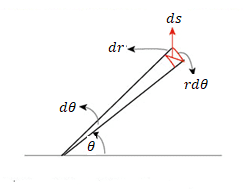
If I think ,flat two dimensional space the metric will be;
$$ds^2 = dr^2 + r^2dθ^2$$

I know the derivation of this so it gives me a bit clue about it,
In this case
upload_2017-12-27_15-50-22.png

So in positively curved space instead of ##rdθ## we will have ##R^2sin^2(\frac {r}{R})dθ## which its kind of obvious.

So anyone who can help to understand the concept maybe an image ?
 

Attachments

  • upload_2017-12-27_15-41-40.png
    upload_2017-12-27_15-41-40.png
    4 KB · Views: 672
  • upload_2017-12-27_15-50-22.png
    upload_2017-12-27_15-50-22.png
    3.5 KB · Views: 780
Physics news on Phys.org
I am not sure I understand what your question is.
 
Orodruin said:
I am not sure I understand what your question is.

I didnt understand where the $$ds^2 = dr^2 + R^2sin^2(\frac {r}{R})dθ^2$$ comes from. Like It writes there yes but I can't make a picture in my head...In example why there is sin function ?
 
Consider a circle on the sphere around one of the poles of radius ##r##. What would be the circumference of this circle?
 
upload_2017-12-27_18-44-32.png


So I guess I find it, here ##k=Rsin(\frac {r}{R})## cause when we set ##r=R## we should get a ##k=R##.

So $$ds^2 = dr^2 + R^2sin^2(\frac {r}{R})dθ^2$$

In here its actually ##ds^2 = dr^2 + k^2dθ^2## ?
 

Attachments

  • upload_2017-12-27_18-44-32.png
    upload_2017-12-27_18-44-32.png
    2.8 KB · Views: 740
When you set ##r = R## you have an angle from the pole that corresponds to one radian and so you get ##R \sin(1~\mbox{rad})## as your ##k##. Note that the ##r## you have marked in the figure is not the ##r## coordinate or the radius of the circle along the sphere's surface. The ##r## coordinate is the distance from the pole along the surface of the sphere.
 
I need an image I guess..I am unfamilier with polar coordinates.Its hars for me to describe and understand in those terms.
 
Orodruin said:
Consider a circle on the sphere around one of the poles of radius ##r##. What would be the circumference of this circle?

##sin(r)## ? where ##0≤0≤π## ?
 
Orodruin said:
Consider a circle on the sphere around one of the poles of radius ##r##. What would be the circumference of this circle?

##sin(r)## ? where ##0≤0≤π## ?
 
  • #10
Is this metric can be also described as;

##ds^2=dr^2+sin^2(r)dθ^2## ?
 
  • #11
Arman777 said:
I need an image I guess..I am unfamilier with polar coordinates.Its hars for me to describe and understand in those terms.
Polar coordinates on the sphere work just as polar coordinates in a plane. You refer to a point by using the distance ##r## and direction ##\theta## from the origin.
 
  • #12
I guess I understand, For a case where unit circle ##ds^2=dr^2+sin^2(r)dθ^2## this is true. If we take a part of a circle in this sphere then the radius of the sphere will be ##sin(r)##. But since its not a unit circle, the radius of a given circle in the sphere will be, ##Rsin(\frac {r} {R})## so then It turns just a normal circle metric.
 

Similar threads

  • · Replies 19 ·
Replies
19
Views
4K
  • · Replies 4 ·
Replies
4
Views
2K
  • · Replies 24 ·
Replies
24
Views
4K
  • · Replies 5 ·
Replies
5
Views
3K
  • · Replies 3 ·
Replies
3
Views
3K
  • · Replies 2 ·
Replies
2
Views
2K
  • · Replies 1 ·
Replies
1
Views
2K
  • · Replies 1 ·
Replies
1
Views
1K
  • · Replies 20 ·
Replies
20
Views
2K
  • · Replies 19 ·
Replies
19
Views
4K