Spin difference between entangled and non-entangled

Click For Summary
Entangled-spin pairs in the Stern–Gerlach experiment consistently yield opposite results when measured along the same axis, unlike non-entangled pairs, which may not always show this correlation. The distinction lies in the fact that entangled particles have a defined relationship before measurement, while non-entangled particles do not possess definite spins until observed. Quantum mechanics predicts that the results of measurements are eigenvalues of operators corresponding to the observable, emphasizing the probabilistic nature of quantum states. Historical context reveals that the concept of entanglement was articulated by Schrödinger following the EPR paradox, highlighting its fundamental role in quantum mechanics. Ultimately, entanglement illustrates a departure from classical interpretations, reinforcing the non-locality inherent in quantum systems.
  • #181
Thanks to responses I received in this thread I satisfied my curiosity regarding solid line on the graph below.
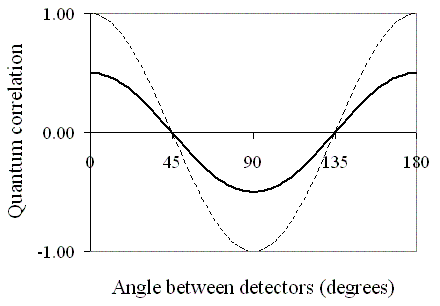
MalusQC.png


Fig. 1 The realist prediction (solid curve) for quantum correlation in an optical Bell test.
The quantum-mechanical prediction is the dotted curveNow I would like to understand why the result of Aspect experiment (doted line) is a proof for entanglement.

What are the most DIRECT evidences that the “entangled” photons in this experiment are indeed entangled - have perfectly opposite polarization?
 
Physics news on Phys.org
  • #182
miosim said:
What are the most DIRECT evidences that the “entangled” photons in this experiment are indeed entangled - have perfectly opposite polarization?

Are you asking what the evidence is that they have perfectly opposite polarization after they've been measured?

Every time anyone has ever set two polarizers at 90 degrees so that we're checking for "perfectly opposite" and sent one photon into each one, they've always both passed or neither passed. That was a well-known experimental observation decades before the Aspect experiment.
 
  • #183
miosim said:
Thanks to responses I received in this thread I satisfied my curiosity regarding solid line on the graph below.
MalusQC.png


Fig. 1 The realist prediction (solid curve) for quantum correlation in an optical Bell test.
The quantum-mechanical prediction is the dotted curveNow I would like to understand why the result of Aspect experiment (doted line) is a proof for entanglement.

What are the most DIRECT evidences that the “entangled” photons in this experiment are indeed entangled - have perfectly opposite polarization?

The obvious thing is that the quantum predictions are matched for entangled pairs, and that is different than the predictions for other hypotheses. What more do you want? :)
 
  • #184
Nugatory said:
Are you asking what the evidence is that they have perfectly opposite polarization after they've been measured?
Yes, this is how I should ask.
Nugatory said:
Every time anyone has ever set two polarizers at 90 degrees so that we're checking for "perfectly opposite" and sent one photon into each one, they've always both passed or neither passed

So how this result is translated into conclusion that EACH photon in the pair has "perfectly opposite" to each other (90 degrees difference) polarization.
The Aspect's (and others') experiment is statistical in nature (performed on series of photons). The wave function, is also, as I understand, could be interpreted statistically - say it applies only to the average result. In this case, in absence of perfect correlation (entanglement) for EACH photon pair we still may be ended up with the statistically perfect correlation - doted line and will be in agreement with the statistical interpretation of QM.

If this is true, would it undermine "spooky" action on distance?
 
  • #185
DrChinese said:
The obvious thing is that the quantum predictions are matched for entangled pairs, and that is different than the predictions for other hypotheses. What more do you want

Could this match, between QM and the experimental results for entangled pairs, be limited to the statistical average only? Do we have any ground to extend this statistical result into behavior of individual pairs?
 
  • #186
miosim said:
... The wave function, is also, as I understand, could be interpreted statistically - say it applies only to the average result. In this case, in absence of perfect correlation (entanglement) for EACH photon pair we still may be ended up with the statistically perfect correlation - doted line and will be in agreement with the statistical interpretation of QM.

If this is true, would it undermine "spooky" action on distance?

No. When the angles are integer multiples of 90 degrees, there is perfect correlation (or anti-correlation) for every pair. This demonstrates entanglement very nicely. At other angles, the statistics support quantum non-locality via agreement with predictions. As to action at a distance: this is dependent on your interpretation.
 
  • #187
DrChinese said:
When the angles are integer multiples of 90 degrees, there is perfect correlation (or anti-correlation) for every pair

Before follow your explanation I have a question about Fig.1.
I thought that at 90 degrees between polarizer QM prediction should be the same as realistic prediction. Why the realistic prediction on the Fig. 1 is only 50%?
 
  • #188
miosim said:
Why the realistic prediction on the Fig. 1 is only 50%?

By talking to my self I understood why it is 50%.
 
  • #189
Nugatory said:
Every time anyone has ever set two polarizers at 90 degrees so that we're checking for "perfectly opposite" and sent one photon into each one, they've always both passed or neither passed. That was a well-known experimental observation decades before the Aspect experiment.
If the perfect correlation of entangled photons that passes two polarizers at 90 degrees was observed before Aspect experiment, do we really need Bell's theorem, rotating polarizers, and other complex experiments to prove entanglement. Apparently even for polarizers at 90 degrees the realistic prediction would never explains 100% correlation ?
 
  • #190
miosim said:
If the perfect correlation of entangled photons that passes two polarizers at 90 degrees was observed before Aspect experiment, do we really need Bell's theorem, rotating polarizers, and other complex experiments to prove entanglement. Apparently even for polarizers at 90 degrees the realistic prediction would never explains 100% correlation ?

That is not the case. It depends on the particular realistic theory. As mentioned previously, that solid line is one possibility and it has certain advantages. Others do other things well. None of them match QM. So you have asked different questions: a) what proves or demonstrates entanglement; and b) why don't local realistic theories match QM vis a vis entanglement. The answer to a) is perfect correlations demonstrate entanglement. Matching the predictions of QM at other angles (where there are no perfect correlations) demonstrates entanglement too.

The answer to b) is that in local realism, there is no ongoing state of entanglement. It might be something, but it isn't entanglement because separated particles can have no ongoing physical connection. And not surprisingly, local realism cannot mimic entanglement (as we now know).
 
  • #191
DrChinese said:
The answer to a) is perfect correlations demonstrate entanglement.

So far I able to follow your explanation, but I probably missing something.

If the result of the the perfect correlation of entangled photons (that passes two polarizers at 90 degrees) was a well-known decades before the Aspect experiment, what was the explanation for this phenomenon at that time? How long ago the first experiment of this kind was performed? Did Einstein know about result of this experiment?
 
  • #192
miosim said:
So far I able to follow your explanation, but I probably missing something.

If the result of the the perfect correlation of entangled photons (that passes two polarizers at 90 degrees) was a well-known decades before the Aspect experiment, what was the explanation for this phenomenon at that time? How long ago the first experiment of this kind was performed? Did Einstein know about result of this experiment?

As far as I know, the first entanglement experiments were in the 70's. So Einstein did not know. Entanglement of photons and entanglement in general was not well understood for many years after EPR. The perfect correlations of EPR were not really specific, more general and theoretical.

Keep in mind that the conflicts between local realism and QM were not known until after 1965. So for many years, no thought was given that entanglement statistics disprove local realistic theories.
 
  • #193
DrChinese said:
the conflicts between local realism and QM were not known until after 1965. So for many years, no thought was given that entanglement statistics disprove local realistic theories.
In case of experiment with two polarizers at 90 degrees it isn't just a statistic; it should be demonstrated (practically) for each individual pair passes polarizer.
So, if at the time of EPR paper, someone confront Einstein with the Gedankenexperiment about entangled photons that passes two polarizers at 90 degrees his prediction (most probably) would be 50% correlation, while the supporters of the mainstream QM would come up with 100% correlation?

How difficult would be performing this experiment in 1935?
 
  • #194
miosim said:
In case of experiment with two polarizers at 90 degrees it isn't just a statistic; it should be demonstrated (practically) for each individual pair passes polarizer.
So, if at the time of EPR paper, someone confront Einstein with the Gedankenexperiment about entangled photons that passes two polarizers at 90 degrees his prediction (most probably) would be 50% correlation, while the supporters of the mainstream QM would come up with 100% correlation?

Einstein would say that (100% correlation) was consistent with a local hidden variables theory (and proof of entanglement, which it is). The 50% would be a different local hidden variables theory (no entanglement though). There are an infinite number possible, and they all disagree with experiment at one angle or another. The 100% ones needed Bell to show us the flaw.
 
  • #195
DrChinese said:
Einstein would say that (100% correlation) was consistent with a local hidden variables theory (and proof of entanglement, which it is).
Because Einstein didn't believe in entanglement he would be in difficult position to offer (not exotic) realistic explanation for the 100% correlations. I am still puzzling why Bohr and others didn't challenge EPR paper with this simple Gedankenexperiment. I guess I still missing some important details.

Let's conceder this Gedankenexperiment and to follow all events that lead to the 100% correlation for the detectors set at 90 degrees. I will conceder two scenarios:

1). When the entangled pair interacts with the closer polarizer the wave function collapses yielding two independent photons having perfectly opposite polarization that also perfectly aligned with corresponding polarizer. In this case both photons will be detected and this contributes to the 100% correlation.

2). However if after the wave function collapse the first photon is not fully aliened with the detector it still may pass detector (with some probability) however I am not sure that this insure the 100% pass for second photon. This pair may erode "picture perfect" 100% correlation.

It is why I don't see how we can observe 100% correlation in this experiment even entanglement is true. What I am missing?
If the polarisa that is closer to the source interact with entangled particle
In the his prediction (
As I understand the 100% correlation result from the fact that when one photon
 

Similar threads

  • · Replies 1 ·
Replies
1
Views
2K
  • · Replies 41 ·
2
Replies
41
Views
5K
  • · Replies 12 ·
Replies
12
Views
3K
  • · Replies 12 ·
Replies
12
Views
2K
  • · Replies 1 ·
Replies
1
Views
3K
  • · Replies 4 ·
Replies
4
Views
2K
  • · Replies 15 ·
Replies
15
Views
2K
  • · Replies 2 ·
Replies
2
Views
2K
Replies
2
Views
2K
  • · Replies 19 ·
Replies
19
Views
5K