sergiokapone
- 306
- 17
I already asked this question on physics.stackexchange.com, but did not get the desired response. I am interested in the opinion of your community.
Picture an entangled pair of spin 1/2-spin particles with total spin 0. In the diagram, particle 1 of the pair is moving to the left (-y), and particle 2 to the right (+y).
If a z-oriented SG is used to detect the spin direction of particle 1 on the left, then the spin direction of particle 2 can be predicted with 100% certainty by using another z-oriented SG on the right. For example, if the left SG finds particle 1 to have spin [itex]\frac{\hbar}{2}[/itex], there is be a 100% probability that a z-directed SG on the right will detect particle 2 as having spin [itex]-\frac{\hbar}{2}[/itex].
Now consider leaving the left SG unchanged (pointing to +z), and rotating the right SG so it will point to +x. If particle 1 is detected on the left to have spin [itex]\frac{\hbar}{2}[/itex], two possibilities can be considered for what will happen when particle 2 reaches the +x-directed SG:
- Particle 2 is detected with 100% probability as having spin [itex]-\frac{\hbar}{2}[/itex] in the +x-direction, or
- Particle 2 is detected with a 50% probability of having spin [itex]-\frac{\hbar}{2}[/itex] in the +x direction, and 50% of having spin [itex]+\frac{\hbar}{2}[/itex] in the -x direction.
In the second case, obviously, it may turn out that the total spin of the system is not equal to zero.
What is the result of measurement, we should expect from SG{+x}?
*SG: Stern-Gerlach apparatus
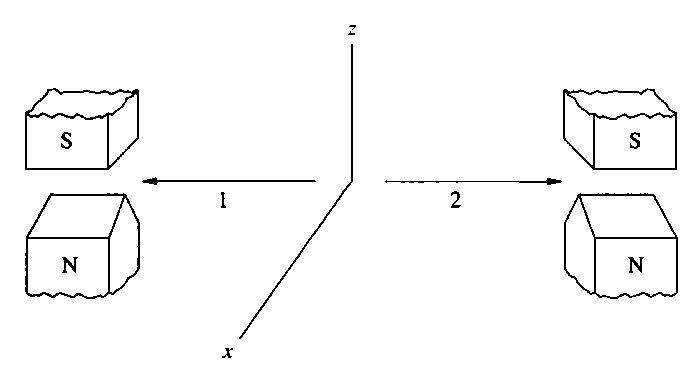
Picture an entangled pair of spin 1/2-spin particles with total spin 0. In the diagram, particle 1 of the pair is moving to the left (-y), and particle 2 to the right (+y).
If a z-oriented SG is used to detect the spin direction of particle 1 on the left, then the spin direction of particle 2 can be predicted with 100% certainty by using another z-oriented SG on the right. For example, if the left SG finds particle 1 to have spin [itex]\frac{\hbar}{2}[/itex], there is be a 100% probability that a z-directed SG on the right will detect particle 2 as having spin [itex]-\frac{\hbar}{2}[/itex].
Now consider leaving the left SG unchanged (pointing to +z), and rotating the right SG so it will point to +x. If particle 1 is detected on the left to have spin [itex]\frac{\hbar}{2}[/itex], two possibilities can be considered for what will happen when particle 2 reaches the +x-directed SG:
- Particle 2 is detected with 100% probability as having spin [itex]-\frac{\hbar}{2}[/itex] in the +x-direction, or
- Particle 2 is detected with a 50% probability of having spin [itex]-\frac{\hbar}{2}[/itex] in the +x direction, and 50% of having spin [itex]+\frac{\hbar}{2}[/itex] in the -x direction.
In the second case, obviously, it may turn out that the total spin of the system is not equal to zero.
What is the result of measurement, we should expect from SG{+x}?
*SG: Stern-Gerlach apparatus