Spiral scissor lift statics

  • Thread starter Thread starter carlcla
  • Start date Start date
Click For Summary
SUMMARY

The discussion centers on the load absorption mechanics of a spiral scissor lift, specifically how the load is distributed between the scissor structure and the spiral column when stationary. The spiral column, identified as a helical band actuator, must support the entire load, while the scissors primarily manage differential moments to maintain platform level. When static, the scissors can only absorb torque loads unless locked, allowing the spiral column to bear the full weight. Understanding these dynamics is crucial for effective design and safety in mechanical engineering projects.

PREREQUISITES
  • Mechanical engineering principles related to load distribution
  • Understanding of scissor lift mechanisms
  • Knowledge of helical band actuators
  • Familiarity with static equilibrium concepts
NEXT STEPS
  • Research the mechanics of helical band actuators
  • Study static equilibrium in mechanical systems
  • Explore design guidelines for scissor lift mechanisms
  • Investigate torque load calculations for stationary lifts
USEFUL FOR

Mechanical engineers, design engineers, and students involved in lift mechanism projects or those seeking to understand load distribution in complex mechanical systems.

carlcla
Messages
11
Reaction score
6
Thread moved from the technical forums to the schoolwork forums
TL;DR Summary: I need help to understand the concept for load absorption in a spiral scissor lift.

Hello everyone!

I have a mechanical engineering project for the end of this semester.

We have been tasked to design a spiral scissor lift similar to what’s in the attached picture. My question is regarding the statics. When the lift is stationary with a load on the top platform, are there any norms or guidelines for how much of the load will be absorbed by the scissor structure and how much of the weight will be absorbed by the spiral column itself?

I understand that when in motion, the spiral column has to be able to lift the entire load. But how about when its being static?
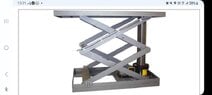
 

Attachments

  • Screenshot_20250410_153102_Docs.jpg
    Screenshot_20250410_153102_Docs.jpg
    21.9 KB · Views: 35
Physics news on Phys.org
carlcla said:
I understand that when in motion, the spiral column has to be able to lift the entire load. But how about when its being static?
The "scissors" keep the platform level in the long direction, while one or more torque tubes, between the two scissor sides, keep the platform level in the cross direction.

The spiral column, (that looks to me like a ball screw), must support the entire load, and the platform.

The scissors carry only differential moments, or torque loads, associated with keeping the platform level when the load is not applied above the column axis.

The column will still carry the entire load when static, unless the scissors can be locked, (at the 4 sliding points), to prevent movement at the top and bottom, and the spiral be released from the platform.
 
@carlcla
1)Could you please clarify your concept of “load absorption”?

2)Could you explain the reason to be and the function of the scissor mechanism in this case?

3)If the joint of the lifting mechanism to the top platform articulated?

4)How static balance would be achieved if we remove the scissor and leave the lifting mechanism in place?


Similar threads

  • · Replies 2 ·
Replies
2
Views
30K
  • · Replies 8 ·
Replies
8
Views
3K
Replies
7
Views
3K
  • · Replies 4 ·
Replies
4
Views
2K
  • · Replies 1 ·
Replies
1
Views
2K
  • · Replies 6 ·
Replies
6
Views
2K
  • · Replies 2 ·
Replies
2
Views
3K
  • · Replies 2 ·
Replies
2
Views
3K
  • · Replies 5 ·
Replies
5
Views
6K
  • · Replies 3 ·
Replies
3
Views
2K