Undergrad Split Epimorphisms .... Bland Proposition 3.2.4 ....

  • Thread starter Thread starter Math Amateur
  • Start date Start date
  • Tags Tags
    Split
Click For Summary
The discussion centers on understanding Proposition 3.2.4 from Paul E. Bland's "Rings and Their Modules," specifically how it relates to Proposition 3.2.3. It is established that if a map is a split monomorphism, its splitting map is surjective, making it an epimorphism, while a split epimorphism has an injective splitting map. The key lemma indicates that if two maps satisfy a specific composition condition, one is a monomorphism and the other an epimorphism. By applying this lemma to the sequences in Propositions 3.2.3 and 3.2.4, it is shown that the conclusions of both propositions are analogous, confirming the validity of Proposition 3.2.4. This analysis clarifies the relationship between the propositions and the nature of the maps involved.
Math Amateur
Gold Member
MHB
Messages
3,920
Reaction score
48
I am reading Paul E. Bland's book "Rings and Their Modules" ...

Currently I am focused on Section 3.2 Exact Sequences in ModR" role="presentation">ModR ... ...

I need some help in order to fully understand Proposition 3.2.4 ...

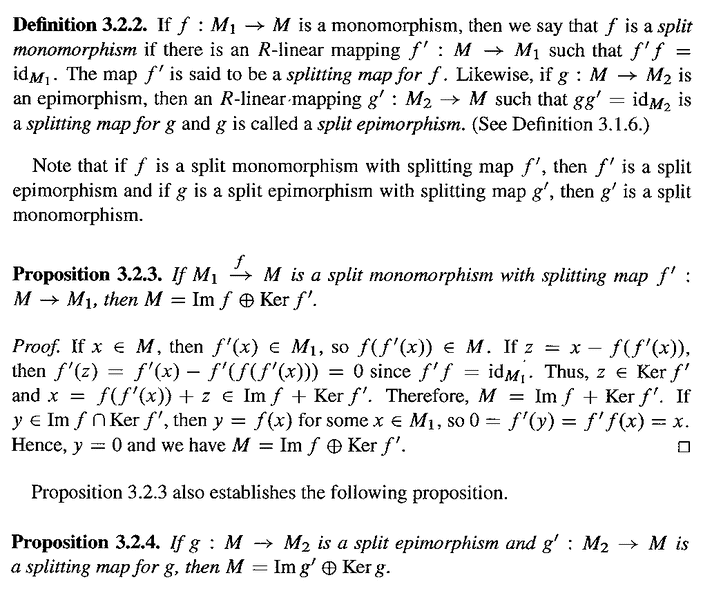
Proposition 3.2.4 reads as follows:
Bland - Prposition 3.2.4 ... ....png

Can someone please explain exactly how Proposition 3.2.3 establishes Proposition 3.2.4 ...
Help will be much appreciated ...

Peter
 

Attachments

  • Bland - Prposition 3.2.4 ... ....png
    Bland - Prposition 3.2.4 ... ....png
    46.3 KB · Views: 574
Physics news on Phys.org
Start with the premises of 3.2.4 about ##g,g'##.

Then, from the author's comment after Definition 3.2.2 we see that ##g'## is a split monomorphism with monomorphism-splitting map ##g##.

Hence by Proposition 3.2.3, the range ##M## of the split monomorphism ##g'## can be written as a direct sum of the split monomorphism's image (##\textrm{Im}\ g'##) and the Kernel of the monomorphism-splitting map ##g##.

I find it helps to attach the word 'epimorphism-' or 'monomorphism-' as a prefix to the words 'splitting map' in order to avoid confusion as to whether the map in question is splitting an epimorphism or a monomorphism.

Are you able to satisfy yourself as to the truth of the author's comment after Definition 3.2.2?
 
  • Like
Likes Math Amateur
Hi Andrew ... thanks for the help ...

Regarding the authors comments after Definition 3.2.2 ...

Firstly, if ##f## is a split monomorphism with splitting map ##f'##... then any point/element of ##M_1##, say ##a##, must be mapped to itself: ... hence ##f'## must be surjective ... that is ##f'## is an epimorphism ...

Secondly if ##g## is a split epimorphism with splitting map ##g'##... then any point ##a \in M_2## will be mapped to ##g'(a)## ... and no other point of ##M_2##, say ##b##, may be mapped to ##g'(a)## ... otherwise ... ##g## must map the point ##g'(a)## back to both ##a## and ##b## ... which is impossible since ##g## is a map ... therefore ##g'## is injective ... that is, ##g'## is a monomorphism ... ...

Peter
 
Yes. A neat way to put the second one is to let ##a,b\in M_2## and assume ##g'(a)=g'(b)##. Then we have

$$a=id_{M_2}(a) = (g\circ g')(a) = g(g'(a)) = g(g'(b)) = (g\circ g')(b) = id_{M_2}(b) = b$$

which gives us the injectivity property of ##g'##.
 
  • Like
Likes jim mcnamara and Math Amateur
The key to your question is this lemma:

If ##f:M \to N## and ##g:N \to M## are R-maps such that ##g \circ f = 1_M## then ##f## is an R-monomorphism and ##g## is an R-epimorphism. You may prove that.
Here we have a sequence

##M\overset{f}{\rightarrow}N\overset{g}{\rightarrow}M##

of R-maps such that ##g \circ f = 1_M##.In proposition 3.2.3. we have this sequence

##M_1\overset{f}{\rightarrow}M\overset{f’}{\rightarrow}M_1##

of R-maps such that ##f’ \circ f = 1_{M_1}##.

By the lemma, ##f## is a monomorphism and we have ##f’ \circ f = 1_{M_1}##: definition 3.2.2. calls ##f## the split monomorphism and calls ##f’## the splitting map for ##f##.

Proposition 3.2.3 says ##M = \text{im } f \oplus \text{ker } f’##


Can you see this:

By the lemma, ##f’## is an epimorphism and we have ##f’ \circ f = 1_{M_1}##: but now definition 3.2.2. calls ##f’## the split epimorphism and ##f## the splitting map for ##f’##.

Proposition 3.2.3 says ##M = \text{im } f \oplus \text{ker } f’##This is exactly the situation we have in proposition 3.2.4. here we have this sequence

##M_2\overset{g’}{\rightarrow}M\overset{g}{\rightarrow}M_2##

of R-maps such that ##g \circ g’ = 1_{M_2}##: ##g## the split epimorphism and ##g’## the splitting map for ##g##.

So change ##f## into ##g’##, and ##f’## into ##g##, and ##M_1## into ##M_2## and proposition 3.2.3 becomes proposition 3.2.4. And the conclusion is ##M = \text{im } g’ \oplus \text{ker } g##
 
  • Like
Likes Math Amateur
I am studying the mathematical formalism behind non-commutative geometry approach to quantum gravity. I was reading about Hopf algebras and their Drinfeld twist with a specific example of the Moyal-Weyl twist defined as F=exp(-iλ/2θ^(μν)∂_μ⊗∂_ν) where λ is a constant parametar and θ antisymmetric constant tensor. {∂_μ} is the basis of the tangent vector space over the underlying spacetime Now, from my understanding the enveloping algebra which appears in the definition of the Hopf algebra...

Similar threads

  • · Replies 2 ·
Replies
2
Views
1K
  • · Replies 5 ·
Replies
5
Views
2K
Replies
2
Views
1K
Replies
2
Views
2K
  • · Replies 3 ·
Replies
3
Views
2K
  • · Replies 1 ·
Replies
1
Views
1K
  • · Replies 1 ·
Replies
1
Views
1K
  • · Replies 2 ·
Replies
2
Views
1K
  • · Replies 12 ·
Replies
12
Views
3K
  • · Replies 16 ·
Replies
16
Views
3K