Spring Classes (Freshman Math Major): Too much?

Click For Summary
SUMMARY

The discussion centers on a freshman math major's decision to take three math classes simultaneously: College Calculus 3, Introduction to Differential Equations, and Introduction to Linear Algebra, alongside a World Civilization course. Participants unanimously agree that this schedule is manageable and typical for math majors, especially considering the foundational nature of these courses. They emphasize the importance of understanding concepts like eigenvalues, eigenvectors, and partial derivatives to succeed in the upcoming classes. Additionally, they recommend consulting with a math department advisor for tailored guidance.

PREREQUISITES
  • Understanding of College Calculus 3 concepts
  • Familiarity with Differential Equations
  • Knowledge of Linear Algebra, including matrices and vector spaces
  • Ability to work with eigenvalues and eigenvectors
NEXT STEPS
  • Research "Eigenvalues and Eigenvectors in Linear Algebra"
  • Study "Partial Derivatives and Their Applications in Differential Equations"
  • Explore "Proof Techniques in Linear Algebra"
  • Learn about "Course Requirements for Math Majors at Various Universities"
USEFUL FOR

Freshman math majors, academic advisors, and students considering a heavy course load in mathematics will benefit from this discussion.

Totalderiv
Messages
69
Reaction score
1
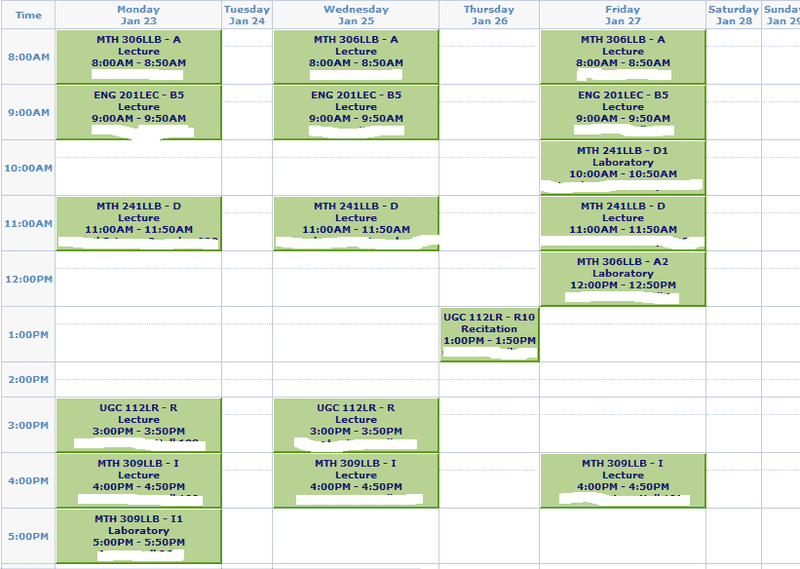
Hey I'm currently a freshman math major and just registered for my spring classes. When I went to my adviser, she thought I was insane for taking three math classes at one time. Am I insane?

Schedule:

-College Calculus 3
-Introduction to Differential Equations
-Introduction to Linear Algebra
-World Civilization 2
-May take Advanced Writing 1 as well
2hfj8xx.png
 
Last edited:
Physics news on Phys.org
No, that's not insane. When starting out in grad school, students typically take 3 math classes and they are much harder , plus there are teaching/other duties (although grades in grad school aren't a big deal, usually).

If possible, it might be safer to take one of those over the summer instead.
 
No, it's not insane. You might even find the schedule a bit light (depending on how much work the classes are).

How did you do in fall?? How many classes did you take then?? Did it work out??

By the way, what is "introduction to linear algebra"? Is it proof based? Don't take it if it's not proof based...
 
micromass said:
No, it's not insane. You might even find the schedule a bit light (depending on how much work the classes are).

How did you do in fall?? How many classes did you take then?? Did it work out??

By the way, what is "introduction to linear algebra"? Is it proof based? Don't take it if it's not proof based...

The description says "Linear equations, matrices, determinants, vector spaces, linear mappings, inner products, eigenvalues, eigenvectors." Right now I'm expecting an A in my Calc 2 class.
 
Totalderiv said:
The description says "Linear equations, matrices, determinants, vector spaces, linear mappings, inner products, eigenvalues, eigenvectors." Right now I'm expecting an A in my Calc 2 class.

Do you go to Waterloo?
 
Kevin_Axion said:
Do you go to Waterloo?

Nope
 
Totalderiv said:
Nope

Haha okay, I was just wondering because the course outline looks exactly the same as Waterloo students'.
 
Kevin_Axion said:
Haha okay, I was just wondering because the course outline looks exactly the same as Waterloo students'.

The course IDs and description he gave match with University of Buffalo. I don't go there, but Google is amazing. :smile:
 
Totalderiv said:
Hey I'm currently a freshman math major and just registered for my spring classes. When I went to my adviser, she thought I was insane for taking three math classes at one time. Am I insane?

...

Insane? Absolutely not! Taking three to four math courses at one time1 is what math majors do! :approve:

1 in the typical U.S. semester-based system.
 
  • #10
I'd imagine you'll be fine. At many schools linear algebra would be a prerequisite for both calculus of multiple variables and differential equations, but more than likely, you'll have gotten to the stuff you need in algebra by the time you need it for calc 3 and diff equ.

The only advice I really have is: try and familiarize yourself with
1) how to figure out equations of planes via points and normal vectors (cross product stuff) before you get to the partial derivatives sections in calc 3 where you need to find tangent planes to surfaces.
2) eigenvalues/vectors before you get into solving systems of linear ODEs in your diff equ class.

Both of these things may come up in your calculus 3 or differential equations class before you get into that in your algebra class depending on how each course is set up ... especially if the algebra course is proof intense and you end up spending a lot of time on vector spaces and linear transformations instead of doing loads of "engineering" type computational linear algebra or whatever ...

Good luck though, I'm sure you'll be fine if you're willing to put in the time required for the courses. One last piece of advice, if you have time, do every problem in the book, not just the stuff that your profs may assign.
 
  • #11
At this point, you probably just have a university advisor for registration purposes... someone who can maybe advise you on university policies, etc. (and likely advises people in all majors (including "basket-weaving" ones). But you really need to get an advisor (maybe an unofficial advisor) in the math department if you are a math major. Perhaps consult with your current Calc professor if you have a high opinion of him/her. Even someone with "lecturer status" has likely worked their way though a higher degree in the field (and certainly through an undergraduate degree). Eventually you'll want to consult with someone who teaches upper-level courses.

Aside from that advice: I concur with Dembadon above... at some point (in whatever major you have) you'll end up taking at least three to four courses in the major (or related fields).

Personally, I think it looks QUITE manageable. At this point, it looks to be only 4-5 courses, probably 12-15 credit hours. When I was an undergrad, I took 6+ courses (18+ credit hours) every term except the last, where I let myself "slack-off"with only 12 credit hours and finish up a research-based thesis, and had also kind-of exhausted the upper-level courses I was interested in in three fields (chemistry, math and physics -- I probably should have looked over to the engineering curriculum for something). Now course, there's probably also a balance to be struck between lots of courses and really delving into those you do take (even if you still have great scores under a more course-heavy approach). And then, lastly, there's sanity. But what's your time in undergrad for if not for learning as much as you can?
 
  • #12
It's actually 15 credit hours without the writing course, and 18 credits hours with it. (The math courses are 4 credits each.)

I'm with the others in saying that taking the three math courses at the same time is "not insane." To my regret, I didn't do something similar -- I was placed into Calc III, but instead of taking 2 math courses a semester my freshman year (the normal thing for sophomore math majors), I only took one a semester for 2 years. :rolleyes:
 
  • #13
thats kinda weird for a math student, as the survey (non-proof based) courses of LA and DiffEq don't count towards the degree (at least where i went) -- majors have to take the proof based versions after they have 1 semester of proof writing / real analysis.
 
  • #14
Obviously, the major requirements depend on the school (and the country). As an undergrad in the US, I had to take the following courses for a math major:

7 lower division courses:
- Calculus I, II, III
- Linear Algebra
- Differential Equations
- Probability & Statistics
- Discrete Mathematics
8 upper division courses

Generally, the lower division courses had to be taken before commencing on the upper division courses (which include Real Analysis, Complex Variables, Algebraic Structures, etc.). But there were some exceptions (Number Theory, one of our upper division courses, only required Calculus II and Linear Algebra as prerequisites).
 
  • #15
eumyang said:
Obviously, the major requirements depend on the school (and the country). As an undergrad in the US, I had to take the following courses for a math major:

7 lower division courses:
- Calculus I, II, III
- Linear Algebra
- Differential Equations
- Probability & Statistics
- Discrete Mathematics
8 upper division courses

Generally, the lower division courses had to be taken before commencing on the upper division courses (which include Real Analysis, Complex Variables, Algebraic Structures, etc.). But there were some exceptions (Number Theory, one of our upper division courses, only required Calculus II and Linear Algebra as prerequisites).
so did you have to take differential equation twice? the survey course for engineers (and i guess math students) first, and then again as a proof based course?
 
  • #16
Highway said:
so did you have to take differential equation twice? the survey course for engineers (and i guess math students) first, and then again as a proof based course?
No, I didn't. I wasn't "required" to take the upper-division version at all.

At my school, there were different concentrations within the math major, and each concentration had a list of upper-division courses required. However, IIRC all of the concentrations required only 3-5 courses with the rest (totaling 8) as upper division electives in math. My concentration (pure math) required 2 semesters of Analysis and 2 semesters of Algebraic Structures, with the rest being electives.

I believe that there are some schools (in the US) where they offer a lower-division DiffEq course and a 2nd semester of DiffEq that is more theoretical in nature.
 
  • #17
Hi TotalDeriv,

My schedule right now looks almost identical to the one you're going to take except I'm taking a music class instead of world history. I'm a freshman too and my advisor thought I was crazy as well but so far I would say my schedule hasn't been too bad and there are many times when I felt I could have handled more work. However my classes aren't heavy on proofs so it might be different for you.

You do need to know some matrices and eigenvalues/eigenvectors as well as partial derivatives for differential equations. For my diffy q class, my professor just taught the stuff we need to know from linear algebra really quickly.
 

Similar threads

Replies
41
Views
7K
  • · Replies 1 ·
Replies
1
Views
1K
  • · Replies 4 ·
Replies
4
Views
2K
  • · Replies 8 ·
Replies
8
Views
2K
  • · Replies 5 ·
Replies
5
Views
3K
  • · Replies 6 ·
Replies
6
Views
3K
  • · Replies 32 ·
2
Replies
32
Views
3K
  • · Replies 22 ·
Replies
22
Views
3K
  • · Replies 4 ·
Replies
4
Views
2K
  • · Replies 17 ·
Replies
17
Views
5K