Spring Force and Displacement: Understanding the Relationship

Click For Summary
The discussion focuses on the relationship between spring force and displacement, emphasizing the need to correctly integrate work done by a spring. The equation for work done is clarified as (1/3)As^3 + (1/2)Bs^2, highlighting that the external force compresses the spring. Participants note that the integration bounds should be from 0 to s, as s represents the displacement from equilibrium, not a specific position. The conversation also clarifies that in the standard formula F = kx, x denotes distance rather than position. Understanding these concepts is crucial for accurately calculating work in spring mechanics.
fireman2020
Messages
4
Reaction score
1
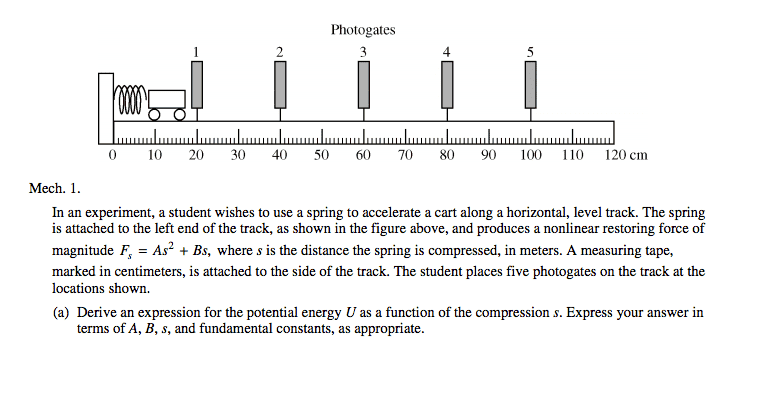
Problem:
zVFHw8X.jpg


Attempted Solution:
3XEQJgA.jpg


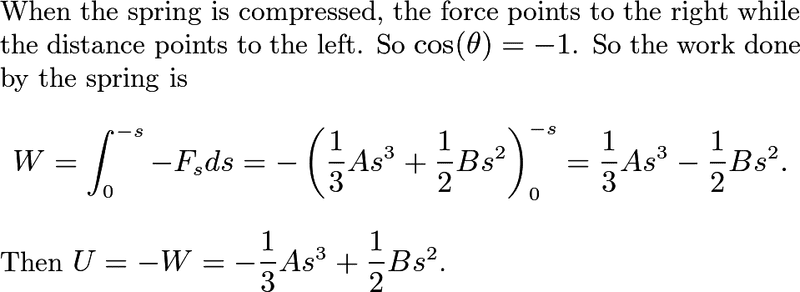
The answer is actually (1/3)As^3+(1/2)Bs^2
 
Physics news on Phys.org
Actually there is work done by an external force (pointing toward the left) in order to compress the spring in the first place. The force and direction of motion are in the same direction. See if that helps it come out right for you. The spring will do work to move the cart, starting at some position -s like you said and moving towards 0, so you should integrate from -s to 0 to calculate the work done by the spring as it is released.
 
Firstly, well done noting that the force on the cart and the displacement of the cart point in opposite directions.

Secondly, your bounds should not be from zero to -s but from zero to s. This is because s represents a displacement from equilibrium, not a particular point on the ruler. It is not important that you traveled from a specific location x_1 to x_2. Rather, this equation wants you to input the distance s that was traveled.
 
  • Like
Likes scottdave and fireman2020
I'm not real up-to-speed on these kinds of problems, so pardon me for that. But you have an equation F = As2 + Bs. So what that tells me is that as s gets larger, the force gets larger. So in compressing the spring, which you are doing, s should be getting larger. So why are you integrating from 0 to -s. Wouldn't that be stretching the spring, not compressing it?
 
  • Like
Likes scottdave
Daniel Gallimore said:
Firstly, well done noting that the force on the cart and the displacement of the cart point in opposite directions.

Secondly, your bounds should not be from zero to -s but from zero to s. This is because s represents a displacement from equilibrium, not a particular point on the ruler. It is not important that you traveled from a specific location x_1 to x_2. Rather, this equation wants you to input the distance s that was traveled.

Oh so in the standard F=kx, the x is the distance? Not the position? That makes so much more sense. Thanks.
 
The book claims the answer is that all the magnitudes are the same because "the gravitational force on the penguin is the same". I'm having trouble understanding this. I thought the buoyant force was equal to the weight of the fluid displaced. Weight depends on mass which depends on density. Therefore, due to the differing densities the buoyant force will be different in each case? Is this incorrect?

Similar threads

  • · Replies 18 ·
Replies
18
Views
2K
Replies
17
Views
2K
  • · Replies 56 ·
2
Replies
56
Views
4K
  • · Replies 14 ·
Replies
14
Views
2K
  • · Replies 2 ·
Replies
2
Views
745
Replies
6
Views
980
  • · Replies 14 ·
Replies
14
Views
4K
Replies
29
Views
3K
  • · Replies 5 ·
Replies
5
Views
1K
  • · Replies 13 ·
Replies
13
Views
1K