Spring mass system attached to a disc

Join the discussion
Registration is free. Ask a follow-up in this thread, or start your own.
5 replies · 2K views
rafaamcarvalho
Messages
3
Reaction score
0
Hello to all, first sorry about any mistakes because English is not my native language. I'm trying to solve this problem and I can't seem to find the equation of motion
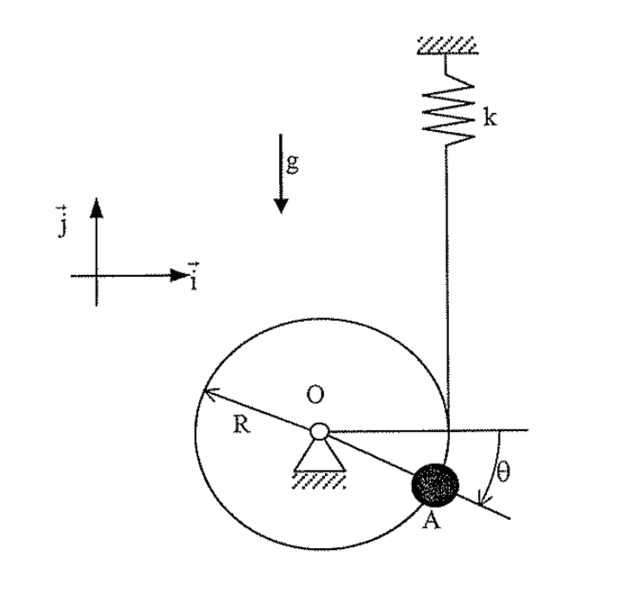
Homework Statement


Captura de Tela 2017-05-09 às 17.17.13.png

The disc and the point A both have mass m;
θ(0) = 0

2. The attempt at a solution
I tried to use the Newton's second law for rotation but I can't find the values of the point A and K in therms of θ.
I don't know if what I did here was correct, but I tried this:

ΣMo = Jα
Jα = m⋅g⋅r - k⋅x⋅r; x = r⋅sinθ
 
Physics news on Phys.org
rafaamcarvalho said:
Jα = m⋅g⋅r - k⋅x⋅r
Is this for small oscillations only, or can θ be anything? If anything, the mgr term is wrong.
rafaamcarvalho said:
x = r⋅sinθ
It looks to me that the strong wraps around the disc, so it is not sine θ. If the disc has rotated θ, what length of string is wrapped onto it?
 
  • Like
Likes   Reactions: rafaamcarvalho
haruspex said:
Is this for small oscillations only, or can θ be anything? If anything, the mgr term is wrong.

I believe so. But if its not m⋅g⋅r, what could it be?

You are right, the spring wraps around the disc, so is the displacement x = r⋅θ?

And how to calcule the polar moment of inertia J of a disc with mass m with a concentrated mass m in point A?
 
rafaamcarvalho said:
its not m⋅g⋅r, what could it be?
Draw the diagram showing the line of action of mg. For the moment of a force about an axis, you multiply it by the perpendicular distance from its line of action to the axis.
rafaamcarvalho said:
polar moment of inertia J of a disc with mass m with a concentrated mass m in point A
Find the moment of inertia of each mass around the axis and add them.
 
haruspex said:
Find the moment of inertia of each mass around the axis and add them.

Oh got it, did not check if it was perpendicular, so the therm should be m⋅g⋅cosθ⋅r?

And then my final formula would be,

(m⋅r² + ½⋅m⋅r²)α + (k⋅r²)⋅θ - (m⋅g⋅cosθ⋅r) = 0 ?
 
rafaamcarvalho said:
Oh got it, did not check if it was perpendicular, so the therm should be m⋅g⋅cosθ⋅r?

And then my final formula would be,

(m⋅r² + ½⋅m⋅r²)α + (k⋅r²)⋅θ - (m⋅g⋅cosθ⋅r) = 0 ?
Looks right.
 
  • Like
Likes   Reactions: rafaamcarvalho