Square root differential problem

Click For Summary

Discussion Overview

The discussion revolves around a differential equation involving a Taylor series expansion. Participants are examining the derivation of terms in the equation and questioning the steps taken to arrive at specific results, particularly focusing on the second term of an equation derived from the Taylor series.

Discussion Character

  • Exploratory
  • Technical explanation
  • Debate/contested
  • Mathematical reasoning

Main Points Raised

  • One participant expresses confusion about how the second term of equation 2 is derived from the differentiation of the second term in equation 1.
  • Another participant suggests that the derivation involves a Taylor series, noting that in this case, \( x = \epsilon \) and \( a = 0 \), and agrees with the result presented.
  • Several participants question the absence of the \( \epsilon h' \) term in the denominator of the second term in equation 2, suggesting it should remain.
  • There is a discussion about the implications of setting \( \epsilon = 0 \) and the presence of \( e \) multiplying the second term in equation 2, with one participant explaining that the \( \epsilon h \) in the denominator is set to zero when taking \( f'(0) \).

Areas of Agreement / Disagreement

Participants express differing views on the derivation steps and the presence of certain terms in the equations. There is no consensus on the resolution of these questions, indicating ongoing debate and uncertainty.

Contextual Notes

Participants highlight potential missing assumptions regarding the treatment of terms in the Taylor series expansion and the implications of setting \( \epsilon \) to zero. The discussion reflects a need for clarity on the mathematical steps involved.

knockout_artist
Messages
70
Reaction score
2
Hi,

I working on their text this equation did not make sense to me.

From equation 1 it differentiate second term , I wonder how he got second term of equation 2.

What I think is, what I wrote at the bottom
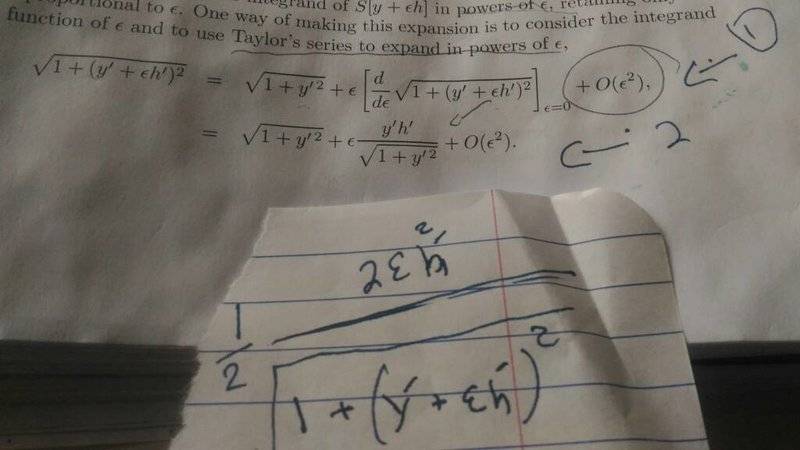
P_20170713_121813.jpg
 
Physics news on Phys.org
They are doing a Taylor series and writing ## f(x)=f(a)+f'(a)(x-a) +... ## In this case ## x=\epsilon ## and ## a=0 ##. ## \\ ## I agree with their result.
 
but how did they resolve
f(x)=f(a)+f′(a)(x−a)+..
to get second term in eq 2.
 
knockout_artist said:
but how did they resolve
f(x)=f(a)+f′(a)(x−a)+..
to get second term in eq 2.
The chain rule. In numerator of ## f'(\epsilon) ## you have ## 2(y'+\epsilon h) h ##. You then compute ## f'(0) ##.
 
  • Like
Likes   Reactions: knockout_artist
but then why there is no ϵh' term in denominator in second term in equation 2 ?
It should have stayed there.

and if were to consider ϵ = 0 then why there is still e multiplying second term in equation 2 ?
 
knockout_artist said:
but then why there is no ϵh' term in denominator in second term in equation 2 ?
It should have stayed there.

and if were to consider ϵ = 0 then why there is still e multiplying second term in equation 2 ?
The ## \epsilon ## is from ## (x-a)=(\epsilon-0)= \epsilon ##. Meanwhile, the ## \epsilon h ## in tthe denominator gets put equal to zero as part of taking ## f'(0) ##. (The entire term is the product of both of these which is ## f'(0)(x-a) ##.)
 
So like this ?
 

Attachments

  • phy-formum.jpeg
    phy-formum.jpeg
    23.2 KB · Views: 495
Last edited:
  • Like
Likes   Reactions: Charles Link

Similar threads

  • · Replies 3 ·
Replies
3
Views
6K
  • · Replies 4 ·
Replies
4
Views
2K
  • · Replies 7 ·
Replies
7
Views
2K
  • · Replies 3 ·
Replies
3
Views
2K
  • · Replies 4 ·
Replies
4
Views
2K
  • · Replies 14 ·
Replies
14
Views
2K
  • · Replies 2 ·
Replies
2
Views
1K
  • · Replies 2 ·
Replies
2
Views
2K
  • · Replies 15 ·
Replies
15
Views
2K
  • · Replies 5 ·
Replies
5
Views
2K