Calculating the Second Moment of Area for Floating Bodies

Click For Summary
SUMMARY

The calculation of the distance between the center of buoyancy (B) and the metacenter (M) for floating bodies is defined by the equation BM = I/V, where I represents the second moment of area and V is the volume of the submerged portion. The second moment of area (I) should be calculated for the horizontal slice at the waterline, known as the waterplane. For a rectangular hull, the formula I = bd^3/12 applies, using the hull's length for b and the draft for d. This ensures accurate stability assessments of floating bodies.

PREREQUISITES
  • Understanding of buoyancy principles in fluid mechanics
  • Familiarity with the second moment of area calculations
  • Knowledge of submerged volume calculations
  • Basic concepts of stability in floating bodies
NEXT STEPS
  • Study the calculation of the second moment of area for various shapes
  • Explore the concept of waterplane area in naval architecture
  • Learn about buoyancy and stability in floating bodies using "Physics of Continuous Matter" by B. Lautrup
  • Investigate the relationship between hull shape and stability in marine engineering
USEFUL FOR

Naval architects, marine engineers, students of fluid mechanics, and anyone involved in the design and stability analysis of floating structures.

tomtomtom1
Messages
160
Reaction score
8
Homework Statement
Stability Of Floating Bodies
Relevant Equations
BM = I / V
Hello all

I was hoping someone could help shed some light on understanding an equation for floating bodies.

I am trying to work out the distance between B and M shown in the sketch below:-
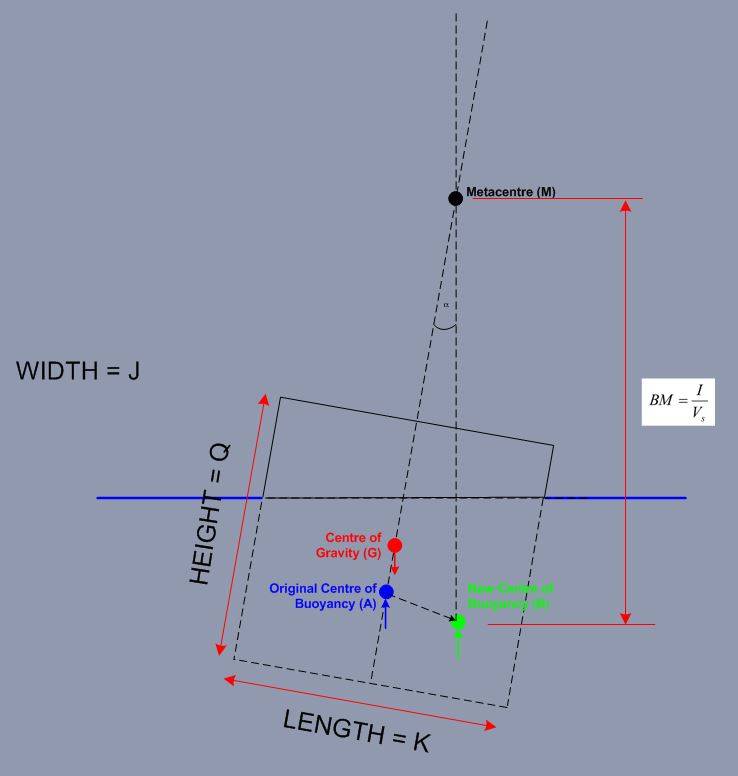
STABILITY.JPG


I have been given the equation:-

BM = I/V

BM = is the distance from center of buoyancy to the meta center
I = Is the second moment of area
V = Volume of the submerged portion of the body.

I just want to know how to calculate I?

Is I worked out for the entire floating board or is I worked out for just the portion of the body above the water line or is I calculated to the portion of the body below the water line?

I know that I is bd^3/12 but in my example do i use q for b and k for d - how do you know what values to use and what portion of the bosy I relates to?

Can anyone help?

Thank you.
 
Physics news on Phys.org
I remember that there's something about stability of floating bodies in "Physics of Continuous Matter Exotic and Everyday Phenomena in the Macroscopic World" by B. Lautrup. Maybe that will help?
 
tomtomtom1 said:
Is I worked out for the entire floating board or is I worked out for just the portion of the body above the water line or is I calculated to the portion of the body below the water line?
It is the second moment of area of the horizontal slice through the hull at the waterline. This slice is also known as the waterplane.
So use k for d, but b will be the length of the hull (assuming it is just a rectangular box).
This length will also feature in the volume, so will cancel out.
 
  • Like
Likes   Reactions: tomtomtom1

Similar threads

  • · Replies 7 ·
Replies
7
Views
3K
Replies
19
Views
1K
  • · Replies 10 ·
Replies
10
Views
11K
  • · Replies 2 ·
Replies
2
Views
2K
Replies
10
Views
11K
  • · Replies 37 ·
2
Replies
37
Views
3K
  • · Replies 17 ·
Replies
17
Views
2K
  • · Replies 2 ·
Replies
2
Views
5K
  • · Replies 6 ·
Replies
6
Views
2K
  • · Replies 6 ·
Replies
6
Views
3K