Standard form, vertex form. Something isn't right here

Click For Summary
SUMMARY

The discussion centers on the confusion surrounding the definitions of "standard form" and "vertex form" for quadratic functions. Participants clarify that the standard form is typically expressed as f(x) = ax² + bx + c, while the vertex form is represented as f(x) = a(x - h)² + k. The inconsistency in terminology across different textbooks and educational resources is highlighted, with some sources incorrectly labeling the vertex form as standard form. Ultimately, the consensus is that students should adhere to the definitions provided by their specific educational materials to avoid confusion.

PREREQUISITES
  • Understanding of quadratic functions
  • Familiarity with the concepts of standard form and vertex form
  • Knowledge of completing the square technique
  • Basic algebraic manipulation skills
NEXT STEPS
  • Research the differences between standard form and vertex form of quadratic functions
  • Learn how to complete the square for quadratic equations
  • Explore various algebra textbooks to compare definitions of standard and vertex forms
  • Practice converting quadratic functions between standard form and vertex form
USEFUL FOR

Students studying algebra, educators teaching quadratic functions, and anyone seeking clarity on the terminology used in mathematics regarding quadratic equations.

Niaboc67
Messages
249
Reaction score
3
I mainly just need some clarification here. I was doing my homework and then browsing the web to find an answer to my problem and came across mathewarehouse' definition of Standard form and then I looked at my homework and went..."huh?" I don't understand if my homework is listening this wrong or mathwarehouse or if I am misunderstanding something.
Please help

Here are the two images my homework first:
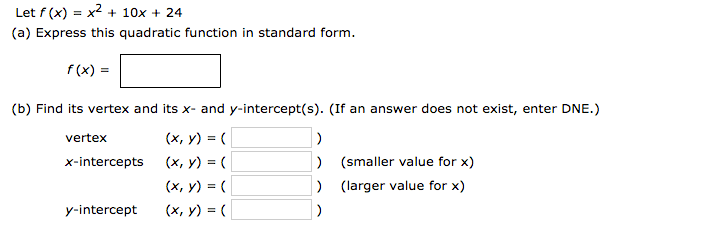
DPL4U16.png

here it is telling me f(x)=x^2+10x+24 is a quadratic function which must be expressed in standard form. But mathewarehouse would leads me to think that it's already in standard form:
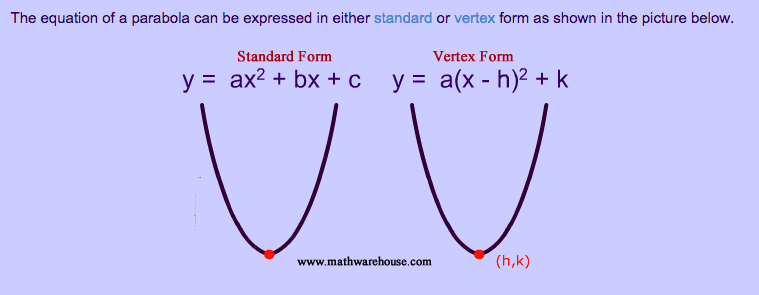
WL9EyPx.png


What's the deal?
 
Physics news on Phys.org
Looks like f is already in standard form.
 
The standard form is expressed by completing the square.

The vertex is simply the point on the parabola where the graph changes direction, as shown on the graph you posted above, the (h,k) coordinate which is determined from the vertex form equation (complete the square equation of the function).
 
I still don't understand. These two things are giving me conflicting ideas. Which is which? Is f(x)=x^2+10x+24 a quadratic function or is standard form? So maybe it's just trying to confuse me? and I just need to put it in twice and then to find the vertex but completing the square aka putting it in vertex form? is that right?

Is a quadratic function something which is already in standard form?
 
An equation can be expressed in standard or vertex form. A quadratic function in standard form is f(x) = a(x - h)2 + k.

It's just semantics really, albeit confusingly laid out above.

The standard and vertex equations ( y =) are referred to as standard and vertex respectively and in that sense are not incorrect in what is being shown, however, a quadratic function in standard form is expressed as f(x) = a(x - h)2 + k.

So in the question you are being asked to express a function in standard form, you complete the square. As with most mathematical questions a follow on effect is used, your answer for (a) is guiding you towards the answer for (b).
 
@Jimmy Johnson THANKS A TON! that clears up a lot. This math program I am using likes to be purposely cryptic I think.
 
You need to use whatever definition your program is using for the term "standard form." I don't think many textbooks would call y = a(x - h)2 + k "standard form" but your program seems to be doing this.
 
No - standard form is the ax^2 + bx + c version, and a\left(x-h\right)^2 + k is the vertex form. Your text is using the names in a non-standard way - as is #5.
 
statdad said:
No - standard form is the ax^2 + bx + c version, and a\left(x-h\right)^2 + k is the vertex form. Your text is using the names in a non-standard way - as is #5.
I agree.
 
  • #10
In most cases of this topic I've seen in textbooks or online the standard form of a quadratic function is expressed in vertex form. However I agree that it is inconsistent throughout different teachings etc.

"Different textbooks have different interpretations of the reference "standard form" of a quadratic function. Some say f (x) = ax2 + bx + c is "standard form", while others say that f (x) = a(x - h)2 + k is "standard form". To avoid confusion, this site will not refer to either as "standard form", but will reference f (x) = a(x - h)2 + k as "vertex form" and will reference f(x) = ax2 + bx + c by its full statement."

Nevertheless I think we can all agree that the standard form of this question is looking for the vertex form.
 
  • #11
Jimmy Johnson said:
In most cases of this topic I've seen in textbooks or online the standard form of a quadratic function is expressed in vertex form. However I agree that it is inconsistent throughout different teachings etc.

"Different textbooks have different interpretations of the reference "standard form" of a quadratic function. Some say f (x) = ax2 + bx + c is "standard form", while others say that f (x) = a(x - h)2 + k is "standard form". To avoid confusion, this site will not refer to either as "standard form", but will reference f (x) = a(x - h)2 + k as "vertex form" and will reference f(x) = ax2 + bx + c by its full statement."

Nevertheless I think we can all agree that the standard form of this question is looking for the vertex form.

No, I don't think we can agree on that. Perhaps the book (or on-line course, or whatever) really does mean that a*x^2 + b*x+c is the standard form, and maybe the question is merely asking the student to recognize that the given function is already in standard form. Sometimes simple exercises like that are given to help firm up a concept in a student's mind, the theory being that repetition helps. However, I would hope that somewhere in the course notes or lectures (or whatever) the concepts of "standard form" and "vertex form" are actually defined.
 
  • #12
Ray Vickson said:
No, I don't think we can agree on that. Perhaps the book (or on-line course, or whatever) really does mean that a*x^2 + b*x+c is the standard form, and maybe the question is merely asking the student to recognize that the given function is already in standard form.
That was my thought, as well.
Ray Vickson said:
Sometimes simple exercises like that are given to help firm up a concept in a student's mind, the theory being that repetition helps. However, I would hope that somewhere in the course notes or lectures (or whatever) the concepts of "standard form" and "vertex form" are actually defined.
 
  • #13
Jimmy Johnson said:
In most cases of this topic I've seen in textbooks or online the standard form of a quadratic function is expressed in vertex form. However I agree that it is inconsistent throughout different teachings etc.

"Different textbooks have different interpretations of the reference "standard form" of a quadratic function. Some say f (x) = ax2 + bx + c is "standard form", while others say that f (x) = a(x - h)2 + k is "standard form". To avoid confusion, this site will not refer to either as "standard form", but will reference f (x) = a(x - h)2 + k as "vertex form" and will reference f(x) = ax2 + bx + c by its full statement."

Nevertheless I think we can all agree that the standard form of this question is looking for the vertex form.
It appears that your quote is from the link: http://mathbitsnotebook.com/Algebra1/Quadratics/QDVertexForm.html .

I agree with you that the terminology "standard form" for a quadratic function is not standard. I currently teach College Algebra using a textbook by Ron Larson. In my view, it's unfortunate that he refers to the well named "Vertex Form" as the "Standard Form" for quadratic functions. This seems to be a fairly wide-spread practice in these lower level Algebra textbooks. It's rather inconsistent (again, that's in my view) because these same books often refer the "standard form" of a quadratic equation as being: ax2 + bx + c = 0.

Larson uses the terminology, "General Form" for a quadratic function written as: f(x) = ax2 + bx + c .

That's my two cents.

SammyS
 

Similar threads

  • · Replies 6 ·
Replies
6
Views
2K
  • · Replies 7 ·
Replies
7
Views
2K
  • · Replies 6 ·
Replies
6
Views
4K
  • · Replies 6 ·
Replies
6
Views
2K
  • · Replies 1 ·
Replies
1
Views
2K
  • · Replies 1 ·
Replies
1
Views
5K
  • · Replies 3 ·
Replies
3
Views
11K
  • · Replies 30 ·
2
Replies
30
Views
8K
  • · Replies 11 ·
Replies
11
Views
3K
  • · Replies 5 ·
Replies
5
Views
8K