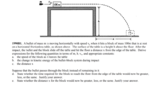
State whether the distance x for the block would be greater/less/same

  • Thread starter Thread starter paulimerci
  • Start date Start date
  • Tags Tags
    Block State
Click For Summary

Homework Help Overview

The discussion revolves around analyzing two different collision scenarios involving a bullet and a block. The first scenario is a perfectly inelastic collision, while the second is described as a perfectly elastic collision, although some participants challenge this classification. The participants explore how these collisions affect the distance the block travels after being struck by the bullet.

Discussion Character

  • Mixed

Approaches and Questions Raised

  • Participants discuss the implications of momentum transfer and energy conservation in both collision types. Questions arise regarding the classification of the second collision and the differences in the block's motion post-impact. Some participants seek clarification on the steps needed to articulate their reasoning effectively.

Discussion Status

The discussion is ongoing, with participants providing insights and questioning each other's reasoning. There is an exploration of the differences in horizontal velocity and energy transfer between the two scenarios, but no consensus has been reached on the correct classification of the second collision or the implications for the distance traveled by the block.

Contextual Notes

Participants note the mass difference between the bullet and the block, which influences the outcomes of the collisions. There is also mention of the need to clarify the definitions of elastic and inelastic collisions, as well as the impact of collision duration on the resulting motion.

paulimerci
Messages
287
Reaction score
47
Homework Statement
Attached problem below!
Relevant Equations
Conservation of momentum and Conservation of energy
I was able to solve for a, b, c, and d.
I don't know whether I'm saying it right for part e.
The first scenario is a perfectly inelastic collision. After impact, the bullet transfers momentum to the block, causing the block to move (it was initially at rest), and the bullet + block fall at a distance of x. However, when we perform energy conservation for the block-bullet system, the final velocity is less than the initial velocity of the block.
The second scenario is a perfectly elastic collision. During the impact, the bullet transferred some of its momentum to the block and leaves with velocity less compared to its initial velocity but a higher velocity compared to the block, and thereby the block should have landed at a distance less than x.
Was it right?
 

Attachments

  • Screenshot 2023-02-15 at 11.25.33 PM.png
    Screenshot 2023-02-15 at 11.25.33 PM.png
    36.9 KB · Views: 138
Physics news on Phys.org
paulimerci said:
the final velocity is less than the initial velocity of the block.
True, but it asks about energy, not velocity.
paulimerci said:
The second scenario is a perfectly elastic collision.
No.
paulimerci said:
a higher velocity compared to the block, and thereby the block should have landed at a distance less than x.
Yes, though you could fill in one more step in that logic.
 
  • Like
Likes   Reactions: paulimerci
haruspex said:
True, but it asks about energy, not velocity.

No.

Yes, though you could fill in one more step in that logic.
The second scenario is an elastic collision, the bullet doesn’t stick to the block. The collision was inelastic to elastic after impact. what type of collision should I write that as?
 
haruspex said:
True, but it asks about energy, not velocity.

No.

Yes, though you could fill in one more step in that logic.
Guide me what step should I add?
 
paulimerci said:
The second scenario is an elastic collision, the bullet doesn’t stick to the block.
It doesn’t bounce off either. It is neither perfectly elastic nor perfectly inelastic.
The standard terminology (which I dislike) uses "elastic" to mean perfectly elastic. Anything else is inelastic. Coalescence, as in the first part, is perfectly inelastic.
paulimerci said:
Guide me what step should I add?
You wrote that the block's velocity in the second scenario will be less than that of the bullet in the second scenario. To show the distance is less in the second scenario than in the first, you need to refer to something that is different between the two scenarios.
 
haruspex said:
It doesn’t bounce off either. It is neither perfectly elastic nor perfectly inelastic.
The standard terminology (which I dislike) uses "elastic" to mean perfectly elastic. Anything else is inelastic. Coalescence, as in the first part, is perfectly inelastic.

You wrote that the block's velocity in the second scenario will be less than that of the bullet in the second scenario. To show the distance is less in the second scenario than in the first, you need to refer to something that is different between the two scenarios.
Okay, As the block leaves the table it takes a projectile motion. Do I have to use kinematic equations?
 
paulimerci said:
n. Do I have to use kinematic equations?
No, just indicate what is different between the two scenarios as the block leaves the table, and why that difference occurs.
 
  • Like
Likes   Reactions: MatinSAR and nasu
paulimerci said:
The second scenario is a perfectly elastic collision.
I don't see it that way. When you have a perfectly elastic collision, the final velocities of the colliding objects are strictly determined from the initial velocities. Specifically in this case, since the block is 100 times more massive than the bullet, the bullet in a perfectly elastic collision should bounce back. That is one solution implied by the two conservation equations. The other solution that conserves energy and momentum is for the bullet to go through unmolested and is the solution that is usually ignored because it is just an affirmation of Newton's first law. Here, bullet exchanges energy and momentum with the block, as it goes through the block which fits neither of the two possible outcomes.
 
  • Like
Likes   Reactions: MatinSAR and nasu
kuruman said:
I don't see it that way. When you have a perfectly elastic collision, the final velocities of the colliding objects are strictly determined from the initial velocities. Specifically in this case, since the block is 100 times more massive than the bullet, the bullet in a perfectly elastic collision should bounce back. That is one solution implied by the two conservation equations. The other solution that conserves energy and momentum is for the bullet to go through unmolested and is the solution that is usually ignored because it is just an affirmation of Newton's first law. Here, bullet exchanges energy and momentum with the block, as it goes through the block which fits neither of the two possible outcomes.
Okay, I agree with what you said. Thank you @kuruman and @haruspex for taking time to read this and explain.
 
  • #10
haruspex said:
No, just indicate what is different between the two scenarios as the block leaves the table, and why that difference occurs.
That is what I posted in #1. I need to correct the error I made for scenario two. You mean that?
 
  • #11
paulimerci said:
That is what I posted in #1.
I cannot see that you did.
Just concentrate on the point, within each scenario, where the block is about to leave the table. What is different for the block in the second scenario from its attributes in the first?
 
  • Like
Likes   Reactions: MatinSAR
  • #12
Since the block is 100 times larger than the mass of the bullet, it should have eventually bounced back, which didn't happen in both scenarios. In the first scenario, it's a perfectly inelastic collision, and in the second scenario, it's neither elastic nor inelastic.
In the first scenario, the force of the bullet was much greater, which should have eventually reduced as it collided and stuck with the block, which means its impact time is greater and the force of collision is less (similar to air bags? I'm not sure). In the second scenario, the impact time is less and the force of the collision is greater. And that's the reason the block landed at a distance less than x. I'm I right?
 
  • #13
paulimerci said:
Since the block is 100 times larger than the mass of the bullet, it should have eventually bounced back, which didn't happen in both scenarios
Irrelevant.
paulimerci said:
in the second scenario, it's neither elastic nor inelastic.
No, as I wrote, it is inelastic, just not perfectly elastic.
paulimerci said:
In the first scenario, the force of the bullet was much greater
What do you mean by "the force of the bullet"? The force it exerts on the block? You cannot be sure of that, and it is not necessary to be. Perhaps the first block was longer, though the same mass.
paulimerci said:
which means its impact time is greater
Unlikely.
paulimerci said:
and the force of collision is less
You just said it was much greater.
paulimerci said:
In the second scenario, the impact time is less and the force of the collision is greater. And that's the reason the block landed at a distance less than x.
I don't see the logic there.

It's not complicated. Just try to answer the question I posed in post #11. At the point where the block is about to leave the table, what determines how far it will go before landing?
 
  • Like
Likes   Reactions: MatinSAR
  • #14
haruspex said:
Irrelevant.

No, as I wrote, it is inelastic, just not perfectly elastic.

What do you mean by "the force of the bullet"? The force it exerts on the block? You cannot be sure of that, and it is not necessary to be. Perhaps the first block was longer, though the same mass.

Unlikely.

You just said it was much greater.

I don't see the logic there.

It's not complicated. Just try to answer the question I posed in post #11. At the point where the block is about to leave the table, what determines how far it will go before landing?
Okay, the horizontal component of the velocity is different in both scenarios.
 
  • #15
paulimerci said:
Okay, the horizontal component of the velocity is different in both scenarios.
Right. So step back a bit further. Why is the horizontal velocity of the block different?
 
  • #16
haruspex said:
Right. So step back a bit further. Why is the horizontal velocity of the block different?
because of the transfer of energy from the bullet to the block.
 
  • #17
paulimerci said:
because of the transfer of energy from the bullet to the block.
This is an inelastic collision. What can you be more precise about than transfer of energy?
 
  • #18
In an inelastic collision, kinetic energy is not conserved, but momentum is.
 
  • #19
paulimerci said:
In an inelastic collision, kinetic energy is not conserved, but momentum is.
Right. So can you use conservation of momentum to show that the block will acquire less velocity if the bullet passes through it?
 
  • #20
haruspex said:
Right. So can you use conservation of momentum to show that the block will acquire less velocity if the bullet passes through it?
Okay,
Applying Conservation of momentum,
$$p_i = p_f$$
$${m_b v_b}_i + {m_w v_w}_i = {m_b v_b}_f + {m_wv_w}_f$$
$$ {v_w}_f = \frac{{m_b v_b}_i - {m_b v_b}_f}{m_w} $$

The final velocity of the bullet is not given.
 
  • #21
paulimerci said:
Okay,
Applying Conservation of momentum,
$$p_i = p_f$$
$${m_b v_b}_i + {m_w v_w}_i = {m_b v_b}_f + {m_wv_w}_f$$
$$ {v_w}_f = \frac{{m_b v_b}_i - {m_b v_b}_f}{m_w} $$

The final velocity of the bullet is not given.
Right, but you know that in the first scenario ##v_{bf}=v_{wf}## and in the second scenario ##v_{bf}>v_{wf}##. If in your equation above you increase ##v_{bf}## what happens to ##v_{wf}##?
 
  • Like
Likes   Reactions: MatinSAR
  • #22
haruspex said:
Right, but you know that in the first scenario ##v_{bf}=v_{wf}## and in the second scenario ##v_{bf}>v_{wf}##. If in your equation above you increase ##v_{bf}## what happens to ##v_{wf}##?
It(##v_wf##) will decrease.
 
  • #23
paulimerci said:
It(##v_wf##) will decrease.
So the distance to hitting the floor will ….?
 
  • #24
haruspex said:
So the distance to hitting the floor will ….?
decrease too!
 
  • #25
paulimerci said:
decrease too!
Bingo.
 
  • #26
haruspex said:
Bingo.
Thank you so much @haruspex for taking time and helping me think and understand the problem. I truly appreciate that!
 

Similar threads

  • · Replies 12 ·
Replies
12
Views
3K
  • · Replies 4 ·
Replies
4
Views
2K
  • · Replies 2 ·
Replies
2
Views
4K
  • · Replies 1 ·
Replies
1
Views
1K
  • · Replies 3 ·
Replies
3
Views
9K
  • · Replies 11 ·
Replies
11
Views
7K
Replies
1
Views
2K
  • · Replies 16 ·
Replies
16
Views
3K
  • · Replies 4 ·
Replies
4
Views
2K
  • · Replies 6 ·
Replies
6
Views
4K