Homework Help Overview
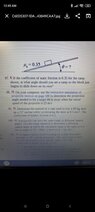
The problem involves determining the angle at which a block begins to slide down a ramp, given the coefficient of static friction. It falls under the subject area of friction and dynamics, specifically focusing on static and kinetic friction forces acting on an object on an inclined plane.
Discussion Character
- Exploratory, Conceptual clarification, Assumption checking
Approaches and Questions Raised
- Participants discuss the forces acting on the block, including gravitational force and frictional forces. There are attempts to express the conditions for sliding using equations related to static and kinetic friction. Some participants question the appropriateness of certain equations and the definitions of the forces involved.
Discussion Status
The discussion is ongoing, with participants providing insights into the forces at play and the conditions necessary for sliding. Some guidance has been offered regarding the distinction between static and kinetic friction, and the relevance of the normal force in this context. There is an exploration of the conceptual understanding of the problem, particularly regarding the angle at which the block transitions from rest to motion.
Contextual Notes
Participants are navigating through the definitions and applications of friction coefficients and the forces acting on an inclined plane. There is a recognition of the need for clarity on when to apply specific equations related to static friction.