Static electricity and method of seperating

Click For Summary

Homework Help Overview

The discussion revolves around the electrostatic separation of conducting and non-conducting spheres, focusing on the behavior of these materials when interacting with a charged roller.

Discussion Character

  • Conceptual clarification, Assumption checking

Approaches and Questions Raised

  • Participants explore the differences in charge behavior between conducting and non-conducting materials, questioning why conducting spheres fall off while non-conducting spheres require scraping. There is also discussion about the movement of charges within these materials.

Discussion Status

Some participants have provided insights into the behavior of charges in conductors versus non-conductors, suggesting that mobile charges in conductors can flow throughout the material, while non-conductors hold charge at the surface. Multiple interpretations of the underlying principles are being explored.

Contextual Notes

There is a lack of consensus on the exact mechanisms at play, and some assumptions about charge distribution and mobility in different materials are being questioned.

winston
Messages
2
Reaction score
0
The figure below shows an electrostatic method of separating conducting and non-conducting spheres
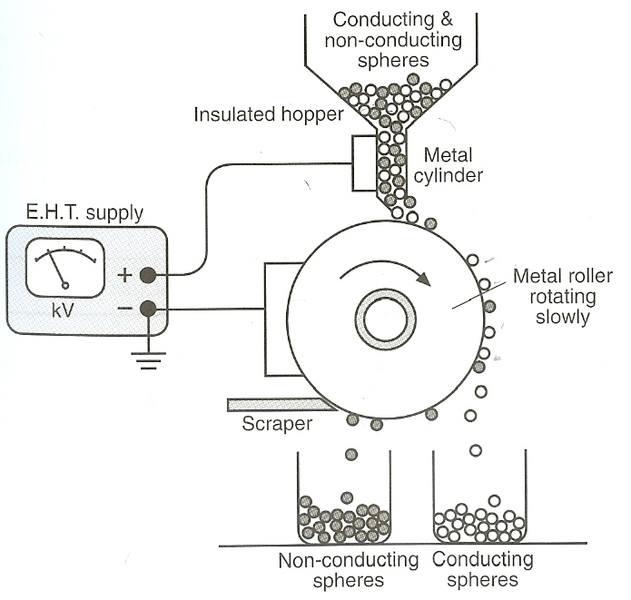
scan.jpg


Why do the conducting spheres fall off from the roller while the non-conducting spheres have to be scrapped off?


Thanks for the help.
Cheers,
Winston
 
Physics news on Phys.org
What is the significance of conducting?
 
Not too sure... Is the answer something about non-conductors holding the charge at the surface but charges in conductors flow throughout the material. But I thought that all the spheres will become negatively charged upon contact with the negatively charged roller.

HELP. THANKS
 
Is the answer something about non-conductors holding the charge at the surface but charges in conductors flow throughout the material.
Yes.

For the non-conducting material, the mobile charges (electrons) do not move so readily, so electrons will not flow onto the positively charged non-conducting material

In the 'conductor', the mobile charges (electrons) readily flow thus reducing the positive charge while the conducting material traverses the arc.
 

Similar threads

  • · Replies 3 ·
Replies
3
Views
6K
Replies
23
Views
5K
Replies
9
Views
3K
Replies
1
Views
2K
  • · Replies 1 ·
Replies
1
Views
4K
  • · Replies 7 ·
Replies
7
Views
3K
  • · Replies 0 ·
Replies
0
Views
906
  • · Replies 11 ·
Replies
11
Views
4K
  • · Replies 29 ·
Replies
29
Views
4K
  • · Replies 1 ·
Replies
1
Views
2K