Statically indeterminate (deflection)

Join the discussion
Registration is free. Start your own thread to ask a follow-up.
1 reply · 9K views · last reply
feedingjax
Messages
2
Reaction score
0
For these types of question, I know deflection equation is needed to find the reaction.
However, my question is that when should i use the max. deflection equation and when should i use only simple deflection equation for my calculation ?

Thank you very much!
Free-body diagram of a three-support beam with a pin support at A and roller supports at B and C, a downward point load F between A and B, and reactions HA, VA, VB and VC, with distances a, b and c marked along the beam.

Diagram of a propped cantilever beam fixed at left end A and supported by a roller at right end B, carrying a uniformly distributed load w downward, with EI marked, the reaction R_B upward at B, and the length L with x-axis from A.


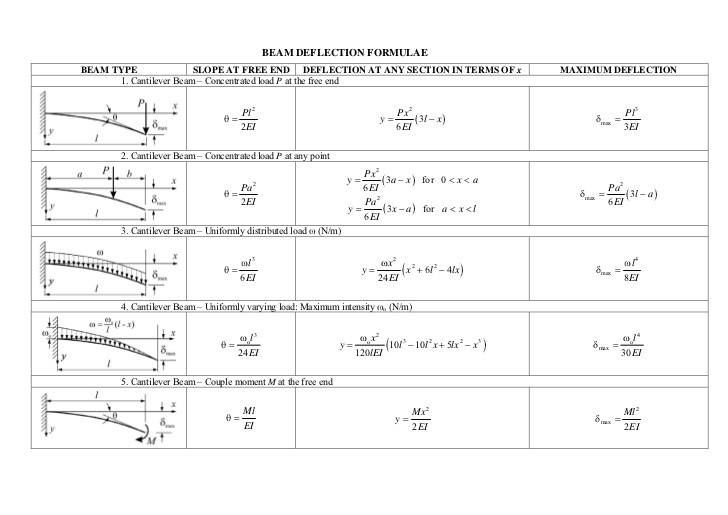
Table titled Beam Deflection Formulae listing slope at free end, deflection at any section in terms of x, and maximum deflection for cantilever beams under point load, partial point load, uniform load, varying load and couple moment.
 
Physics news on Phys.org
feedingjax said:
For these types of question, I know deflection equation is needed to find the reaction.
However, my question is that when should i use the max. deflection equation and when should i use only simple deflection equation for my calculation ?

Thank you very much!
Beam diagram with a pin support A at the left end, a roller support B and a roller support C, with a downward load F between A and B; reactions H_A, V_A, V_B and V_C are shown, with distances a, b and c marked along the beam.

Diagram of a fixed-support beam from A to B with a uniformly distributed downward load w, a pin-roller support at B with reaction R_B, flexural rigidity EI, and length L measured along an x axis.


Table titled Beam Deflection Formulae listing slope at free end, deflection along the beam and maximum deflection for cantilever beams under concentrated, uniformly distributed, uniformly varying and couple moment loads.

I think you are trying to be too choosy with your equations here.

Don't worry about which particular cases to use the max. deflection formula to solve an indeterminate problem. Pick the most general deflection formula for a particular beam and loading arrangement. If the location of the redundant support in question requires the use of a max. deflection formula, as in the case of the propped cantilever, then substituting the length of the cantilever into the general deflection equation should give the same equation as that for the max. deflection.

The max. deflection formulas in the table above are all special cases of the general deflection equation for the type of loading indicated for the cantilever. You should be able to verify this by evaluating the cantilever formulas above for x = L.