Stokes' Theorem and Curvature on a Torus

Click For Summary

Discussion Overview

The discussion revolves around the application of Stokes' theorem in the context of a torus, specifically examining the integration of a curvature form over a toroidal surface and the identification of boundaries associated with line integrals. Participants explore the geometric interpretation of the problem and the implications of boundary conditions.

Discussion Character

  • Exploratory
  • Debate/contested
  • Technical explanation

Main Points Raised

  • One participant questions whether the integration of the curvature form over the torus aligns with Stokes' theorem, particularly regarding the boundaries C1 and C2.
  • Another participant notes that both C1 and C2 are closed loops, suggesting that this supports the application of Stokes' theorem.
  • There is a clarification regarding the parameterization of the horizontal axis, indicating that the loops are indeed closed due to the identification of edges.
  • A participant describes the boundaries of the surface S, likening it to a ring with C2 as the outer boundary and C1 as the inner boundary.
  • Some participants express uncertainty about whether the described shape is a torus or a cylinder, with one arguing that if the top and bottom edges are not identified, it would be a cylinder.
  • Another participant asserts that if the surface were a torus, the integral of the curvature form would be zero due to the absence of boundaries.
  • One participant concludes that the shape discussed is more accurately described as a ring rather than a torus.

Areas of Agreement / Disagreement

Participants express differing views on whether the surface in question is a torus or a cylinder, leading to unresolved questions about the application of Stokes' theorem in this context. There is no consensus on the geometric classification of the surface.

Contextual Notes

Participants highlight the importance of boundary identification in the application of Stokes' theorem, with some assumptions about the geometry of the surface remaining unaddressed. The discussion reflects varying interpretations of the problem's setup and the implications for the theorem's applicability.

lichen1983312
Messages
85
Reaction score
2
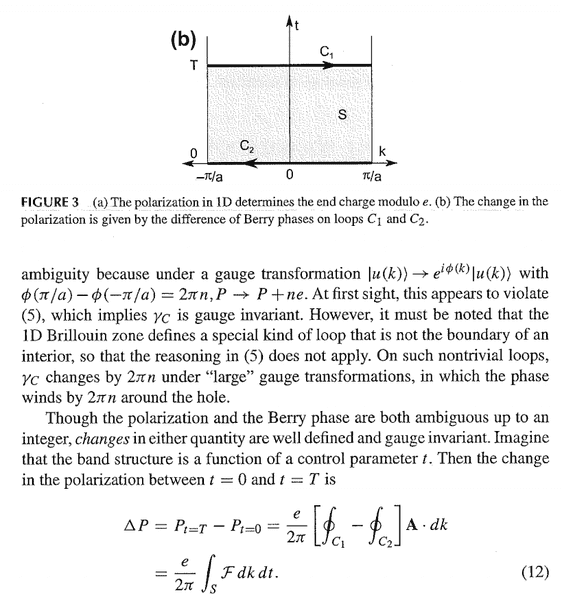
I am now looking at a physics problem that should be a use of stokes' theorem on a torus. The picture (b) here is a torus that the upper and bottom sides are identified as the same, so are the left and right sides. ##A## is a 1-form and ##F = dA## is the corresponding curvature. As is shown in the equation, the author says the integration of ##F## over the whole torus is the same thing as the difference between the two line integral along C1 and C2. Is this a case of stokes' theorem? I don't understand how C1 and C2 is the boundary of S. Please help.
Untitled-1.png
 
Physics news on Phys.org
Notice they using radial measure on the horizontal axis and they mention that the difference is ##2\pi##

That means C1 is a closed loop and C2 is a closed loop.

Does that make sense?
 
jedishrfu said:
Notice they using radial measure on the horizontal axis and they mention that the difference is ##2\pi##

That means C1 is a closed loop and C2 is a closed loop.

Does that make sense?
Sorry for the confusion, the horizontal axis is parameterized with angle, both C1 and C2 are closed loops because the left and right sides are identified.
 
So what don't you understand about the boundary of S? It's like a ring with C2 as the outer boundary and C1 as the inner boundary.

When they plot it using radial measure S looks like a rectangle.
 
So this is not a torus? I though the upper side and bottom side are identified as the same edge.
 
Stokes theorem for torus: ##\int_{\mathbb{T}^m} d\omega=0## :) The torus does not have boundary
 
lichen1983312 said:
So this is not a torus? I though the upper side and bottom side are identified as the same edge.

I do no think this is a torus. Rather, it seems to be a cylinder. The two vertical edges seem identified but the top and bottom do not. If so, then it is a case of Stokes Theorem because the boundary of this cylinder is ##C_1-C_2## or ##C_2-C_1## depending on the orientation.

If the top and bottom were also identified then you would have a torus but then the integral of ##dA## would be zero since as zwierz pointed out, the boundary of a torus is empty.

Another way to think of it is that if ##C_1## and ##C_2## are identified to make a torus then the integrals of ##A## along them would be the same except for a sign and would cancel out to give zero.
 
Last edited:
Hi guys, Thanks for the help, I think it really is a ring not torus.
 

Similar threads

  • · Replies 28 ·
Replies
28
Views
7K
  • · Replies 9 ·
Replies
9
Views
4K
  • · Replies 1 ·
Replies
1
Views
11K
  • · Replies 4 ·
Replies
4
Views
3K
  • · Replies 3 ·
Replies
3
Views
2K
  • · Replies 2 ·
Replies
2
Views
2K
  • · Replies 7 ·
Replies
7
Views
3K
  • · Replies 6 ·
Replies
6
Views
4K
  • · Replies 8 ·
Replies
8
Views
4K
  • · Replies 1 ·
Replies
1
Views
1K