Strange Relationships of the Circle

Click For Summary
SUMMARY

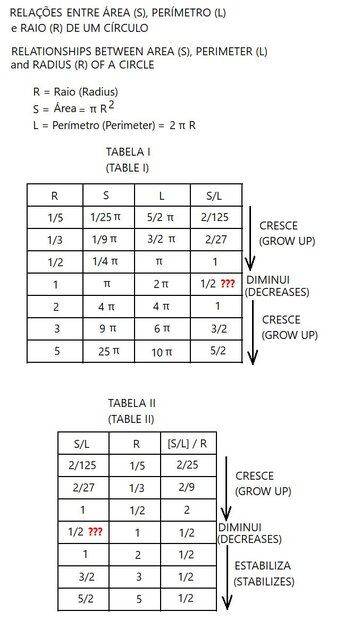
The discussion centers on the mathematical relationships between the area (S) and perimeter (L) of a circle, particularly how the ratios S/L and [S/L]/R vary with radius size (R). Key corrections were made regarding the perimeter values in the provided table, specifically that they should be 2/5π and 3/5π for the first two entries. The correct ratio S/L for R=1/2 is established as 1/4, not 1, highlighting the importance of unit consistency in mathematical expressions. The conversation emphasizes the need for accurate representation of geometric properties and encourages the use of appropriate symbols for clarity.

PREREQUISITES
  • Understanding of basic geometry concepts, particularly circles and their properties.
  • Familiarity with algebraic manipulation of formulas, specifically S = πR² and L = 2πR.
  • Knowledge of dimensional analysis to differentiate between area and length units.
  • Ability to interpret and correct mathematical tables and ratios.
NEXT STEPS
  • Study the implications of the square-cube law on geometric shapes.
  • Learn about dimensional analysis and its application in mathematical expressions.
  • Explore the use of different symbols in mathematics for clarity and precision.
  • Investigate common errors in mathematical tables and how to avoid them.
USEFUL FOR

Mathematicians, educators, students in geometry, and anyone involved in mathematical modeling or teaching who seeks to understand the relationships between geometric properties accurately.

dom_quixote
Messages
52
Reaction score
9
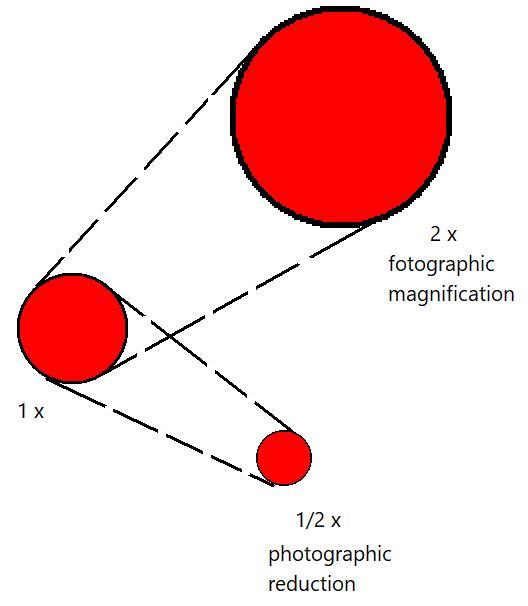
PHOTOGRAPHIC REDUCTION OR ENLARGEMENT
magno.JPG


The proportions of a circle never change. But...

radius.JPG


Question:
If a circle is always a circle, then how is it possible that the S/L and {[S/L]/R} ratios of a circle can vary as a function of the radius size?
 
  • Skeptical
Likes   Reactions: weirdoguy and PeroK
Mathematics news on Phys.org
Because they aren't unitless quantities. S has units of length squared and L has units of length, so when you double the length, they don't change the same way.
 
  • Like
  • Love
Likes   Reactions: mfb and dom_quixote
There are errors in your table for the perimeter. It should read 2/5π and 3/5π 2/3π for the first two. And S/L for R=1/2 is 1/4, not 1.
 
Last edited:
  • Like
Likes   Reactions: dom_quixote and berkeman
jack action said:
There are errors in your table for the perimeter. It should read 2/5π and 3/5π for the first two. And S/L for R=1/2 is 1/4, not 1.
##\frac 2 3 \pi## ?
 
  • Like
Likes   Reactions: dom_quixote and jack action
dom_quixote said:
If a circle is always a circle, then how is it possible that the S/L and {[S/L]/R} ratios of a circle can vary as a function of the radius size?
Try it with a square if you have problems understanding it for a circle. It's more a geometry question rather than physics.

Related topic:
https://en.wikipedia.org/wiki/Square–cube_law
 
  • Like
Likes   Reactions: dom_quixote and Nugatory
There are many basic arithmetic errors in your charts. The [S/L]/R column should always be 1/2, for instance.
 
  • Like
Likes   Reactions: dom_quixote, Nugatory and gmax137
In fact, I made a mistake :sorry:.
The corrected table is below:

rad_corr.JPG


Note in the TABLE I a singularity, when R=2/1:
S = L ?
Certainly not!
S expresses area;
L expresses length.

P.S.:
If there is another error in the table, I apologize for my numerical dyslexia :wink:!
 
Last edited:
  • Haha
Likes   Reactions: PeroK
How about applying some simple algebra before you make the tables?
Since ##S=\pi R^2## and ##L=2 \pi R## then ##\frac{S}{L} = \frac{\pi R^2}{2 \pi R} = \frac{R}{2}## and ##\frac{(\frac{S}{L})}{R} = \frac{1}{2}##.
That is all there is to this, now you can correct your tables.
 
  • Like
  • Love
Likes   Reactions: hutchphd, Nugatory, dom_quixote and 1 other person
dom_quixote said:
S = L ?
Certainly not!
S expresses area;
L expresses length.
They can have have the same numerical value (which is what your table shows), but different units (which your table doesn't show).

dom_quixote said:
If there is another error in the table, I apologize for my numerical dyslexia :wink:!
See post #6 and #8.
 
  • Like
Likes   Reactions: dom_quixote
  • #10
dom_quixote said:
Note in the TABLE I a singularity, when R=2/1:
S = L ?
Certainly not!
S expresses area;
L expresses length.
Why don't you use letters that more closely align with what they represent?
R is fine for radius, but why are you using S for area and L for length? Better would be A for area and P or C for either perimeter or circumference.
DaveE said:
How about applying some simple algebra before you make the tables?
Or even some simple arithmetic.
You have errors in the first two rows of table 1.
##2\pi \frac 1 5 \ne \frac{5\pi} 2##
##2\pi \frac 1 3 \ne \frac{3\pi} 2##
 
Last edited:
  • Like
Likes   Reactions: dom_quixote
  • #11
The initial questions have been asked and answered, so I'm closing this thread.
 
  • Like
Likes   Reactions: weirdoguy, jim mcnamara and PeroK

Similar threads

  • · Replies 2 ·
Replies
2
Views
2K
  • · Replies 28 ·
Replies
28
Views
3K
  • · Replies 1 ·
Replies
1
Views
1K
  • · Replies 2 ·
Replies
2
Views
2K
  • · Replies 7 ·
Replies
7
Views
2K
  • · Replies 4 ·
Replies
4
Views
2K
  • · Replies 22 ·
Replies
22
Views
4K
  • · Replies 0 ·
Replies
0
Views
469
  • · Replies 37 ·
2
Replies
37
Views
9K
  • · Replies 17 ·
Replies
17
Views
6K