Strength Testing Welded Steel Tubing and Bolts for a Weight Lifting Bench

Click For Summary

Discussion Overview

The discussion revolves around the structural integrity and load-bearing capacity of a welded steel tubing and bolt assembly used in a weight lifting bench. Participants explore the implications of design choices, including the use of bolts and the effects of cutting and overlapping the steel tubing.

Discussion Character

  • Technical explanation
  • Debate/contested
  • Experimental/applied

Main Points Raised

  • One participant describes the dimensions and modifications made to the steel tubing, expressing confidence in the bolts' ability to hold the structure together under expected loads.
  • Another participant raises concerns about the design, specifically the potential weakening of the steel due to multiple holes and the importance of considering shear forces and bearing stress in the bolted joint.
  • A later reply clarifies the dimensions of the overlapping metal and the positioning of the bolts, while asserting that the maximum load expected on the bench is significantly lower than the bolts' proof load.
  • The original poster questions whether cutting and bolting the leg has weakened it and considers the potential benefits of welding the joint instead.

Areas of Agreement / Disagreement

Participants express differing views on the safety and structural integrity of the modified design. There is no consensus on whether the modifications have weakened the leg or if welding would provide a stronger solution.

Contextual Notes

Participants note various factors that could affect the load-bearing capacity, including the spacing of holes and the friction forces in the bolted joint. There are unresolved questions regarding the specific load limits and failure modes of the materials involved.

Monkey
Messages
9
Reaction score
0
I had a piece of box section steel tubing, 400mm long, 5 x 10cm section, 3mm thick. It has a foot welded to the bottom which stabilises it at the floor (this is in red). It is a weight lifting bench.

I needed to shorten the length, so I cut it in two and overlapped a join, then fixed it with 3 x 14mm Bolts. I have attached a screenshot of what I have done. According to what information I can find on bolts they are capable of a proof load of more than 5000KG (M12 are 4890, M6 are 9100KG - I couldn't find data for 14mm).

How can I work out the load which can be applied to the bolts before they will fail? I´m thinking that the bolts are more than capable of holding the box section together and that in reality the box section would probably crease/bend before the bolts ever snapped.
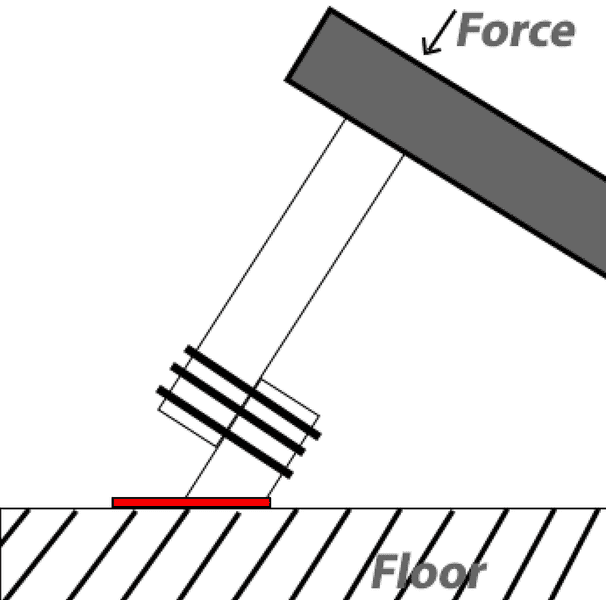
load.png
 
Engineering news on Phys.org
EDIT: (M12 are 4890, M16 are 9100KG - I couldn't find data for 14mm).
 
I think that's a high-risk design you have there. Off the top of my head, I would be worried about too many holes weakening the strut and your edge/hole and hole/hole spacing (I figure this isn't drawn to scale, but thought I'd mention it). The failure mode in the bolts will be shear, but remember that the bolted joint will have some friction force associated with it, so it'll increase the shear load that the joint can take before failure. I would think the bearing stress in the member would be pretty high as well. I think there's more to consider than just proof load of your bolts.
 
Yes, sorry, good point about the scaling. The overlapping part is actually much larger than the bolt diameter, each bolt is an M14mm and the overlapping metal is 90mm x 100mm. The bolts are also not on top of each other as the picture would indicate, there are 2 on top and one middle below - attached is a simplified image of the bolts position.

At the end of the day the maximum load the bench will probably ever take is 200KG - The original bench is rated at 270+KG, I haven't changed the angle of the leg at all, I just cut it down and overlapped the join as I needed it to be shorter

My view at the time was that the bolts are so strong that even with a direct shear load of 300kg per bolt they wouldn't shear, and as much as 300kg is never going to happen, not even 300kg for the whole joint. I suppose my real question is, have I weakened that leg by cutting and then bolting it?

If it is theoretically weaker, what if I welded the join?

Thanks for your feedback.
 

Attachments

  • Screen Shot 2014-09-27 at 8.24.04 AM.png
    Screen Shot 2014-09-27 at 8.24.04 AM.png
    2 KB · Views: 641

Similar threads

  • · Replies 36 ·
2
Replies
36
Views
4K
  • · Replies 3 ·
Replies
3
Views
3K
  • · Replies 11 ·
Replies
11
Views
4K
Replies
14
Views
10K
  • · Replies 12 ·
Replies
12
Views
17K
  • · Replies 3 ·
Replies
3
Views
3K
  • · Replies 3 ·
Replies
3
Views
5K
  • · Replies 3 ·
Replies
3
Views
18K
Replies
3
Views
4K
  • · Replies 6 ·
Replies
6
Views
5K