Stress Strain Diagram: Find Constants E, K, n, and α

Click For Summary
SUMMARY

The discussion focuses on determining the constants E, K, n, and α from a stress-strain diagram using specific equations: linear stress σ=Eε, uniform plastic stress σ=Kδ², and necking stress σ=αδ. The calculated value for E is 33.33 MPa. The values for K vary based on the chosen points in the plastic deformation region, with calculations yielding K=2.366864e10 and K=1.125e10. The challenge lies in the relationship between plastic strain δ and elastic strain ε, as the constants require σ(δ) rather than σ(ε).

PREREQUISITES
  • Understanding of stress-strain relationships in materials science
  • Familiarity with linear and plastic deformation concepts
  • Knowledge of mathematical modeling for curve fitting
  • Proficiency in using stress-strain equations for material constants
NEXT STEPS
  • Research the relationship between elastic strain ε and plastic strain δ in material deformation
  • Study the derivation and application of the Ramberg-Osgood equation for plasticity
  • Learn about curve fitting techniques for stress-strain data analysis
  • Explore methods for identifying maximum stress points in stress-strain diagrams
USEFUL FOR

Material scientists, mechanical engineers, and students studying material mechanics who are analyzing stress-strain relationships and determining material constants for engineering applications.

Dell
Messages
555
Reaction score
0
given the following points of the stress strain graph

points.JPG

and knowing that the stages are defined

linear σ=Eε
uniform plastic σ=Kδ2
necking σ=αδ

where ε is an elastic strain and δ plastic strain

find the values of the constants E K n α

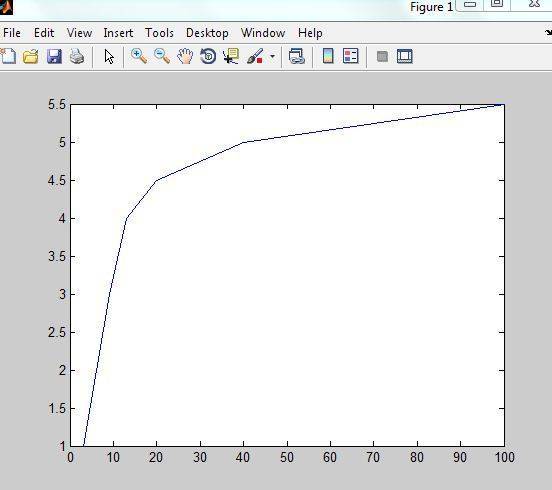
using the given data i plotted σ(ε) and got the following
Capture.JPG


now to find the constant E, i take the linear portion and find its incline, i get
E=33.33MPa

as for the others
for the platic deformation, can i take an of the points after (3,9) ?
for each point i chose i get a different value
K=σ/δ2
K=4e4/(13e-4)2=2.366864e10
K=4.5e4/(20e-4)2=1.125e10

is the necking portion not meant to be after a maximum point in the graph? in this graph i have no such point.
 
Physics news on Phys.org
Linear, curved, linear.
 
okay i see what you are saying, so then i can find the curve of the last part as i did for the first part, but how about the curved portion?
 
as i said for each point i take i get a different value
K=σ/δ^2
K=4e4/(13e-4)^2=2.366864e10
K=4.5e4/(20e-4)^2=1.125e10
 
i think that the problem is the relationship between δ and ε, since the graph i have and the data given is for is σ(ε), but the constants i need are for σ(δ) what is the connection between δ and ε?
i thought that δ=ε+c (c being the permanent deformation after the linear portion of the graph,) but i solved the equations using δ=ε+c

σ=αδ
σ=Kδ^2
using the given data

but i cannot solve for K, α, every time i plug in different data i get different values,

i have been using the 1st 3 sets of data for the 1st linear section
the second 3 sets for the parabolic section
the last 2 sets for the final linear section

clearly the δ cannot be raplaced directly by ε since when the stress=0 the function MUST also be 0, and the strain will not be 0 after plastic deformation, looking at the graph we can also see that the parabolic and linear sections will not reach (0,0)
i can find the functions for these curves as a function of the strain ε but not δ which i need in order to find the constants
 

Similar threads

  • · Replies 10 ·
Replies
10
Views
2K
  • · Replies 4 ·
Replies
4
Views
2K
Replies
1
Views
2K
  • · Replies 1 ·
Replies
1
Views
3K
  • · Replies 19 ·
Replies
19
Views
4K
  • · Replies 4 ·
Replies
4
Views
4K
Replies
3
Views
3K
Replies
1
Views
3K
Replies
6
Views
2K
  • · Replies 1 ·
Replies
1
Views
88K