Stress-Strain of Alloy with 100μm Nucleus Size

Click For Summary

Discussion Overview

The discussion revolves around determining the modulus of elasticity and yielding stress for an alloy with a specified nucleus size of 100 microns, based on a provided stress-strain diagram. Participants explore the implications of the nucleus size on these mechanical properties and the interpretation of the stress-strain relationship.

Discussion Character

  • Technical explanation
  • Debate/contested
  • Mathematical reasoning

Main Points Raised

  • One participant calculates the modulus of elasticity (E) as 200 GPa based on a given stress and strain, but expresses uncertainty about how to determine the yielding stress.
  • Another participant suggests ignoring the nucleus size information, indicating that yielding occurs where there is a deviation from the linear stress-strain relationship.
  • A participant questions the interpretation of deviation from linearity, suggesting that there may be a non-linear region before yielding.
  • One participant proposes using an imaginary linear line starting at 0.2% strain to estimate yielding stress.
  • Another participant agrees with the previous suggestion regarding the use of the 0.2% offset line to find yielding stress.
  • A participant assumes a strain of 0.003 for yielding stress and calculates a corresponding stress, but doubts its correctness based on the graph.
  • One participant states that the convention is to use the stress where the 0.2% offset line intersects the actual stress-strain curve.
  • Another participant expresses confusion about how to find the actual curve after the linear section of the graph.
  • A participant suggests that the actual curve can be read off visually from the graph.
  • One participant inquires if there is a method to calculate the curve rather than relying on visual interpretation.
  • A participant shares links to their previous posts for further context or clarification.

Areas of Agreement / Disagreement

Participants exhibit disagreement regarding the interpretation of the stress-strain relationship, particularly concerning the role of the nucleus size and the method for determining yielding stress. There is no consensus on how to proceed with the calculations or the significance of the non-linear region.

Contextual Notes

Participants express uncertainty about the assumptions underlying their calculations, particularly regarding the strain values and the nature of the stress-strain curve beyond the linear region. There are unresolved questions about the applicability of the nucleus size to the mechanical properties being discussed.

Dell
Messages
555
Reaction score
0
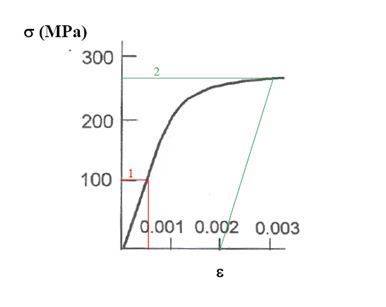
as depicted in the diagram below
stress-strain.JPG

the stress strain for an alloy with an average nucleus size of 100 micron
find
1)the modulus of elasticity for the alloy
2) the yielding stress


for 1) i assume that the red line is meant to be at 0.0005 therefore
E=dσ/dε=100e6/0.0005

E=200Gpa

for 2) i don't know what i can do, all that i do know is that the slant of the line from ε=0.002 to the point of σy is equal to 200Gpa (from the E i found before), but how can i use this to find the stress, i do not know the strain for σy, since i was given the nuclesu size i think i must somehow use that, but how??
 
Physics news on Phys.org
Ignore the 100 micron nucleus info. The sample yields where there is a deviation from a linear stress/strain relationship, right?
 
but how can i use that information, when you say a deviation from stress strain relationship, do you mean a deviation from the young modulus? i don't think that that's true, is there not a small portion where the line is not linear but before yielding?
even on the graph there is a portion between the linear section and the point marked as 2 with the green line
 
i think i need to use the imaginary linear line that starts at 0.2% and rises to yielding stress at a slant equal to E
 
Agreed.
 
now i assume that the apropriate strain for the yielding stress is 0.003, is that correct?

σ/0.001=E=200Gpa

σ=200MPa

is this correct? according to the graph it cannot be
 
It's simpler than that. The convention is to use the stress where the 0.2% offset line meets the actual stress-strain curve.
 
but i don't know the function of the actual curve, do you mean the linear section,
where
σ=200Gpa*ε
(ε=0.002)

σ=400MPa

dont think that's what you mean,

how can i find the curve after the linear section?
 
You read it off by eye.
 
  • #10
is there no way to calculate it?
 

Similar threads

Replies
19
Views
2K
  • · Replies 5 ·
Replies
5
Views
2K
  • · Replies 9 ·
Replies
9
Views
5K
Replies
1
Views
2K
  • · Replies 2 ·
Replies
2
Views
7K
  • · Replies 6 ·
Replies
6
Views
2K
Replies
5
Views
1K
  • · Replies 4 ·
Replies
4
Views
3K
  • · Replies 1 ·
Replies
1
Views
3K
  • · Replies 3 ·
Replies
3
Views
5K