Strong force as exchange of mesons, or of quark and antiquark

Click For Summary

Discussion Overview

The discussion revolves around the nature of the strong force between nucleons, specifically whether it can be described as the exchange of mesons or the exchange of quarks and antiquarks. Participants explore the implications of these descriptions and their consistency, focusing on the interpretation of Feynman diagrams and the representation of time and space within them.

Discussion Character

  • Debate/contested
  • Technical explanation
  • Conceptual clarification

Main Points Raised

  • One participant suggests that the strong force can be described by both the exchange of mesons and the exchange of quarks and antiquarks, questioning the consistency between these two interpretations.
  • Another participant asserts that Feynman diagrams do not have an actual time axis, only representing initial and final states, which raises questions about the interpretation of particle movement.
  • A different participant argues that there is indeed a vertical time axis in Feynman diagrams, suggesting that antiparticles move backwards in time, but questions whether the spatial direction indicated by arrows should be reversed for antiparticles.
  • One participant challenges the notion that antiparticles move backwards in time, indicating a disagreement on this conceptual point.
  • Another participant emphasizes that the only meaningful times in a Feynman diagram are the initial and final states, noting that the internal structure does not have a time ordering.

Areas of Agreement / Disagreement

Participants express differing views on the interpretation of Feynman diagrams and the nature of antiparticles, indicating that multiple competing views remain without a consensus on these points.

Contextual Notes

There are unresolved questions regarding the interpretation of time and space in Feynman diagrams, as well as the relationship between the exchange of mesons and quarks in the context of the strong force.

crick
Messages
39
Reaction score
4
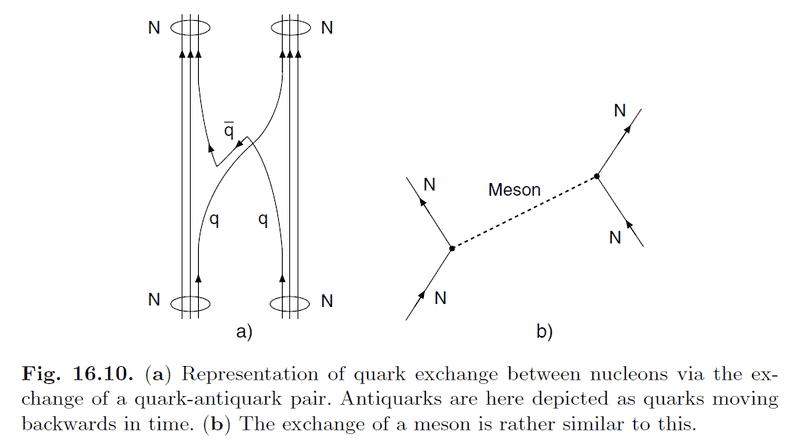
The (residual) strong force between nucleons can be desribed as

- The exchange of a meson (from a nucleon to the other), as in picture b)
- The exchange of a quark and an antiquark: in picture a) one nucleon "gives" a quark and receive an antiquark and it's the opposite for the other
2mK5f.png


I do no see how these two description are consistent with each other since in picture b) the meson (a quark + an antiquark) goes from one nucleon to the other, while in a) there is an exchange. So are these two interpretation equivalent? The nucleon that gives the quark also gives the antiquark (and therefore a meson) or receives it instead?
 

Attachments

  • 2mK5f.png
    2mK5f.png
    21.7 KB · Views: 1,139
Physics news on Phys.org
Same thing. You don't have an actual time axis anyway in these diagrams, only initial and final states.

Here is your meson going from left to right in the left diagram:

meson.png
 

Attachments

  • meson.png
    meson.png
    5.1 KB · Views: 1,128
  • Like
Likes   Reactions: crick
mfb said:
Same thing. You don't have an actual time axis anyway in these diagrams, only initial and final states.

Here is your meson going from left to right in the left diagram:

View attachment 227384

Thanks for the answer.

But there is actually a time axis and it is vertical (going from down to up). I'm aware that antiparticles move backwards in time (in the picture it moves downward a bit) but the fact is that it moves from left to right "in space".

Is this wrong? So actually (besides moving backwards in time) the direction in space indicated by the arrow in the feynman diagram should be reversed for an antiparticle?
 
crick said:
I'm aware that antiparticles move backwards in time

No they don't.
 
  • Like
Likes   Reactions: Klystron
crick said:
But there is actually a time axis and it is vertical (going from down to up).
The only meaningful times in a Feynman diagram are the initial and final states. Everything inside doesn't have a time ordering, and in fact you have to consider all times for all vertices for calculating such a diagram.
 

Similar threads

  • · Replies 1 ·
Replies
1
Views
1K
  • · Replies 9 ·
Replies
9
Views
4K
  • · Replies 2 ·
Replies
2
Views
2K
  • · Replies 9 ·
Replies
9
Views
2K
  • · Replies 14 ·
Replies
14
Views
4K
  • · Replies 4 ·
Replies
4
Views
3K
  • · Replies 4 ·
Replies
4
Views
2K
  • · Replies 10 ·
Replies
10
Views
3K
Replies
7
Views
2K
  • · Replies 5 ·
Replies
5
Views
2K