Submodules A + B and A intersect B .... Blyth Ch. 2

  • Context: Undergrad 
  • Thread starter Thread starter Math Amateur
  • Start date Start date
Click For Summary
SUMMARY

The discussion focuses on T. S. Blyth's "Module Theory: An Approach to Linear Algebra," specifically Chapter 2, which addresses the properties of submodules, their intersections, and sums. The claims in question state that the sum of two submodules, denoted as A + B, is the smallest submodule containing both A and B, while the intersection A ∩ B is the largest submodule contained in both. Participants seek formal proofs for these assertions, with one user providing a detailed explanation of how A + B is generated by the union of generating sets for A and B, and suggesting a similar approach for proving the properties of intersections.

PREREQUISITES
  • Understanding of module theory and submodules
  • Familiarity with generating sets in linear algebra
  • Knowledge of formal proof techniques in mathematics
  • Basic concepts of intersections and sums of sets
NEXT STEPS
  • Study the formal definitions of submodules in module theory
  • Learn about generating sets and their role in module construction
  • Explore the properties of intersections and sums in algebraic structures
  • Review proof techniques specific to algebraic structures, particularly in module theory
USEFUL FOR

Mathematicians, students of algebra, and educators seeking to deepen their understanding of module theory, particularly those interested in the properties and proofs related to submodules and their interactions.

Math Amateur
Gold Member
MHB
Messages
3,920
Reaction score
48
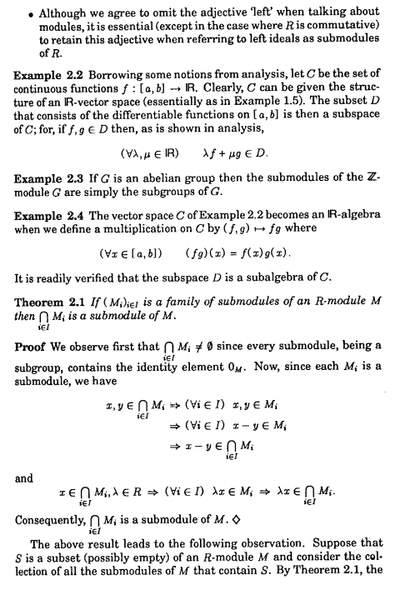
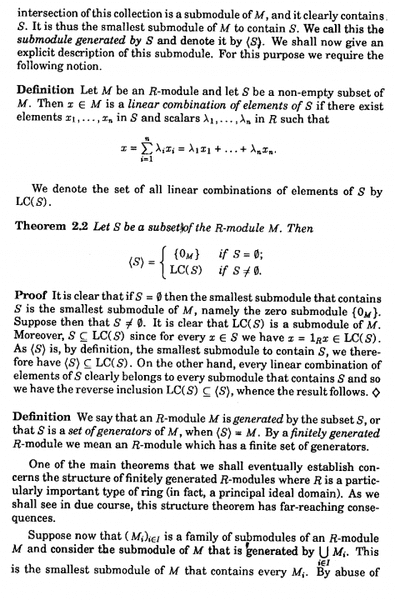
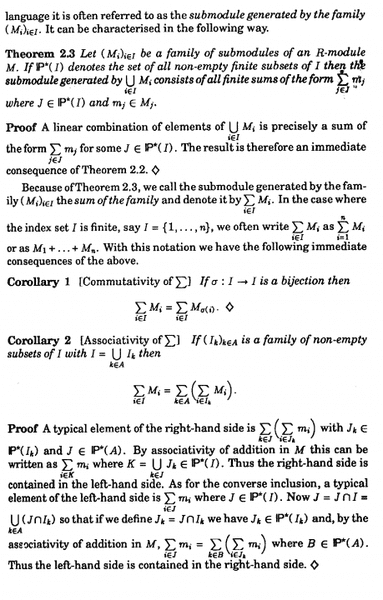
I am reading T. S. Blyth's book "Module Theory: An Approach to Linear Algebra" ... ... and am currently focussed on Chapter 2: Submodules; Intersections and Sums ... ...

I need help with understanding two claims that Blyth makes concerning submodules ...

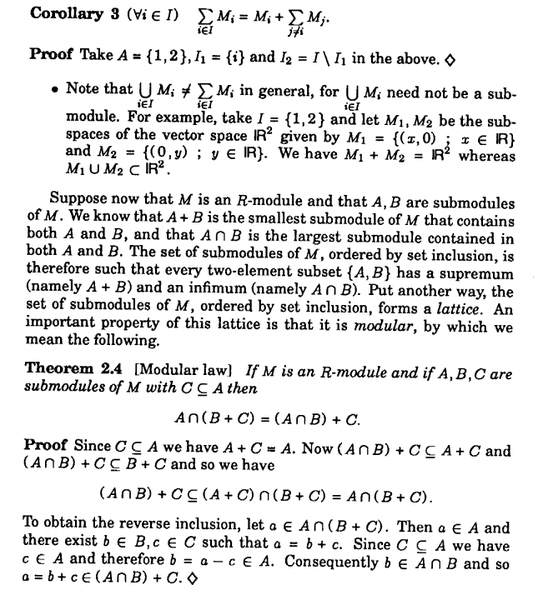
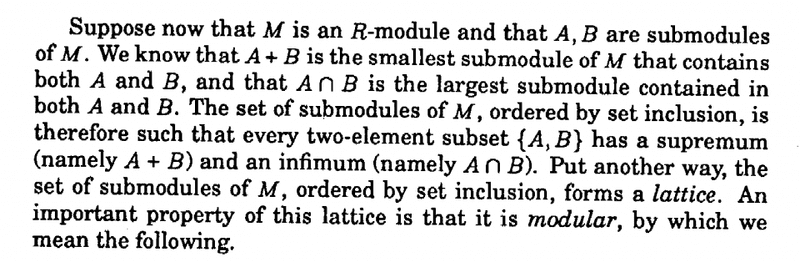
The relevant text is as follows: ( see end of post for other text that may be relevant)
?temp_hash=73c4113bcdd90e05481e0782497ccecb.png

I have two questions concerning the above text ... ...
Question 1In the above text we read:

" ... ... We know that ##A + B## is the smallest submodule of ##M## that contains both ##A## and ##B##, ... ... "My question is: how exactly do we know this ... ? How would we formally and rigorously prove this ... ?
Question 2In the above text we read:

" ... ... and that ##A \cap B## is the largest submodule contained in both ##A## and ##B##, ... ... "My question is: how exactly do we know this ... ? How would we formally and rigorously prove this ... ?Hope that someone can help with the above two questions ...

Peter

==============================================================================

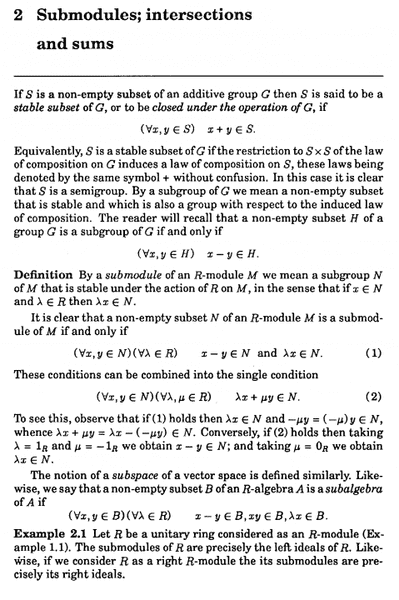
PS Just in case readers need to reference some of Blyth's definitions or theorems in Chapter 2, I am providing the relevant text as follows:
?temp_hash=73c4113bcdd90e05481e0782497ccecb.png

?temp_hash=73c4113bcdd90e05481e0782497ccecb.png

?temp_hash=73c4113bcdd90e05481e0782497ccecb.png

?temp_hash=73c4113bcdd90e05481e0782497ccecb.png

?temp_hash=73c4113bcdd90e05481e0782497ccecb.png
 

Attachments

  • Blyth - Modules  ch 2 .. A plus B ... and ... A intersect B ....png
    Blyth - Modules ch 2 .. A plus B ... and ... A intersect B ....png
    40.9 KB · Views: 629
  • Blyth - 1 - Chapter 2 - Page 1 ... ....png
    Blyth - 1 - Chapter 2 - Page 1 ... ....png
    39.4 KB · Views: 712
  • Blyth - 2 - Chapter 2 - Page 2 ... ....png
    Blyth - 2 - Chapter 2 - Page 2 ... ....png
    40.6 KB · Views: 735
  • Blyth - 3 - Chapter 2 - Page 3 ... ....png
    Blyth - 3 - Chapter 2 - Page 3 ... ....png
    52.9 KB · Views: 600
  • Blyth - 4 - Chapter 2 - Page 4 ... ....png
    Blyth - 4 - Chapter 2 - Page 4 ... ....png
    48.3 KB · Views: 636
  • Blyth - 5 - Chapter 2 - Page 5 ... ....png
    Blyth - 5 - Chapter 2 - Page 5 ... ....png
    67.3 KB · Views: 677
Physics news on Phys.org
Math Amateur said:
" ... ... We know that ##A+B## is the smallest submodule of ##M## that contains both ##A## and ##B##, ... ... "
My question is: how exactly do we know this ... ? How would we formally and rigorously prove this ... ?
How are ##A+B## and ##LC(A\cup B)## related?
Then given any submodule ##C \subseteq M## which contains both, ##A## and ##B##, does it contain ##LC(A\cup B)##? And why?

Math Amateur said:
" ... ... and that ##A \cap B## is the largest submodule contained in both ##A## and ##B##, ... ... "
My question is: how exactly do we know this ... ? How would we formally and rigorously prove this ... ?
By theorem 2.1 ##A\cap B## is a submodule of ##M##. Then how are ##A\cap B## and ##LC(A\cap B)## related?
Now given any submodule ##C##, that is contained in ##A## as well as in ##B##, is it contained in ##A\cap B## or ##LC(A\cap B)##? And why?

And at last: If you know all this about any possible submodule ##C \subseteq M##, what does it tell you?
 
  • Like
Likes   Reactions: Math Amateur
Proof of Q1.
Define A+B\equiv \{a+b\ :\ a\in A\wedge b\in B\}. This is easily shown to be closed under addition and scalar multiplication, and hence a module. It must be a subset of M because M is closed under addition and scalar multiplication and every element of A+B can be expressed as the addition or scalar, multiplication of elements of A and/or B, which are elements of M.

Let ##G_A## and ##G_B## be generating sets for ##A## and ##B## respectively. Then, by the definition of A+B, G_A\cup G_B is a generating set for A+B.

Let C be a submodule of M that contains A and B. Then C contains both G_A and G_B and hence contains G_A\cup G_B. Any element of A+B is a finite linear combination of elements of G_A\cup G_B and, since that union is in C which, being a module, is closed under finite linear combinations, the element must also be in C. So we have A+B\subseteq C.

I imagine the proof for Q2 may be similar but using intersections of generating sets rather than unions. Why not have a go at that and let me know if you get stuck.

Andrew
 
  • Like
Likes   Reactions: Math Amateur

Similar threads

  • · Replies 3 ·
Replies
3
Views
2K
Replies
1
Views
1K
  • · Replies 3 ·
Replies
3
Views
2K
Replies
2
Views
2K
  • · Replies 2 ·
Replies
2
Views
2K
  • · Replies 11 ·
Replies
11
Views
2K
  • · Replies 2 ·
Replies
2
Views
2K
Replies
8
Views
2K
  • · Replies 3 ·
Replies
3
Views
3K
  • · Replies 2 ·
Replies
2
Views
2K