Sum of Torque vs. Conservation of Angular Momentum Quick help needed

Click For Summary

Homework Help Overview

The discussion revolves around the concepts of torque and angular momentum, specifically in the context of a massless rod and the application of conservation laws in rotational dynamics.

Discussion Character

  • Mixed

Approaches and Questions Raised

  • Participants present calculations related to torque and angular momentum, questioning the correctness of their approaches and results. There is an exploration of moments of inertia for a massless rod, with some participants expressing uncertainty about the appropriate formulas to use.

Discussion Status

Some participants have provided feedback on the calculations, indicating that certain approaches may be correct while also questioning the use of specific moments of inertia. There is an ongoing dialogue about the definitions and assumptions related to the problem setup.

Contextual Notes

Participants note the constraints of the problem, including the massless nature of the rod and the presence of weights, which raises questions about the moments of inertia used in the calculations. There is also mention of the forum's guidelines regarding posting multiple questions in one thread.

riseofphoenix
Messages
294
Reaction score
2
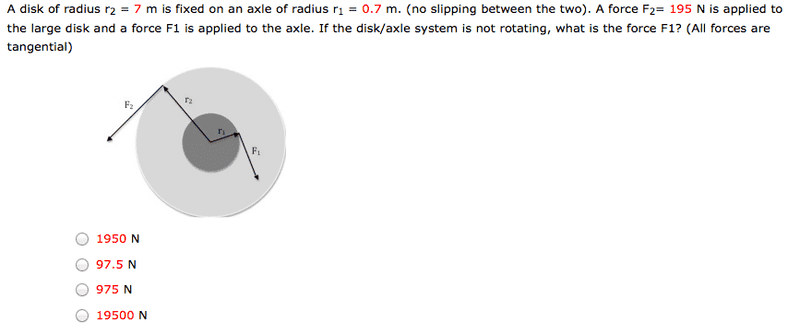
Number 11)

11.png


This is what I did:

Ʃτ = F2r2 + F1r1 = 0
(195)(7) + F1(0.7) = 0
F1(0.7) = -(195)(7)
F1 = -1365/0.7
F1 = -1950 N
F1 = 1950 N

Is that answer right?

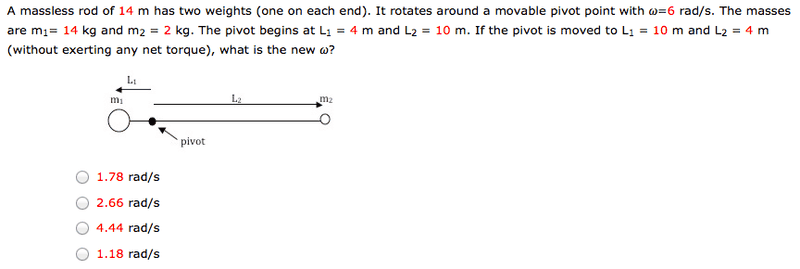
Number 12)
12.png


This is what I did:

Since this is a massless rod and the location of the axis is through the end, I = ML2

Linitial = Lfinal (Conservation of Angular Momentum)
(I1ω1 + I2ω2)initial = (I1ω1 + I2ω2)final
[ M1L12ω1 ] + [ M2L22ω2 ] = [ M1L12ω1 ] + [ M2L22ω2 ]
[ (14 kg)(4)2(6) ] + [ (2 kg)(10)2(6) ] = [(14 kg)(10)22) ] + [ (2 kg)(4)22) ]
1344 + 1200 = 1400(ω2) + 32(ω2)
2544 = 1432(ω2)
2544/1432= ω2
1.776 = ω2
1.78 rad/s = ω2

Is that right?

Number 13)

13.png


I think this one is right. I googled it...

Number 14)

14.png


fobserver = fsource [ (v + vobserver)/(v + vsource) ]
fobserver = 1550 [ (340 + 9 m/s)/(340 + 24 m/s) ]
fobserver = 1550(349/364)
fobserver = 1550(0.958791209)
fobserver = 1486 Hz

Is that right?
 
Last edited:
Physics news on Phys.org
riseofphoenix said:
Number 11)

11.png


This is what I did:

Ʃτ = F2r2 + F1r1 = 0
(195)(7) + F1(0.7) = 0
F1(0.7) = -(195)(7)
F1 = -1365/0.7
F1 = -1950 N
F1 = 1950 N

Is that answer right?
You're familiar enough with this site, that you should know by now that you shouldn't be posting 4 questions in one thread.

Your solution to problem appears to be correct.
 
riseofphoenix said:
Number 12)
12.png


This is what I did:

Since this is a long uniform rod and the location of the axis is through the end, I = (1/3)ML2

Linitial = Lfinal (Conservation of Angular Momentum)
(I1ω1 + I2ω2)initial = (I1ω1 + I2ω2)final
[ (1/3)M1L12ω1 ] + [ (1/3)M2L22ω2 ] = [ (1/3)M1L12ω1 ] + [ (1/3)M2L22ω2 ]
[ (1/3)(14 kg)(4)2(6) ] + [ (1/3)(2 kg)(10)2(6) ] = [ (1/3)(14 kg)(10)22) ] + [ (1/3)(2 kg)(4)22) ]
448 + 400 = 466.67(ω2) + 10.67(ω2)
848 = 477.34(ω2)
848/477.34 = ω2
1.776 = ω2
1.78 rad/s = ω2

Is that right?
I suspect that the answer is correct, but you used the wrong moments of inertia throughout.

Why do you have the 1/3 in all of them (moments of inertia) ? These are mass-less rods.
 
SammyS said:
I suspect that the answer is correct, but you used the wrong moments of inertia throughout.

Why do you have the 1/3 in all of them (moments of inertia) ? These are mass-less rods.
Wait but...what should they be then?
I've been looking online for "moment of inertia for massless rod" and I can't find anything other than (1/3)ML2

So it would just be ML2?
 
Last edited:
And sorry about posting 4 questions all in one post! I just needed someone to verify my work real quick

Is it ok if I ask you to check one very last thing for me? I promise it'll be quick
 
riseofphoenix said:
Wait but...what should they be then?
I've been looking online for "moment of inertia for massless rod" and I can't find anything other than (1/3)ML2

So it would just be ML2?
What is the mass of a massless rod?

The only objects with mass in problem 12 are the two weights.
 

Similar threads

Replies
3
Views
2K
  • · Replies 9 ·
Replies
9
Views
8K
  • · Replies 4 ·
Replies
4
Views
2K
  • · Replies 3 ·
Replies
3
Views
3K
  • · Replies 9 ·
Replies
9
Views
6K
Replies
4
Views
3K
  • · Replies 4 ·
Replies
4
Views
5K
  • · Replies 9 ·
Replies
9
Views
16K
Replies
5
Views
9K
  • · Replies 11 ·
Replies
11
Views
3K