Sun's Shrinkage due to Gravity: Visualize the Impact

Click For Summary

Discussion Overview

The discussion revolves around the visual effects of the sun's gravitational field on its apparent size as observed from Earth. Participants explore concepts related to gravitational lensing, the bending of light, and the implications for both the sun and more massive celestial bodies, such as giant stars and galaxies.

Discussion Character

  • Exploratory
  • Debate/contested
  • Conceptual clarification

Main Points Raised

  • Some participants propose that the sun appears smaller due to the bending of light by its gravitational field, leading to a barrel distortion effect.
  • Others question the reasoning behind the sun appearing smaller, suggesting that light rays from the perimeter of the sun might bend toward the observer, potentially making the sun look larger instead.
  • A later reply introduces the idea that gravitational distortion could reveal more of the sun's far hemisphere, which might contribute to it appearing larger.
  • Some participants discuss the independence of visual size from the parts of the object sending rays, emphasizing the angle at which rays arrive at the observer's eye.
  • There is a suggestion to consider the effects of gravitational lensing on massive objects like galaxies, questioning whether they would appear uniformly magnified or exhibit radial distortion.
  • One participant asserts that light emitted radially from the sun would not be bent, only slowed due to gravitational effects, while another challenges this claim by illustrating the path of light rays from the sun to an observer.

Areas of Agreement / Disagreement

Participants express differing views on whether the sun appears smaller or larger due to gravitational effects, with no consensus reached on the matter. The discussion remains unresolved regarding the implications of gravitational lensing for both the sun and other massive celestial bodies.

Contextual Notes

Participants rely on various assumptions about light behavior and gravitational effects, and there are unresolved questions about the specifics of light bending and visual perception in this context.

B0b-A
Messages
155
Reaction score
32
How much smaller does the sun appear because of it's gravitational field ?
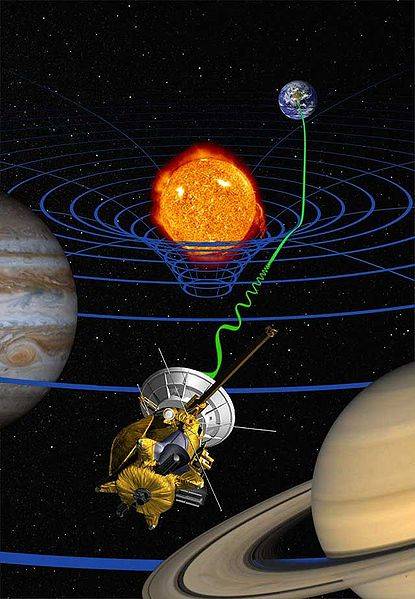
415px-Cassini-science-br.jpg


This illustration shows EM waves being bent by the gravitational well of the sun.

The light from the sun itself will also be bent by its gravitational well, making the sun appear smaller , ( and have barrel distortion ).

So how much smaller does the sun's disc appear, compared with it's true diameter ?.

[ Next question: what will be the shrinkage with giant stars whose mass is 1000x suns ? ].
 
Physics news on Phys.org
B0b-A said:
making the sun appear smaller
Why smaller?
 
A.T. said:
Why smaller?
I thought the rays from the perimeter of the sun would be bent by gravity toward the observer-sun axis , making the sun look smaller when viewed from Earth* , [ * not an atmospheric effect , for the purposes of this question assume Earth has no atmosphere ].
 
B0b-A said:
I thought the rays from the perimeter of the sun would be bent toward the observer-sun axis, making the sun look smaller when viewed from Earth
Why would that make the Sun look smaller?
 
A.T. said:
Why would that make the Sun look smaller?
by your repetition are you subtly hinting that I've got the wrong end of the stick and the sun appears larger because of gravitational lensing ?.
 
Hmm, it just occurred to me that the edges of the far hemisphere of the sun would become visible from Earth because of the gravitational distortion : that would make the sun appear bigger.
 
Last edited:
B0b-A said:
Hmm, it just occurred to me that the edges of the far hemisphere of the sun would become visible from Earth because of the gravitational distortion : that would make the sun appear bigger.
The visual size depends on the angle at which the most outer rays arrive at the eye, not on which parts of the object send these rays. In general these two things are independent, but in this case they happen to coincide: you see the sun bigger and more parts of it.
 
A.T. said:
The visual size depends on the angle at which the most outer rays arrive at the eye, not on which parts of the object send these rays. In general these two things are independent, but in this case they happen to coincide: you see the sun bigger and more parts of it.

What would be the effect on something really massive like a galaxy ? :
would it just appear uniformly magnified ?, or with radial distortion, ( see attached) ...

how different is real shape of galaxy from how it appears.jpg
 
Last edited:
  • #10
B0b-A said:
How much smaller does the sun appear because of it's gravitational field ?

415px-Cassini-science-br.jpg


This illustration shows EM waves being bent by the gravitational well of the sun.

The light from the sun itself will also be bent by its gravitational well, making the sun appear smaller , ( and have barrel distortion ).

So how much smaller does the sun's disc appear, compared with it's true diameter ?.

[ Next question: what will be the shrinkage with giant stars whose mass is 1000x suns ? ].
Light coming out of the Sun is moving [em]radially[/em] with respect to the Sun, so it won't be bent, only "slowed" so to say. To be bent its direction vector has to have tangential component.

Edit: by "slowed" I mean gravitational redshift, of course.
 
  • #11
Tajimura said:
Light coming out of the Sun is moving [em]radially[/em] with respect to the Sun, so it won't be bent, only "slowed" so to say. To be bent its direction vector has to have tangential component.

This is incorrect. Draw yourself a picture of a ray coming from the edge of the sun to an observer on Earth. It is certainly not moving radially.
 

Similar threads

  • · Replies 29 ·
Replies
29
Views
2K
  • · Replies 4 ·
Replies
4
Views
3K
Replies
17
Views
4K
Replies
5
Views
2K
  • · Replies 73 ·
3
Replies
73
Views
16K
  • · Replies 8 ·
Replies
8
Views
8K
  • · Replies 21 ·
Replies
21
Views
6K
  • · Replies 12 ·
Replies
12
Views
3K
  • · Replies 4 ·
Replies
4
Views
5K
  • · Replies 1 ·
Replies
1
Views
4K