Super Capacitor Charging/Discharging

  • Thread starter Thread starter Akmalidin
  • Start date Start date
  • Tags Tags
    Capacitor
Click For Summary
SUMMARY

The discussion centers on the challenges of using supercapacitors for charging a phone, specifically a supercapacitor with a capacitance of 100F and a maximum voltage of 2.7V. Users noted that the charging current was low (around 700mA) and that connecting the phone while charging the capacitor resulted in even slower charging. Key points include the importance of low Equivalent Series Resistance (ESR) for high current output and the implications of connecting capacitors in series versus parallel. The conversation highlights the need for proper circuit design to prevent exceeding voltage ratings and ensure balanced charging of capacitors.

PREREQUISITES
  • Understanding of supercapacitor specifications, including capacitance and voltage ratings.
  • Knowledge of circuit design principles, particularly regarding series and parallel connections.
  • Familiarity with Equivalent Series Resistance (ESR) and its impact on current output.
  • Basic grasp of Ohm's Law and its application in electrical circuits.
NEXT STEPS
  • Research supercapacitor datasheets to understand ESR variations among different models.
  • Explore circuit designs that ensure balanced charging for capacitors connected in series.
  • Investigate supercapacitors with higher voltage ratings and their capacity characteristics.
  • Learn about the effects of voltage drop on charging efficiency when using capacitors.
USEFUL FOR

Electronics engineers, hobbyists designing charging circuits, and anyone involved in energy storage solutions using supercapacitors.

Akmalidin
Messages
69
Reaction score
6
Hello,
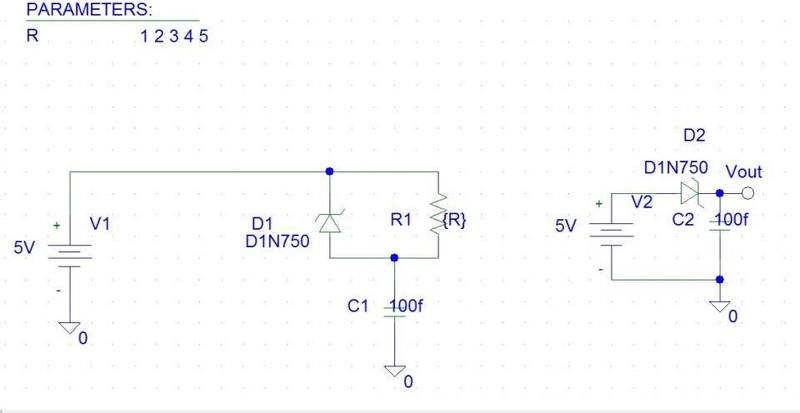
cap.jpg


I am designing a phone charger with super capacitor with capacitance C=100F. The max voltage of cap is 2.7 V. When I charge the capacitance and then charge my phone, it is charging really slowly with low current (around 700mA). However, as I read, capacitance should output high current. The other thing is, when I charge my capacitor while phone is connected to it, it is charging itself then charging my phone slowly. Please let me know how I can make my cap output more current to charge my phone. The schematics are below. I used both . Please share your experience and give advice.
 
Engineering news on Phys.org
Akmalidin said:
... capacitance should output high current ...
No, not at all. A capacitor in an open circuit output no current at all. A cap in a high impedance circuit outputs very little current. A cap in a very low impedance circuit outputs high current (briefly).
 
Yes you are right. Supercap has a low ESR .
 
Akmalidin said:
Yes you are right. Supercap has a low ESR .
It has nothing to do with whether it is a "super" cap, it just has to do with the fundamental characteristics of caps.
 
Akmalidin said:
Yes you are right. Supercap has a low ESR .
I'm not sure all supercaps have low ESR. Check the datasheet to be sure...

https://en.wikipedia.org/wiki/Supercapacitor
The first supercapacitor with low internal resistance was developed in 1982 for military applications through the Pinnacle Research Institute (PRI), and were marketed under the brand name "PRI Ultracapacitor". In 1992, Maxwell Laboratories (later Maxwell Technologies) took over this development. Maxwell adopted the term Ultracapacitor from PRI and called them "Boost Caps"[11] to underline their use for power applications.
 
berkeman said:
I'm not sure all supercaps have low ESR.
Sure, but what I'm trying to get him to realize is that the ESR might well be a red herring in this case, because he doesn't seem to understand Ohm's Law and expects a high Farad cap to produce lots of current regardless of what it's hooked to.
 
  • Like
Likes   Reactions: berkeman
I believe most super caps have a relatively high ESR. The trend has been that the ESR is dropping, but from one cap to the next super caps do not typically have a very low ESR.
 
  • Like
Likes   Reactions: berkeman
When I said low ESR, i compared them to batteries so caps outputs higher current. Please give a feedback the circuit I am using to charge my supercap.
 
Ok, the circuit you are using to charge the cap will destroy it. There is nothing to prevent the voltage from exceeding 2.7 volts when being charged from a 5 volt source.
 
  • #10
Oh sorry, I forgot to mention that I am using two of caps connected in parallel. SO they form 5.4V together.
 
  • #11
Akmalidin said:
Oh sorry, I forgot to mention that I am using two of caps connected in parallel. SO they form 5.4V together.
No they don't.
 
  • #12
I meant in series connection.
 
  • #13
Probably best to draw it that way then. And do you have anything to guarantee that they will charge equally? What is the spec on the caps for tolerance? If their capacitances differ then one will charge to a higher voltage than the other.
 
  • #14
Akmalidin said:
I meant in series connection.
That's probably not a good idea. As ASN points out, there are symmetry issues with it, and the way you usually handle that is with resistors in parallel around the caps, which robs charge and power in the overall circuit. Do they not make supercaps with a rating > 5V?
 
  • #15
There are caps with 5 v but with lower capacity.
 
  • #16
Akmalidin said:
There are caps with 5 v but with lower capacity.
And what is the straightforward way to increase that capacity and keep the 5V (plus margin) rating?... :smile:
 
  • #17
I gues adding the caps in paralel.
 
  • Like
Likes   Reactions: berkeman
  • #18
Akmalidin said:
When I charge the capacitance and then charge my phone, it is charging really slowly
A separate issue to consider: when you power anything from a capacitor that was initially charged to 5V, after the capacitor has given up just 10% of its charge then its voltage will have dropped by 10%. So, I'm wondering is 4.5V still going to be any good for charging a phone?

Or maybe you have this solved ... ?
 
  • #19
4.5V is giving out about 800ma to charge but it is varying (going down). But I think when the current is over 600ma ,the phone can be charged
 
  • #20
An interesting thing to note is that you were planning on putting higher value caps in series. And you avoided the higher voltage caps because they had smaller capacitances. Do you know what happens to total capacitance when capacitors are placed in series?
 

Similar threads

  • · Replies 6 ·
Replies
6
Views
743
  • · Replies 30 ·
2
Replies
30
Views
3K
  • · Replies 4 ·
Replies
4
Views
2K
  • · Replies 2 ·
Replies
2
Views
1K
  • · Replies 14 ·
Replies
14
Views
6K
  • · Replies 2 ·
Replies
2
Views
2K
  • · Replies 2 ·
Replies
2
Views
2K
  • · Replies 15 ·
Replies
15
Views
2K
  • · Replies 4 ·
Replies
4
Views
2K
Replies
2
Views
2K