Supersonic electric propulsion systems for airliners

Click For Summary
SUMMARY

The discussion centers on the feasibility of supersonic electric propulsion systems for airliners, particularly focusing on concepts proposed by Elon Musk. Key statistics indicate that replacing Jet A fuel with batteries could reduce operating costs by 60-80%, emissions by 80%, and runway needs by 40%, as reported by Zunum Aero. Current battery technology limits practical applications to short-haul flights, while hydrogen fuel cells are identified as a promising alternative for longer distances. The conversation highlights the challenges of achieving supersonic speeds with electric propulsion, emphasizing that significant technological advancements are required before such systems can be realized.

PREREQUISITES
  • Understanding of electric propulsion technologies
  • Familiarity with current battery technologies and their limitations
  • Knowledge of hydrogen fuel cells and their applications in aviation
  • Awareness of supersonic flight dynamics and challenges
NEXT STEPS
  • Research advancements in hydrogen fuel cell technology for aviation
  • Explore the principles of Magnetohydrodynamics (MHD) in propulsion systems
  • Investigate the VASIMIR rocket thruster and its potential applications
  • Study the impact of high-altitude flight on range and drag reduction
USEFUL FOR

Aerospace engineers, aviation industry professionals, and researchers interested in the future of electric propulsion and supersonic flight technologies.

Xforce
Messages
73
Reaction score
6
TL;DR
Electric jet liners may sound eco-friendly, however they are small, slow and weak... if power isn’t a major problem, what can we use?
Tesla+SpaceX= supersonic VTOL suborbital electric jet?
“I have an idea for a vertical takeoff and landing supersonic jet.”

Elon Musk, every time the subject of electric planes comes up, to include almost never using the VTOL abbreviation for some reason that’s probably very unimportant.

Statistics:Swapping Jet A (kerosine plane fuel) for a battery can bring a reduction of 60-80% in operating costs, 80% lower emissions and noise, and a 40% reduction in runway needs (not including VTOL), according to numbers crunched by one of the startups in the nascent electric aviation industry, Zunum Aero. Also, around 75% of all flights are domestic, and out of those, around half are under 700 miles and 20% are under 350 miles.
This is a picture of the proposed sub-orbital, supersonic electric jet, looking rather like the MHD Ayaks jet from USSR
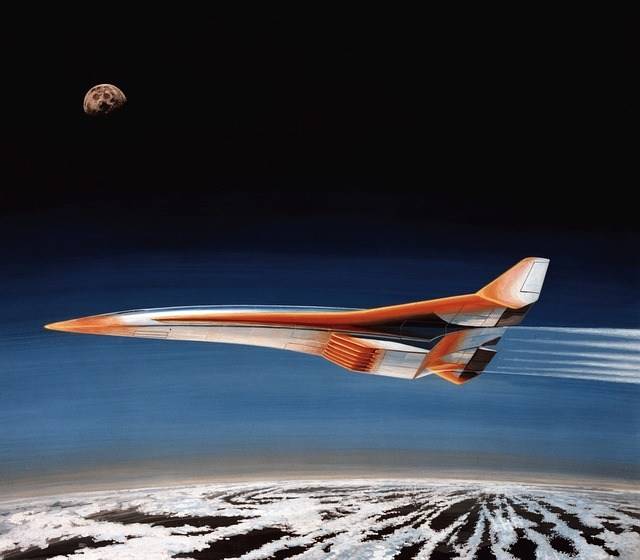
14E07303-5054-46D0-81B0-BF577F1572D1.jpeg

How would we achieve supersonic speeds using just electric propulsion? What could the Musk jet be?
Propellers? Certainly not, just like the first generation of planes and common amongst electric planes. This method usually only achieve velocities below 300 knots (154m/s). The fastest turboprop plane was the Tu-95 I think, which the top speed was about the same speed as cruising speed of a turbofan airliner. Still, it’s impossible to reach supersonic speeds with propellers, since long before breaking the sound barrier, air around the propellers already reaches supersonic speeds (which is troublesome)
 
Physics news on Phys.org
NASA 30 years ago had a good academic research effort focused on space based solar power, sending the power back to Earth by microwaves or lasers. There was a summary of the main papers published under the rubric of 'Radiant energy conversion in space'.
One extension of this concept was for aircraft powered from space. So electric, albeit in a somewhat roundabout way. If ever the climate change pressures get too much, perhaps these ideas will get resurrected.
 
etudiant said:
NASA 30 years ago had a good academic research effort focused on space based solar power, sending the power back to Earth by microwaves or lasers. There was a summary of the main papers published under the rubric of 'Radiant energy conversion in space'.
One extension of this concept was for aircraft powered from space. So electric, albeit in a somewhat roundabout way. If ever the climate change pressures get too much, perhaps these ideas will get resurrected.
Emm, this idea of supersonic electric jet is from Elon... and I don’t think it involves beaming power from space. Also, I’m trying to ask what kind of propulsion might it use.
 
Xforce said:
Statistics:Swapping Jet A (kerosine plane fuel) for a battery can bring a reduction of 60-80% in operating costs, 80% lower emissions and noise, and a 40% reduction in runway needs (not including VTOL), according to numbers crunched by one of the startups in the nascent electric aviation industry, Zunum Aero...
This is a picture of the proposed sub-orbital, supersonic electric jet, looking rather like the MHD Ayaks jet from USSR
You are mixing and matching different predictions (not statistics) and examples. Please do a better job of being more rigorous and accurate in your analysis/reporting.
 
I
russ_watters said:
You are mixing and matching different predictions (not statistics) and examples. Please do a better job of being more rigorous and accurate in your analysis/reporting.
mean according to that picture, it looks like a MHD. Not meaning that it (a Tesla/SpaceX passenger jet) is a similar thing as that Russian spy plane. And I’m skeptical about that picture as a concept. I just want to show that such concept of a supersonic (actually, hypersonic, as it goes at 4000m/s , around Mach 12) electric jet does exist before, and MHD is a really feasible way.
 
There may be concepts, but they should be at least vaguely feasible.
Current battery technology may allow short hop propeller driven commercial flight. Long haul is still far from any practical stage, hydrogen fuel cells appear to be the most promising power source, supplying electric motor driven fans. Supersonic flight is much more demanding still, because it requires gobs of power, so much that we are not close to a new supersonic transport, fossil fueled or electric, hypersonic steps that up another notch.
So the dreams of electrically powered hypersonic jetliners will remain dreams for at least a couple of decades, too many pieces are missing to make a technically feasible design.
 
  • Like
Likes   Reactions: russ_watters
etudiant said:
There may be concepts, but they should be at least vaguely feasible.
Current battery technology may allow short hop propeller driven commercial flight. Long haul is still far from any practical stage, hydrogen fuel cells appear to be the most promising power source, supplying electric motor driven fans. Supersonic flight is much more demanding still, because it requires gobs of power, so much that we are not close to a new supersonic transport, fossil fueled or electric, hypersonic steps that up another notch.
So the dreams of electrically powered hypersonic jetliners will remain dreams for at least a couple of decades, too many pieces are missing to make a technically feasible design.
I want to know the propulsion tech that enables supersonic/hypersonic electric propulsion. Propellers won’t do. I was considering about MHD like stuff
Also flying at high speeds and high altitudes increases the range (less time and less drag) which enables longer ranges, also maybe continuous boost-glide and sub-orbital hops will increase the range even more.
If you’re talking many decades away, probably when things like MHD is mature technology, fusion will also be ready and it enables nearly unlimited range.
This is how MHD works. although the flying craft isn’t a saucer, but if it’s supersonic and it’s VTOL, probably it is.
7AADF622-715B-494B-9A64-A1CA23914CDD.png
 
Last edited:
MHD in propulsion is an electrically accelerated plasma flow. The concept is closest to implementation afaik
with the VASIMIR rocket thruster, which NASA is funding but which has not yet flown.
Sadly the posted picture is so absurdly simplified it is hard to relate to MHD in any way. Indeed, it seems to represent some purely electromagnetic components, with no discernible propulsion element. Nor any indication why the Laplace forces highlighted would provide such propulsion.
 
  • Informative
Likes   Reactions: anorlunda

Similar threads

  • · Replies 139 ·
5
Replies
139
Views
29K
  • · Replies 5 ·
Replies
5
Views
4K
Replies
4
Views
3K
  • · Replies 35 ·
2
Replies
35
Views
8K
Replies
16
Views
6K
  • · Replies 10 ·
Replies
10
Views
5K
  • · Replies 1 ·
Replies
1
Views
4K