Surface area - Double integrals

Click For Summary
The discussion centers on calculating the surface area of a spherical segment defined by the sphere equation x² + y² + z² = 16, specifically between the planes z = 2 and z = -2√3. Participants debate whether to include the areas of the flat surfaces at the top and bottom or focus solely on the curved surface of the sphere. Suggestions include using spherical coordinates for simplification and performing surface integrals over each section of the surface. There is a consensus that only the curved surface area should be calculated, and the conventional method for evaluation involves integrating over the appropriate circular regions in the x-y plane. The conversation emphasizes the importance of understanding different coordinate systems for effective integration.
etf
Messages
179
Reaction score
2
Hi!
Here is my task:
Calculate surface area of sphere $$x^{2}+y^{2}+z^{2}=16$$ between $$z=2$$ and $$z=-2\sqrt{3}$$.
Here are 3D graphs of our surfaces:
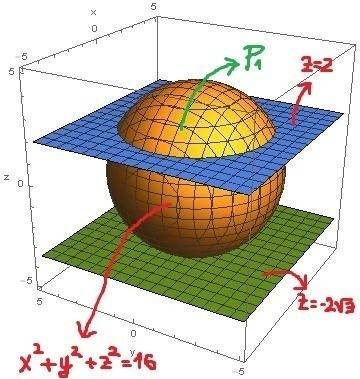
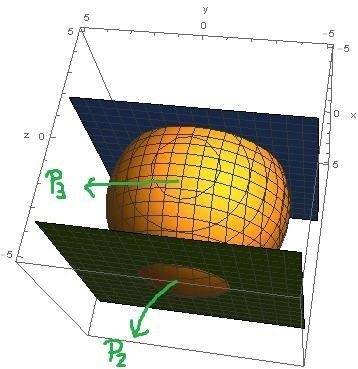
1.jpg


2.jpg


Surface area of interest is P3. It would be P-(P1+P2), where P is surface area of whole sphere. Is it correct?
Here is how I calculated P1:
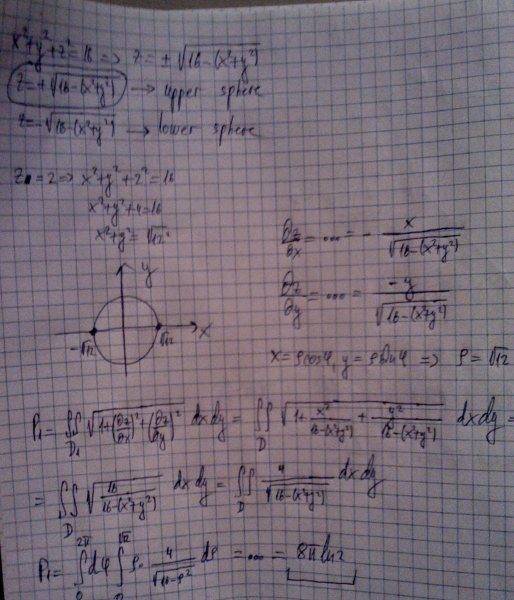
33.jpg


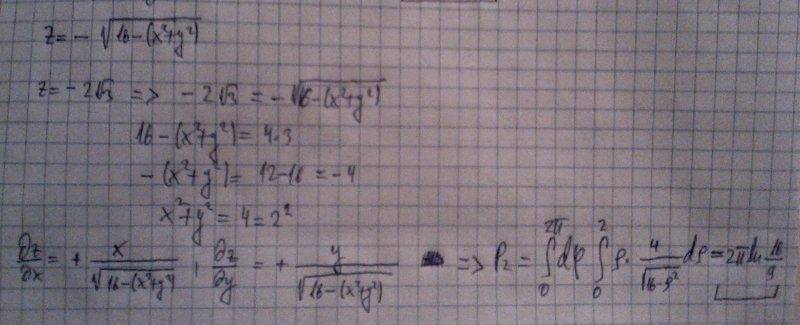
Similarly for P2:

22.jpg


We calculate P using formula 4pi*r*r.
Is it correct?
 
Physics news on Phys.org
Can't really decipher your answer. It looks like 2πscribble.
 
P1=8*pi*ln2, P2=2*pi*ln(16/9), P=4*pi*16
P=4*pi*16-(8*pi*ln2+2*pi*ln(16/9))=201.0619-21.0358=180.0261
 
etf said:
P1=8*pi*ln2, P2=2*pi*ln(16/9), P=4*pi*16
P=4*pi*16-(8*pi*ln2+2*pi*ln(16/9))=201.0619-21.0358=180.0261
You can check your result using the formula in this article:

http://en.wikipedia.org/wiki/Spherical_segment

It seems there is a disagreement somewhere in your calculations between the formula and your result.
 
etf, have you given any consideration to working the problem in spherical coordinates? You can calculate it directly in about two steps.
 
I'm not familiar with spherical coordinates :(
 
Doing multiple integrals and not being familiar with integral transforms is not a good thing. Polar, spherical and cylindrical co-ordinates are important to be able to integrate properly, and without them, you won't get very far.

An interesting way to do this problem is to describe each face of the surface and then perform a surface integral over each one:

$$\iint_S \space dS = \iint_{S_1} \space dS_1 + \iint_{S_2} \space dS_2 + \iint_{S_3} \space dS_3$$

So you have a flat top surface ##S_1## described by the plane ##z = 2## and bounded by the region ##D_1## given by ##x^2 + y^2 = 12##. You also have a flat bottom surface ##S_2## describe by the plane ##z = -2 \sqrt{3}## and bounded by the region ##D_2##. Finally, you have the spherical middle section bounded by the planes.
 
Zondrina said:
Doing multiple integrals and not being familiar with integral transforms is not a good thing. Polar, spherical and cylindrical co-ordinates are important to be able to integrate properly, and without them, you won't get very far.

An interesting way to do this problem is to describe each face of the surface and then perform a surface integral over each one:

$$\iint_S \space dS = \iint_{S_1} \space dS_1 + \iint_{S_2} \space dS_2 + \iint_{S_3} \space dS_3$$

So you have a flat top surface ##S_1## described by the plane ##z = 2## and bounded by the region ##D_1## given by ##x^2 + y^2 = 12##. You also have a flat bottom surface ##S_2## describe by the plane ##z = -2 \sqrt{3}## and bounded by the region ##D_2##. Finally, you have the spherical middle section bounded by the planes.
I think the OP was supposed to calculate only the area of the spherical surface lying between the planes z = -2√3 and z = 2. I don't think the areas of S1 or S2 were ever intended to be included.
 
  • #10
SteamKing said:
I think the OP was supposed to calculate only the area of the spherical surface lying between the planes z = -2√3 and z = 2. I don't think the areas of S1 or S2 were ever intended to be included.

Sorry, I saw the problem a little differently when I first read it this morning. The sphere with its ends cut off seems to be more appropriate, so the ##dS_3## integral would be the only thing required. I believe the conventional method of evaluation then proceeds as usual:

$$\iint_S \space dS = \iint_D \sqrt{z_x^2 + z_y^2 + 1} \space dA$$

The two planes and sphere give two circles in the x-y plane from which the limits can be deduced.
 
  • #11
Zondrina said:
Sorry, I saw the problem a little differently when I first read it this morning. The sphere with its ends cut off seems to be more appropriate, so the ##dS_3## integral would be the only thing required. I believe the conventional method of evaluation then proceeds as usual:

$$\iint_S \space dS = \iint_D \sqrt{z_x^2 + z_y^2 + 1} \space dA$$

The two planes and sphere give two circles in the x-y plane from which the limits can be deduced.

That is certainly not the "natural" method to use. The surface is not symmetric vertically so you would have to work the top and bottom portions separately. And rectangular coordinates also are not the natural choice.
 

Similar threads

  • · Replies 7 ·
Replies
7
Views
2K
Replies
2
Views
2K
  • · Replies 3 ·
Replies
3
Views
2K
  • · Replies 7 ·
Replies
7
Views
2K
  • · Replies 3 ·
Replies
3
Views
5K
  • · Replies 3 ·
Replies
3
Views
3K
  • · Replies 1 ·
Replies
1
Views
1K
  • · Replies 9 ·
Replies
9
Views
2K
  • · Replies 8 ·
Replies
8
Views
3K
  • · Replies 4 ·
Replies
4
Views
2K