Surface tension and Young's contact angle

Click For Summary

Discussion Overview

The discussion revolves around the concepts of surface tension and Young's contact angle, particularly focusing on the forces acting at the interfaces of solid, liquid, and gas. Participants seek clarification on the nature of these forces and their implications in capillary action.

Discussion Character

  • Exploratory
  • Technical explanation
  • Conceptual clarification

Main Points Raised

  • One participant questions the clarity of the forces represented in diagrams related to surface tension, specifically regarding the forces acting on the solid-liquid (γSL), liquid-gas (γLG), and solid-gas (γSG) interfaces.
  • Another participant explains that the surface tensions represent the balance of forces at the interface where solid, liquid, and gas meet, emphasizing that equilibrium must be maintained statically.
  • This participant elaborates on the liquid-gas interface, discussing how surface tension relates to the pressure within air bubbles in water and the conditions under which bubbles grow or shrink.
  • A later reply references Young's law, indicating that the forces act on a corner of liquid bounded by the contact line, providing additional context to the discussion.

Areas of Agreement / Disagreement

Participants express uncertainty regarding the specific bodies on which the forces act, and while some explanations are provided, there is no consensus on the clarity of these concepts or the implications of the diagrams.

Contextual Notes

Participants note that the understanding of surface tension and contact angle may depend on specific definitions and interpretations, particularly regarding the nature of the forces at the interfaces.

etotheipi
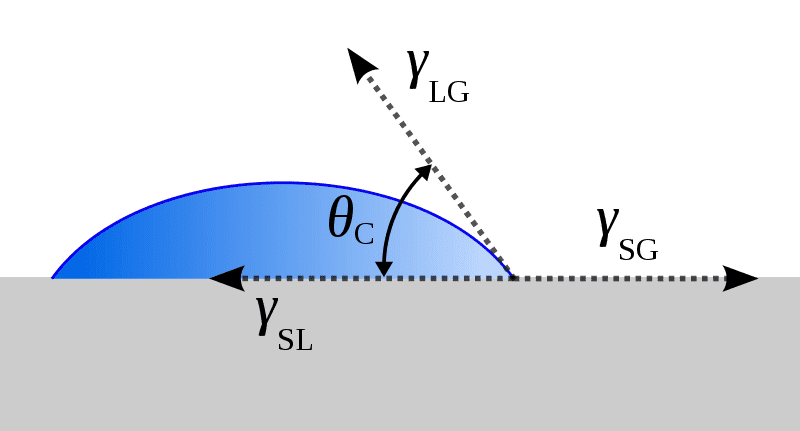
I came across this diagram, the ##\gamma##'s are supposedly forces per unit length of the respective interfaces:
1592667384469.png


It's not clear what these forces are acting on. ##\gamma_{SL}## and ##\gamma_{LG}## look like they could be acting on a small bit of water right at the end, but I have no idea what ##\gamma_{SG}## is supposed to be acting on.

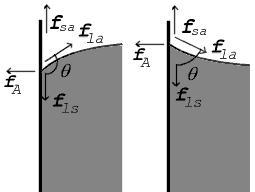
Likewise there's this diagram of capillary action:
1592667531755.png


It's not clear here either what bodies any of those forces are acting on.

I wondered if someone could clarify? Thanks
 
Physics news on Phys.org
etotheipi said:
It's not clear what these forces are acting on. γSL and γLG look like they could be acting on a small bit of water right at the end, but I have no idea what γSG is supposed to be acting on.
Those are surface tension - Solid Liguid interface, Liquid Gas, and Solid Gas.
At the point where all substances S, L, or G meet, there is an equilibrium and the tensions have to balance statically.

You are right, it is not readily apparent on what the tensions are acting.
But usually we are interested in the liquid surface.

Here is what I think
Consider the Water - Air interface ie the tension LG.
"Both" surface tensions, ie either that of the water in air, or that of the air in water ( if we can call that a surface tension, as usually we are interested in the energies at the liquid surface - consider an interface of two liquids ie water and oil - the oil particles could be more attracted to each other than to water particles, and the same for the water particles being attracted more to each other than the oil particles - and vice-versa ), would have to be equal statically or one would have movement. The surface tension of an air bubble in water is manifested as a pressure - a smaller bubble has a higher pressure within than a larger bubble. The surface tension of the water counteracts this pressure with surface tension of the molecules at the liquid-air interface. If less than that to counteract the internal bubble pressure, the bubble grow in size. If more, the bubble shrinks.

Hopefully that stands up ( or gets picked apart ) to PF scrutiny, which I hope it gets, as your question does delve farther into the common general descriptions of contact angle and surface tension.
 
  • Like
Likes   Reactions: etotheipi
I also found a nice reference here

In their words:
In Young’s law, the system on which the forces act is a corner of liquid bounded by the contact line

1592835318287.png
 
Last edited by a moderator:
  • Like
Likes   Reactions: 256bits
The reference does go into more detail.
thanks for the link.
 

Similar threads

  • · Replies 1 ·
Replies
1
Views
1K
  • · Replies 2 ·
Replies
2
Views
2K
  • · Replies 17 ·
Replies
17
Views
4K
Replies
39
Views
3K
  • · Replies 4 ·
Replies
4
Views
2K
  • · Replies 4 ·
Replies
4
Views
5K
  • · Replies 18 ·
Replies
18
Views
2K
  • · Replies 23 ·
Replies
23
Views
3K
Replies
4
Views
1K
  • · Replies 2 ·
Replies
2
Views
2K