System of Implicit Non-Linear First Order ODEs

Join the discussion
Registration is free. Ask a follow-up in this thread, or start your own.
5 replies · 2K views
CSteiner
Messages
31
Reaction score
0
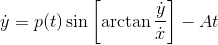
I have an extremely messy system of differential equations. Can anyone offer any ideas for a general solution?
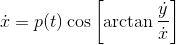
%5Ccos%20%5Cleft%20%5B%5Carctan%20%5Cfrac%7B%5Cdot%7By%7D%7D%7B%5Cdot%7Bx%7D%7D%20%5Cright%20%5D.gif

sin%20%5Cleft%20%5B%5Carctan%20%5Cfrac%7B%5Cdot%7By%7D%7D%7B%5Cdot%7Bx%7D%7D%20%5Cright%20%5D-At.gif


p(t) is a function of t, and A is a constant.
 
Physics news on Phys.org
CSteiner said:
I have an extremely messy system of differential equations. Can anyone offer any ideas for a general solution?

%5Ccos%20%5Cleft%20%5B%5Carctan%20%5Cfrac%7B%5Cdot%7By%7D%7D%7B%5Cdot%7Bx%7D%7D%20%5Cright%20%5D.gif

sin%20%5Cleft%20%5B%5Carctan%20%5Cfrac%7B%5Cdot%7By%7D%7D%7B%5Cdot%7Bx%7D%7D%20%5Cright%20%5D-At.gif


p(t) is a function of t, and A is a constant.
An idea would be to rewrite ##\cos \arctan \frac{\dot{y}}{\dot{x}}## as ##\frac{\dot x}{\sqrt{\dot x^2+\dot y^2}}##, and similar for the other equation. Then try to simplify it a bit.
 
Didn't think of that, thanks! I'll keep working on it.
 
CSteiner said:
I have an extremely messy system of differential equations. Can anyone offer any ideas for a general solution?

%5Ccos%20%5Cleft%20%5B%5Carctan%20%5Cfrac%7B%5Cdot%7By%7D%7D%7B%5Cdot%7Bx%7D%7D%20%5Cright%20%5D.gif

gif.gif


p(t) is a function of t, and A is a constant.

You may be best served by switching to intrinsic coordinates [itex](s, \psi)[/itex] where [tex] \dot x = \dot s \cos\psi, \\<br /> \dot y = \dot s \sin \psi.[/tex] Your system is then [tex] (\dot s - p) \cos \psi = 0 \\<br /> (\dot s - p) \sin \psi = -At.[/tex] Now either [itex]\dot s = p[/itex] or [itex]\cos \psi = 0[/itex]. The first is impossible unless [itex]A = 0[/itex]. The second requires that [itex]\dot x = 0[/itex] and [itex]\dot y = \pm p - At[/itex].

If [itex]A = 0[/itex] then [itex]\dot s = p[/itex] and [itex]\psi[/itex] can be an arbitrary function of [itex]t[/itex].
 
pasmith said:
You may be best served by switching to intrinsic coordinates [itex](s, \psi)[/itex] where [tex] \dot x = \dot s \cos\psi, \\<br /> \dot y = \dot s \sin \psi.[/tex] Your system is then [tex] (\dot s - p) \cos \psi = 0 \\<br /> (\dot s - p) \sin \psi = -At.[/tex] Now either [itex]\dot s = p[/itex] or [itex]\cos \psi = 0[/itex]. The first is impossible unless [itex]A = 0[/itex]. The second requires that [itex]\dot x = 0[/itex] and [itex]\dot y = \pm p - At[/itex].

If [itex]A = 0[/itex] then [itex]\dot s = p[/itex] and [itex]\psi[/itex] can be an arbitrary function of [itex]t[/itex].

Sorry, but it looks like something went wacky with your latex code. Could you retype it? It's hard to understand what your saying.
 
CSteiner said:
Sorry, but it looks like something went wacky with your latex code. Could you retype it? It's hard to understand what your saying.
It takes time before equations render correctly but eventually they do. What are you seeing? Try a different browser or device.
Basically he says to substitute ##\dot x = \dot s \cos\psi##, ##\dot y = \dot s \sin \psi##. Then it's very simple to arrive at a solution.

BTW, perhaps the first solution should have been ##\dot x=0##, ##\dot y=p\pm At##.