System of limited slip differentials with two power sources

Click For Summary
SUMMARY

This discussion focuses on the behavior of a 4x4 system equipped with a RIC engine and limited slip differentials (LSDs) when integrating two electric motors, each rated at 30kWm, alongside a 100kWm engine. The analysis concludes that under ideal conditions, each wheel would receive approximately 40kWm of power, contingent on the LSD settings. The conversation also highlights the potential for the LSDs to misinterpret wheel slip, leading to power distribution issues, and suggests that locking the middle differential could resolve these complications.

PREREQUISITES
  • Understanding of 4x4 drivetrain mechanics
  • Knowledge of limited slip differentials (LSDs)
  • Familiarity with electric motor specifications and performance
  • Basic principles of torque distribution in automotive systems
NEXT STEPS
  • Research the mechanics of limited slip differentials and their settings
  • Explore the impact of electric motor integration in traditional drivetrains
  • Study the effects of locking differentials on vehicle dynamics
  • Investigate the role of RIC engines in hybrid powertrains
USEFUL FOR

Automotive engineers, drivetrain designers, and enthusiasts interested in hybrid vehicle performance and differential mechanics.

howellrh
Messages
1
Reaction score
0
My first ever post here, so hello world!
So I've attached an image of a conventional 4x4 system with one RIC engine and LSDs for all wheels so that all four wheels can be driven, or just one depending on conditions. the front/rear LSD may in fact be locked, but that isn't particularly important...
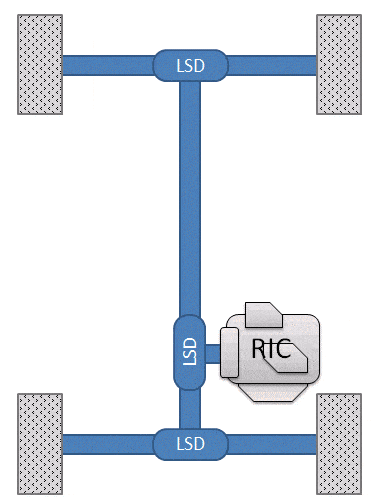
RIC + LSDs.gif

So if the front axle is at the bottom of the page, and the rear axle is at the top (the car is driving down your screen) and i added two electric motors where the rear brakes would usually go, then how would the system behave under acceleration? I know that removing the brakes isn't a great idea in real life, but for the purposes of this question its easier to describe it that way.
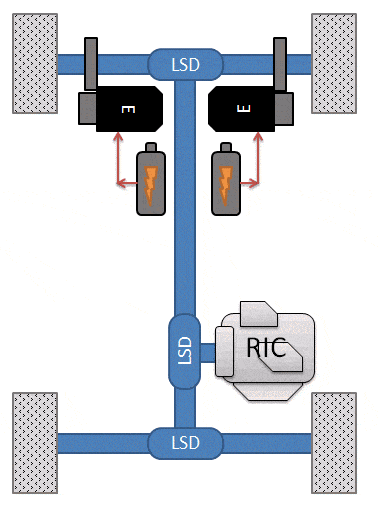
RIC + LSDs + Motors.gif

If you want numbers to play with then let's say the engine is 100kWm and the electric motors are 30kWm each and the LSDs can be whatever type you thing is best for this scenario
All the tyres are the same tread and grip, and we are assuming that the vehicle is on a level homogeneous road surface to keep it to the problem in hand.
My first conclusion on this problem is that the LSDs will sort themselves out (provided they have the right settings - which I can't define) and 1/4 of the overall 160kWm (that's 40kWm) would be applied to each wheel. I just can't decide if in reality the front/read LSD would think that the rear wheels were slipping and send all the power to the front initially, until the LSDs begin to limit the slip in the front/back...
also, what effect would locking the front/rear diff have? would it be better?
thanks to all for your help!
 
Engineering news on Phys.org
There is a problem. The RIC will act as a fulcrum that may effectively reverse the drive from the electric motors to the front axle.
Locking the middle diff will eliminate the problem.
 
Baluncore said:
There is a problem. The RIC will act as a fulcrum that may effectively reverse the drive from the electric motors to the front axle.
Locking the middle diff will eliminate the problem.

howellrh said:
My first ever post here, so hello world!
So I've attached an image of a conventional 4x4 system with one RIC engine and LSDs for all wheels so that all four wheels can be driven, or just one depending on conditions. the front/rear LSD may in fact be locked, but that isn't particularly important...
View attachment 84856
So if the front axle is at the bottom of the page, and the rear axle is at the top (the car is driving down your screen) and i added two electric motors where the rear brakes would usually go, then how would the system behave under acceleration? I know that removing the brakes isn't a great idea in real life, but for the purposes of this question its easier to describe it that way.
View attachment 84854
If you want numbers to play with then let's say the engine is 100kWm and the electric motors are 30kWm each and the LSDs can be whatever type you thing is best for this scenario
All the tyres are the same tread and grip, and we are assuming that the vehicle is on a level homogeneous road surface to keep it to the problem in hand.
My first conclusion on this problem is that the LSDs will sort themselves out (provided they have the right settings - which I can't define) and 1/4 of the overall 160kWm (that's 40kWm) would be applied to each wheel. I just can't decide if in reality the front/read LSD would think that the rear wheels were slipping and send all the power to the front initially, until the LSDs begin to limit the slip in the front/back...
also, what effect would locking the front/rear diff have? would it be better?
thanks to all for your help!
Suppose the RIC is stopped and the rear LH wheel is on solid ground. If the RH rear wheel is on ice, I think the motor will cause it to spin.
By the way, I have drawn myself an electrical analogue of the set up, using transformers for the differentials. When a differential locks, it seems to be equivalent to grounding the transformer centre tap.
 
tech99 said:
By the way, I have drawn myself an electrical analogue of the set up, using transformers for the differentials.
Can you please attach a copy of your model to a post.
tech99 said:
When a differential locks, it seems to be equivalent to grounding the transformer centre tap.
I would have thought that pinion drive would be through the centre tap with a resistor between the opposite ends to simulate a LSD. A short between the opposite ends would emulate a locked diff.
 
Baluncore said:
Can you please attach a copy of your model to a post.

I would have thought that pinion drive would be through the centre tap with a resistor between the opposite ends to simulate a LSD. A short between the opposite ends would emulate a locked diff.
I have tried to attach my diagram of the electrical analogue. Sorry if it does not work.
 

Attachments

  • differential (2).jpg
    differential (2).jpg
    27.6 KB · Views: 525
This is my transformer analogy. Torque for different motors is identified by different mutually prime frequencies.
Change the value of R_lock to lock the centre diff.
 

Attachments

  • AWD.png
    AWD.png
    10.4 KB · Views: 533
I have encountered a vertically oriented hydraulic cylinder that is designed to actuate and slice heavy cabling into sections with a blade. The cylinder is quite small (around 1.5 inches in diameter) and has an equally small stroke. The cylinder is single acting (i.e. it is pressurized from the bottom, and vented to atmosphere with a spring return, roughly 200lbs of force on the spring). The system operates at roughly 2500 psi. Interestingly, the cylinder has a pin that passes through its...

Similar threads

Replies
3
Views
595
  • · Replies 15 ·
Replies
15
Views
3K
  • · Replies 7 ·
Replies
7
Views
2K
  • · Replies 4 ·
Replies
4
Views
5K
  • · Replies 6 ·
Replies
6
Views
3K
  • · Replies 7 ·
Replies
7
Views
13K
  • · Replies 19 ·
Replies
19
Views
3K
  • · Replies 5 ·
Replies
5
Views
4K
  • · Replies 12 ·
Replies
12
Views
13K
  • · Replies 2 ·
Replies
2
Views
2K