Taking the Limit of this fraction involving trig functions

Click For Summary

Homework Help Overview

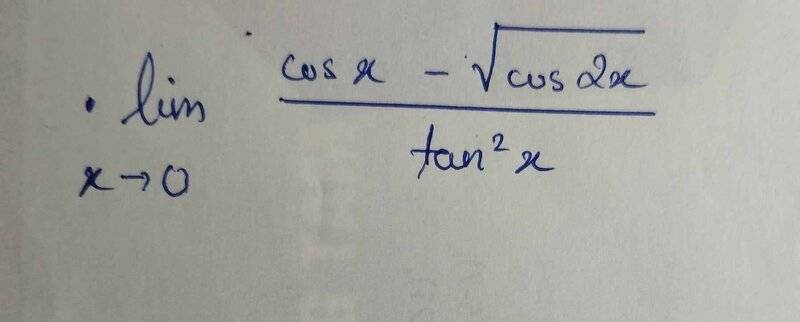
The discussion revolves around evaluating the limit of a fraction involving trigonometric functions, specifically the expression f(x) = (cos x - √(cos 2x)) / (tan^2 x) as x approaches 0. Participants explore various approaches to simplify the expression using trigonometric identities and limits.

Discussion Character

  • Exploratory, Conceptual clarification, Mathematical reasoning, Problem interpretation

Approaches and Questions Raised

  • Participants suggest expressing the function in terms of cos x and exploring the limit as a function of cos x. There are discussions about misunderstanding the application of limits and the potential use of L'Hôpital's rule. Some participants propose factoring or multiplying by the conjugate to simplify the expression.

Discussion Status

The discussion is active with multiple participants providing different perspectives on how to approach the limit. Some guidance has been offered regarding the use of trigonometric identities and the structure of the limit, but there is no explicit consensus on a single method or solution yet.

Contextual Notes

Participants express uncertainty about the instructions given by a teacher and question the clarity of the problem setup. There are indications of differing interpretations of how to manipulate the limit expression effectively.
Memo
Messages
35
Reaction score
3
Poster reminded to always show their work when starting schoolwork threads
Homework Statement
Lim (x->0) (cosx-sqrt(cos2x))/tan^2(x)
x∈(-π/4;π/4)\{0}
Relevant Equations
lim (x->x0) (1-cosa*f(x))/[f(x)]^2=a^2/2
Can't attempt to solve the task.
I'd appreciate it a lot if you could help!
368064999_867353445000190_1304311522445404453_n.jpg
 
Physics news on Phys.org
You can express <br /> f(x) = \frac{\cos x - \sqrt{\cos 2x}}{\tan^2 x} in terms of \cos x using basic trig identities. What can you do with <br /> \lim_{x \to 0} f(x) = \lim_{x \to 0} g(\cos x)?
 
  • Like
Likes   Reactions: PeroK
lim (x->0) g * lim(x->0) cosx
 
Memo said:
lim (x->0) g * lim(x->0) cosx
You are misunderstanding #2. This is not how limits of a function of a function works.
 
Memo said:
lim (x->0) g * lim(x->0) cosx
I think you should get the limit into a form where it is explicitly a function of ##\cos x## and take it from there.
 
1698765444286.png

this is what my teacher gave me. Yes, I don't understand him/her. Not sure if he/she's telling me to convert the function into that form or what, I don't see how it would turn out and just answered within my knowledge
 
Memo said:
View attachment 334560
this is what my teacher gave me. Yes, I don't understand him/her. Not sure if he/she's telling me to convert the function into that form or what, I don't see how it would turn out and just answered within my knowledge
PeroK said:
I think you should get the limit into a form where it is explicitly a function of ##\cos x## and take it from there.
 
I was replying to #4. This is as far as I can get to, sorry.
1698767974696.png
 
Memo said:
I was replying to #4. This is as far as I can get to, sorry.
View attachment 334562
I can't see what you have on the right hand side. That doesn't look as helpful as I'd hoped.

Do you know l'hospital's rule?
 
  • #10
Write it as <br /> (\cos^2 x)\frac{\cos x - \sqrt{2\cos^2 x - 1}}{1 - \cos^2 x} = u^2 \frac{u - \sqrt{2u^2 - 1}}{1 - u^2}
 
  • #11
pasmith said:
Write it as <br /> (\cos^2 x)\frac{\cos x - \sqrt{2\cos^2 x - 1}}{1 - \cos^2 x} = u^2 \frac{u - \sqrt{2u^2 - 1}}{1 - u^2}
Could you tell me what happens after that?
 
  • Like
Likes   Reactions: PeroK
  • #12
pasmith said:
You can express <br /> f(x) = \frac{\cos x - \sqrt{\cos 2x}}{\tan^2 x} in terms of \cos x using basic trig identities. What can you do with <br /> \lim_{x \to 0} f(x) = \lim_{x \to 0} g(\cos x)?
While a tractable path, I’d say it would be slightly more transparent to factorize out cos(x) and write the rest in terms of tan(x). This also directly uses the result regarding the product of limits the teacher apparently referred to.
 
  • Like
Likes   Reactions: SammyS
  • #13
You can also use the limit definition of continuity. If g is continuous at ##x_0##, then, ##lim_{x\rightarrow x_0}g(x)=g(lim_{x\rightarrow x_0})##
 
  • #14
Here's another idea. Multiply top and bottom by the conjugate of numerator to get rid of the square root.

PS This works nicely!
 
Last edited:
  • Like
Likes   Reactions: SammyS and DeBangis21
  • #15
Memo said:
I was replying to #4. This is as far as I can get to, sorry.
View attachment 334562

Use the expression in the above image (post #8) - well, most importantly use the numerator.

##\displaystyle \dfrac{ \cos x-\sqrt{ 2\cos^2x -1 \, } } {\tan^2x}##

Then do as @PeroK suggested in the preceding post.
 
Last edited:

Similar threads

  • · Replies 9 ·
Replies
9
Views
3K
  • · Replies 3 ·
Replies
3
Views
2K
  • · Replies 19 ·
Replies
19
Views
2K
Replies
27
Views
3K
Replies
7
Views
1K
  • · Replies 5 ·
Replies
5
Views
2K
  • · Replies 10 ·
Replies
10
Views
2K
  • · Replies 2 ·
Replies
2
Views
2K
  • · Replies 7 ·
Replies
7
Views
1K
  • · Replies 9 ·
Replies
9
Views
4K