Tangent vector fields and covariant derivatives of the 3-sphere

Click For Summary
SUMMARY

This discussion focuses on the computation of tangent vector fields and covariant derivatives on the 3-sphere, specifically addressing the metric tensor and Lie brackets. The metric \( g \) is defined as a symmetric 3x3 matrix representing the inner products of basis vectors, and it is independent of the Lie brackets of vector fields. The covariant derivatives in the Levi-Civita connection can be computed using the metric to derive Christoffel symbols, with the understanding that the Lie brackets do not vanish when derivatives are covariant.

PREREQUISITES
  • Understanding of Riemannian geometry and metrics
  • Familiarity with tangent vector fields and their properties
  • Knowledge of Lie brackets and their computation
  • Concept of covariant derivatives and the Levi-Civita connection
NEXT STEPS
  • Study the properties of Riemannian metrics in detail
  • Learn about the computation of Christoffel symbols from a given metric
  • Explore the relationship between Lie brackets and covariant derivatives
  • Investigate the geometric interpretation of tangent vector fields on manifolds
USEFUL FOR

Mathematicians, physicists, and students studying differential geometry, particularly those focusing on Riemannian manifolds and their applications in theoretical physics.

docnet
Messages
796
Reaction score
486
Homework Statement
compute the metrics, Lie brackets, and covariant derivatives in the Levi - Civita connection of the 3-sphere
Relevant Equations
{x^2+y^2+u^2+v^2=1}
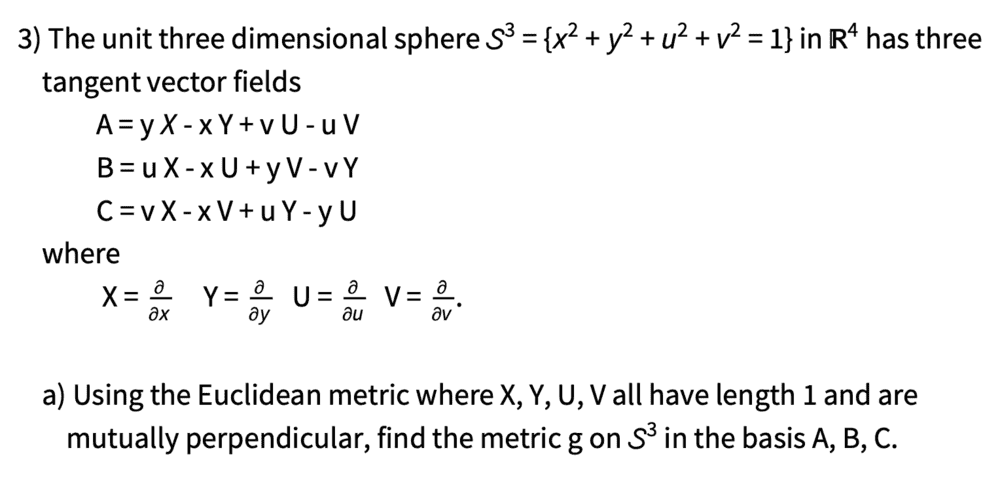
This week, I've been assigned a problem about a 3-sphere. I am confused how to approach this problem and any comments would be greatly appreciated.
Screen Shot 2020-10-28 at 10.21.47 PM.png
Screen Shot 2020-10-28 at 10.21.52 PM.png

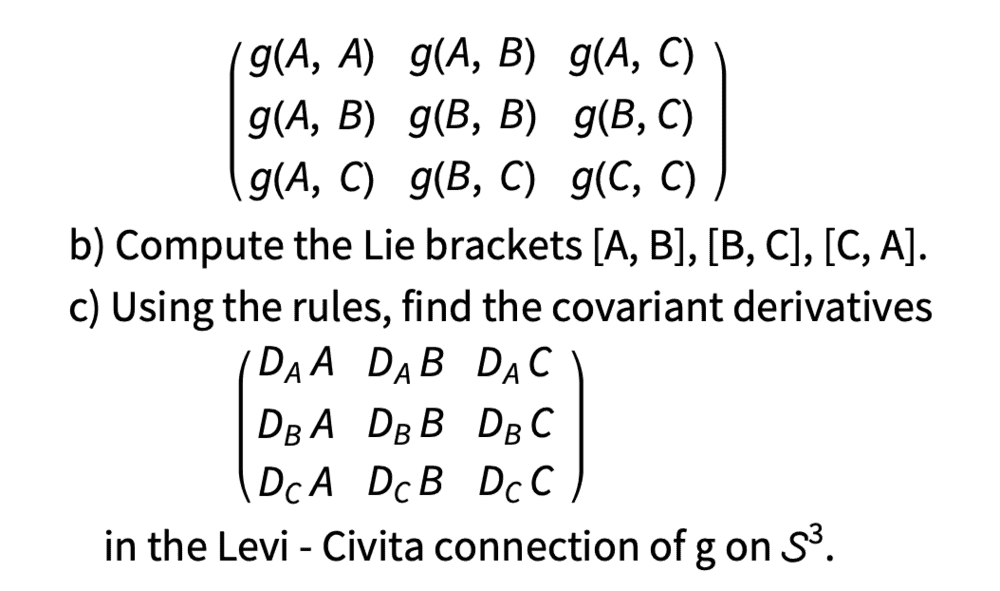
(a) - would I be correct to assume the metric G is simply the dot product of two vector fields with dx^2 dy^2 du^2 and dv^2 next to their corresponding terms?

for example:

g(A,A) = (ydx)^2 + (xdy)^2 + (vdu)^2 + (udv)^2

g(A,B) = (uv)dx^2 + (xdy)^2 + vy(du)^2 + uv(dv^2)

why are the metric arranged in a 3x3 pattern?(b) computing the lie brackets with the chain rule

[A,B] = operate on B with A - operate on A with B
[B,C] = operate on C with B - operate on B with C
[A,C] = operate on C with A - operate on A with C

are these computations entirely independent of the metric g?

(c) does this part involve information from the Lie brackets?thank you in advance for ideas.
 
Last edited:
Physics news on Phys.org
anyone?
 
a) No. The inner product of two vectors should be a number at each point (shouldn't have terms like ##dx^2##). The vector fields ##X,Y,U,V## are orthonormal, so to compute ##g(A,B),## you should just expand and use linearity. If ##e_1,\ldots,e_n## is a basis for a tangent space of a Riemannian manifold, you can define the matrix ##g_{ij}:=g(e_i,e_j)##. It's standard to represent bilinear forms by matrices like this.

b) Yes, Lie brackets of vector fields are independent of any metric.

c) I think the point is just that knowing the Lie brackets let's you save time by using the fact ##\nabla_XY-\nabla_YX=[X,Y],## so three of the covariant derivatives come "for free" once you've done the others.
 
Last edited:
  • Informative
Likes docnet
Infrared said:
a) No. The inner product of two vectors should be a number at each point (shouldn't have terms like dx2). The vector fields X,Y,U,V are orthonormal, so to compute g(A,B), you should just expand and use linearity. If e1,…,en is a basis for a tangent space of a Riemannian manifold, you can define the matrix gij:=g(ei,ej). It's standard to represent bilinear forms by matrices like this.

b) Yes, Lie brackets of vector fields are independent of any metric.

c) I think the point is just that knowing the Lie brackets let's you save time by using the fact ∇XY−∇YX=[X,Y], so three of the covariant derivatives come "for free" once you've done the others.
Thank you for the reply. I really appreciate it.

So we can relate the inner product of two vectors A and B to the metric g(A,B)?

Is the metric a function like this?

g(A, B)
= uy - xy + y^2 - vy - ux + x^2 - yx + vx + uv - vx + yv - v^2 - u^2 + ux -uy +uv
= x^2 +y^2 -u^2 -v^2 -2xy +2uv

or a matrix like this?

g(A, B) =

uy -yx y^2 -yv
-ux x^2 -xy vx
uv -vx vy -v^2
-u^2 ux -uy uvTo compute the covarient derivatives in the Levi-civita connection, should we use the metric to compute the christoffel symbols?

If the derivatives are covarient, will the Lie brackets be 0?

thank you,
 
For now, I'm reading up on coursework and trying to understand the concepts.. I'll post an update when I solved the problem or gotten closer.
 
We are posting the solution below, please type something if you see an error, thanks.

(3a)

The metric g in the basis A, B, C is a symmetric 3 x 3 matrix, with entries the inner (dot) products of the basis vectors.

y^2 + x^2 + v^2 + u^2_______ uy + x^2 + vy + uv_______ vy + x^2 + uv + uy

uy + x^2 + vy + uv_______ u^2 + x^2 + uy + vy_______ uv + x^2 + uy + vy

vy + x^2 + uv + uy_______ uv + x^2 + uy + vy_______v^2 + x^2 + u^2 + y^2

(b)

Each lie bracket [A, B] is computed by taking the derivative in the direction A of B, derivative in the direction B of A, and taking the difference. One vector operates on the other using the chain rule, with 12/16 terms in each derivative coming out as 0.

[A, B] = 2v+2u-2y-2x
[B, C] = 2y-2x-2u+2v
[A, C] = 2x+2y+2u-2v

(c)

The covariant derivatives in the Levi-Civita connection are the ordinary derivatives in the flat Euclidian connection. This is because our basis vector fields A, B, C are linear combinations of the Euclidian Basis vectors X, Y, U, V. This means we computed most the derivatives while calculating the lie brackets. Except the derivative A in the direction of A, B in the direction B, and C in the direction C. After computing these, we obtain the nine ordinary derivatives of g.

-x-y-u-v_______ v-y-x+u_______ -u-y+v+x

-v-u+y+x_______ -x-u-v-y _______ y-u-x+v

u-v-x+y _______ -y-v+u+x _______ -x-v-y-u
 
Last edited:
You should not omit the basis vectors and express the results in terms of ##A,B,C##. What I mean is: ##[A,B]=2(vX+uY-yU-xV)=2C.##
 
  • Like
Likes docnet
fresh_42 said:
You should not omit the basis vectors and express the results in terms of A,B,C. What I mean is: [A,B]=2(vX+uY−yU−xV)=2C.

Much thanks!

The answer is then,

(b)

[A, B] = 2(vX - uY - yU - xV) = 2C
[B, C] = 2(yX - xY + vU -uV) = 2A
[A, C] = 2(uX - vY - xU + yV) = 2B(c)

-xX-yY-uU-vV_______ vX+uY-yU-xV_______ -uX+vY+xU-yV

-vX-uY+yU+xV_______ -xX-yY-uU-vV _______ yX-xY+vU-uV

uX-vY-xU+yV _______ -yX+xY-vU+uV _______ -xX-yY-vV-uUor

-xX-yY-uU-vV_______ C_______________________-B
-C____________________-xX-yY-uU-vV___________A
B_____________________-A_______________________-xX-yY-uU-vV
 
Last edited:

Similar threads

  • · Replies 5 ·
Replies
5
Views
2K
Replies
6
Views
2K
  • · Replies 5 ·
Replies
5
Views
2K
  • · Replies 4 ·
Replies
4
Views
2K
  • · Replies 11 ·
Replies
11
Views
2K
Replies
3
Views
2K
  • · Replies 20 ·
Replies
20
Views
4K
Replies
5
Views
4K
  • · Replies 4 ·
Replies
4
Views
2K
  • · Replies 20 ·
Replies
20
Views
3K