Tangential velocity of external satellite

Click For Summary
SUMMARY

The discussion centers on the tangential velocity of external satellites and the distinction between circular motion and orbital motion. Participants clarify that while satellites exhibit circular motion around the Earth, the gravitational force plays a crucial role in their centripetal acceleration. The conversation emphasizes the importance of understanding the differences in forces involved in orbital mechanics compared to simple circular motion scenarios.

PREREQUISITES
  • Understanding of orbital mechanics
  • Knowledge of gravitational forces
  • Familiarity with centripetal acceleration concepts
  • Basic principles of circular motion
NEXT STEPS
  • Study the principles of orbital mechanics in detail
  • Learn about gravitational force calculations in satellite motion
  • Explore the equations governing centripetal acceleration
  • Investigate the differences between circular motion and orbital motion
USEFUL FOR

Aerospace engineers, physics students, and anyone interested in satellite dynamics and orbital mechanics will benefit from this discussion.

jhonconnor
Messages
7
Reaction score
4
Homework Statement
Two satellites move in circular orbits around the Earth. The radius of the orbit of the outer satellite is three times that of the inner satellite (measured from the center of the Earth). If the modulus of the inner tangential velocity is v then that of the outer satellite is:

So I guess a_1 = a_2 where
a = (v_t)^2/r
and I found that
v_2 = sqrt(3)v_1
but the correct answer is
v_2 = v_1/sqrt(3)

Could you explain me what I'm doing wrong?
Relevant Equations
a = (v_t)^2/r
v_t = w*r
1740686340382.png
 
Physics news on Phys.org
Why do you assume a1 = a2?
 
  • Like
Likes   Reactions: bdrobin519
mjc123 said:
Why do you assume a1 = a2?
Because I tried to get tangential velocity of external satellite with that condition
 
kuruman said:
Ohhhhh, it means that is another kind of problem. I thought that the problem can be solved with circular motion, but I didn't consider the orbital motion and the influence of the gravitational force. Thanks a lot
 
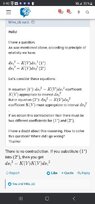
Would this not be the same?
 

Attachments

  • Screenshot_20250227_214007_Chrome.jpg
    Screenshot_20250227_214007_Chrome.jpg
    28.4 KB · Views: 58
bdrobin519 said:
Would this not be the same?
The same as what?
 
jhonconnor said:
Ohhhhh, it means that is another kind of problem. I thought that the problem can be solved with circular motion, but I didn't consider the orbital motion and the influence of the gravitational force. Thanks a lot
But it is circular motion. The satellites go around the center of the Earth at constant speed just like a mass at the end of a string. The difference is in the nature of the force that provides the centripetal acceleration. The kinematics are the same.
 
  • Like
Likes   Reactions: jhonconnor

Similar threads

Replies
12
Views
2K
  • · Replies 2 ·
Replies
2
Views
2K
  • · Replies 12 ·
Replies
12
Views
987
  • · Replies 18 ·
Replies
18
Views
1K
  • · Replies 6 ·
Replies
6
Views
787
Replies
14
Views
2K
Replies
4
Views
2K
  • · Replies 35 ·
2
Replies
35
Views
4K
  • · Replies 6 ·
Replies
6
Views
2K
  • · Replies 8 ·
Replies
8
Views
3K