Taylor Series for Potential in Crystals

Click For Summary
SUMMARY

The discussion focuses on the application of Taylor series expansion (T.S) to model the potential energy in a one-dimensional chain of atoms, specifically using the Lennard-Jones potential. The expansion is performed around the equilibrium position of the atoms, denoted as r=a, to simplify calculations by eliminating the linear term in the potential. The first term of the expansion corresponds to the static approximation of the crystal, while higher-order terms account for vibrational dynamics and multi-phonon processes. The discussion emphasizes that higher-order terms, such as cubic and quartic, are rarely used beyond the quartic due to low transition rates in solid-state physics.

PREREQUISITES
  • Understanding of Taylor series expansion in mathematical physics
  • Familiarity with Lennard-Jones potential in lattice dynamics
  • Knowledge of harmonic and anharmonic oscillators
  • Basic concepts of quantum mechanics related to phonons
NEXT STEPS
  • Study the mathematical derivation of Taylor series expansion in physics
  • Explore the Lennard-Jones potential and its applications in solid-state physics
  • Learn about harmonic and anharmonic oscillators in quantum mechanics
  • Investigate multi-phonon processes and their significance in crystal dynamics
USEFUL FOR

Physicists, materials scientists, and students studying solid-state physics who are interested in understanding the mathematical modeling of atomic interactions and vibrational dynamics in crystals.
Avardia
Messages
6
Reaction score
0
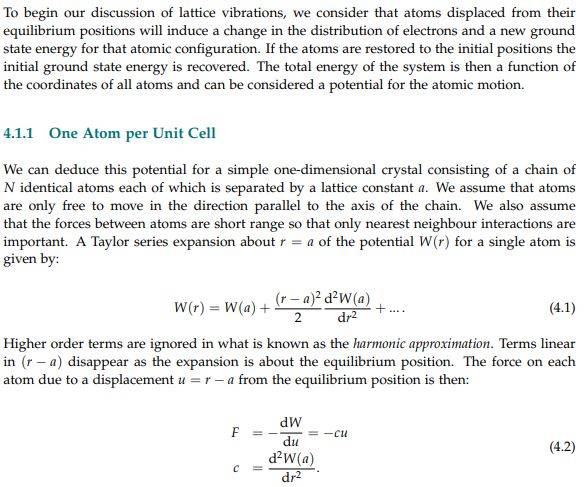
Hi, I've been reading the passage attached below and from what I understand we are looking at a 1D chain of atoms and if anyone atom moves it changes the potential for surrounding atoms and cause a change in energy in the system so the total energy is dependent on all the positions of the atoms relative to their own equilibrium. So the passage goes on to back it up mathematically and I get stumped right form the start with why do we start off with a Taylor series expansion(T.S) to give us the potential for an atom and I know that each atom is separated by a but why do we do the T.S about r=a?

242296
 
Physics news on Phys.org
Avardia said:
I know that each atom is separated by a but why do we do the T.S about r=a
The answer as to why we do a Taylor expansion at all is because physics is hard. Indeed, for the Lennard Jones potential we use to describe lattice dynamics exact solutions are altogether intractable. So we do what we typically do with potentials in such cases, we Taylor expand around the minima, ei: the equilibrium position of the atoms. Keeping only the first term results in the static approximation of the crystal (ie: no phonons, all atoms rigidly fixed in place). Adding in the second term is equivalent to approximating the vibrations with a Hooke's law term and leads to the harmonic cross-section where single phonons are stationary states that propagate with infinite lifetime through the lattice (unless they hit a crystal defect or the crystal surface). Additional terms are referred to as anharmonic terms and are responsible for multi-phonon creation and annihilation processes. These higher order terms account for increasing number of multi-phonon processes. For this reason, the terms are often classified as the elastic (zero phonon) cross-section for the first term, the one phonon for the quadratic term, two-phonon for the cubic (1 in -> 2 out, or 2 in -> 1 out), three-phonon for the quartic (1 in -> 3 out, 2 in -> 2 out, 3 in -> 1 out). And on up you go, however it is rare to ever go beyond the quartic term when modeling properties of solids since the transition rates for such higher order processes is extremely low. In a nutshell, these 'x in - y out' selection rules result from writing the higher order terms as linear combinations of products consisting of the raising and lowering quantum mechanical operators derived for the harmonic approximation (ie: keeping only the Hooke's law term which results in a more or less direct mapping of the lattice to the good old fashioned quantum mechanical oscillator problem). The selection rules drop out of the details associated with this process.
 
To add to what @SpinFlop said, one of the main reasons to expand around a minimum is that the linear term in the expansion:
$$(r-a)\frac{dW(a)}{dr}$$
is zero (because the slope of the potential is zero at the minimum). You can choose to expand around any point you want (call it ##r_0##), but if you don't choose an extremum, you'll have to deal with that extra linear term (##\propto r-r_0##) in your potential. The physics is ultimately the same, but the math is unnecessarily complicated.
 

Similar threads

  • · Replies 1 ·
Replies
1
Views
3K
  • · Replies 3 ·
Replies
3
Views
833
  • · Replies 1 ·
Replies
1
Views
3K
  • · Replies 2 ·
Replies
2
Views
1K
  • · Replies 1 ·
Replies
1
Views
3K
  • · Replies 3 ·
Replies
3
Views
2K
  • · Replies 17 ·
Replies
17
Views
4K
  • · Replies 5 ·
Replies
5
Views
2K
  • · Replies 2 ·
Replies
2
Views
1K
  • · Replies 5 ·
Replies
5
Views
2K