Taylor's Theorem: Get Help with 2 Difficult Questions

  • Context: MHB 
  • Thread starter Thread starter zkee
  • Start date Start date
  • Tags Tags
    Theorem
Click For Summary
SUMMARY

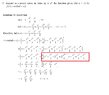
This discussion focuses on solving two specific questions related to Taylor's Theorem. The first question involves integrating the equation $\dfrac{dq}q = \dfrac{3p\,dp}{p^2+1}$, where the correct substitution is $z = p^2+1$. The second question addresses the expansion of the expression $\Bigl(x - \frac{x^2}2 + \frac{x^3}3 - \frac{x^4}4\Bigr)^2$, emphasizing the importance of retaining only terms up to $x^4$. Both solutions highlight the application of logarithmic properties and polynomial expansion techniques.

PREREQUISITES
  • Understanding of Taylor's Theorem
  • Familiarity with integration techniques
  • Knowledge of logarithmic properties
  • Ability to perform polynomial expansions
NEXT STEPS
  • Study integration techniques in calculus
  • Learn about logarithmic identities and their applications
  • Explore polynomial expansion methods
  • Review advanced topics in Taylor series and their applications
USEFUL FOR

Students studying calculus, particularly those focusing on Taylor's Theorem, as well as educators and tutors looking to enhance their understanding of integration and polynomial expansions.

zkee
Messages
2
Reaction score
0
Hey guys,

So i missed a class on Taylor's theorem and I'm getting stuck with these 2 questions. Any help would be greatly appreciated!

View attachment 1964View attachment 1965
 

Attachments

  • q1.jpg
    q1.jpg
    35.3 KB · Views: 102
  • q2.jpg
    q2.jpg
    48.3 KB · Views: 107
Physics news on Phys.org
zkee said:
Hey guys,

So i missed a class on Taylor's theorem and I'm getting stuck with these 2 questions. Any help would be greatly appreciated!

https://www.physicsforums.com/attachments/1964View attachment 1965
Hi zkee, and welcome to MHB!

In q.4, you write the given equation as $\dfrac{dq}q = \dfrac{3p\,dp}{p^2+1}$ ($dp$ is missing in the model solution), and integrate both sides: $$\int\dfrac{dq}q = \int\dfrac{3p\,dp}{p^2+1}.$$ Now make the substitution $z = p^2+1$, so that $dz = 2p\,dp$. That gives you the next line of the model solution, and takes you through as far as the line $\ln q = -\frac32\ln(p^2+1) + c$. Now use properties of the logarithm to get $\frac32\ln(p^2+1) = \ln(p^2+1)^{3/2}$ and $\ln q + \ln(p^2+1)^{3/2} = \ln\left[q(p^2+1)^{3/2}\right]$.

In q.5, the idea is that you are only interested in powers of $x$ up to $x^4$, so you just ignore any higher powers of $x$. So when you expand $\Bigl(x - \frac{x^2}2 + \frac{x^3}3 - \frac{x^4}4\Bigr)^2$, the only terms that survive are $x^2 - 2x\frac{x^2}2 + \frac{x^4}4 + 2x\frac{x^3}3.$
 

Similar threads

  • · Replies 9 ·
Replies
9
Views
3K
  • · Replies 3 ·
Replies
3
Views
2K
  • · Replies 11 ·
Replies
11
Views
2K
  • · Replies 10 ·
Replies
10
Views
3K
  • · Replies 4 ·
Replies
4
Views
1K
  • · Replies 1 ·
Replies
1
Views
2K
  • · Replies 1 ·
Replies
1
Views
2K
  • · Replies 21 ·
Replies
21
Views
4K
  • · Replies 3 ·
Replies
3
Views
3K
  • · Replies 2 ·
Replies
2
Views
1K