Temperature based on colour index using Planck's law

Click For Summary

Discussion Overview

The discussion revolves around determining the temperature of stars using their B-V magnitude in conjunction with Planck's law. Participants explore numerical methods for solving the temperature and the integration process involved, focusing on the application of the Planck equation.

Discussion Character

  • Technical explanation
  • Mathematical reasoning
  • Homework-related

Main Points Raised

  • One participant seeks assistance in solving for temperature (T) using the Planck law, indicating that other quantities are predetermined.
  • Another participant suggests that solving for T numerically should be straightforward and emphasizes the importance of integrating over the bandpass of the filter.
  • A follow-up inquiry asks for clarification on how to perform the integration, requesting a step-by-step guide.
  • Participants propose using numerical methods and coding in Mathematica, Matlab, or Python to facilitate the integration process.
  • A later reply indicates a lack of familiarity with coding but expresses a willingness to solve the problem graphically instead.

Areas of Agreement / Disagreement

Participants generally agree on the numerical approach to solving for temperature, but there is no consensus on the specific methods or steps for integration, as some seek detailed guidance while others suggest coding solutions.

Contextual Notes

Limitations include the lack of detailed steps for integration and the assumption that participants have varying levels of familiarity with numerical methods and coding.

heavystray
Messages
71
Reaction score
0
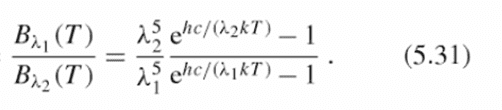
Hi, I'm trying to find temperature of stars using the stars' B-V magnitude by using the Planck law. However i do not know how to solve for T (assume other quantities are all given and determined first). Any idea how to do so? I already tried to do it but reach a dead end. Here I attached the Planck equation. h is Planck's constant, k is Boltzmann's constant, c is the speed of light,
upload_2018-1-23_0-13-28.png
 

Attachments

  • upload_2018-1-23_0-13-28.png
    upload_2018-1-23_0-13-28.png
    7.4 KB · Views: 572
Astronomy news on Phys.org
It should be a simple matter to solve for T numerically. To do it right, you really should integrate λ over the bandpass of the filter.
 
phyzguy said:
It should be a simple matter to solve for T numerically. To do it right, you really should integrate λ over the bandpass of the filter.
How do you integrate it tho? It'd be great if you can show step by step on how to do it, thanks for answering.
 
heavystray said:
How do you integrate it tho? It'd be great if you can show step by step on how to do it, thanks for answering.

I would do that numerically as well. You can write some simple code in Mathematica, Matlab, or Python to do it. Do you know how to use any of those?
 
phyzguy said:
I would do that numerically as well. You can write some simple code in Mathematica, Matlab, or Python to do it. Do you know how to use any of those?
hmmm no..but i think it's ok for now...i'll just solve it using graph, thanks!
 

Similar threads

  • · Replies 5 ·
Replies
5
Views
2K
  • · Replies 6 ·
Replies
6
Views
2K
  • · Replies 3 ·
Replies
3
Views
2K
  • · Replies 1 ·
Replies
1
Views
2K
  • · Replies 6 ·
Replies
6
Views
2K
  • · Replies 12 ·
Replies
12
Views
15K
  • · Replies 1 ·
Replies
1
Views
2K
Replies
0
Views
1K
  • · Replies 26 ·
Replies
26
Views
4K
Replies
11
Views
3K