Tension in a pulley system pulled at an angle

Click For Summary
In a pulley system where the angle is 90 degrees, the tension is not simply 2T, as the configuration alters the distribution of forces. The tension would be less than 2T due to the asymmetry introduced by the angle. Making the pulley fixed can change the dynamics, potentially affecting how forces are transmitted through the system. The sideways force from the right rope could indeed exert a lateral pull on the mass. Creating a free body diagram would help visualize these forces and their interactions within the system.
erensatik
Messages
9
Reaction score
3
Homework Statement
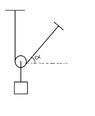
The system is in equilibrium. What is the tension in the bottom rope in the setup below? Neglect the mass of the rope and the pulley.
Relevant Equations
F=ma
This problem just came to my mind when thinking on another problem. Does the tension is just 2T as it is if the angle "a" is 90 degrees? It seems not to me. In a "normal"( I don't really know what is the right word for that) situation, the tension is would be 2T at the line in the middle of two strings and would be symmetric. So it should be less than that I guess. That's all I can think of and I am not sure. Please help me out.
One last thing I need to ask is that does making the pulley fixed makes a difference? I have no idea what would be the difference.
 

Attachments
  • Untitled.png
    Untitled.png
    3.2 KB · Views: 262
Last edited:
Physics news on Phys.org
I don't think you should be showing the vertical rope as straight vertical. Do you think that the sideways force from the right rope might pull the mass to the right a bit?
 
Do you know how to create a free body diagram of that loaded pulley?
 
Lnewqban said:
Do you know how to create a free body diagram of that loaded pulley?
totally got it, saying that is enough. Thanks for the help
 
  • Like
Likes Lnewqban and berkeman
The book claims the answer is that all the magnitudes are the same because "the gravitational force on the penguin is the same". I'm having trouble understanding this. I thought the buoyant force was equal to the weight of the fluid displaced. Weight depends on mass which depends on density. Therefore, due to the differing densities the buoyant force will be different in each case? Is this incorrect?

Similar threads

  • · Replies 12 ·
Replies
12
Views
1K
  • · Replies 27 ·
Replies
27
Views
3K
  • · Replies 18 ·
Replies
18
Views
4K
  • · Replies 10 ·
Replies
10
Views
5K
  • · Replies 22 ·
Replies
22
Views
1K
  • · Replies 22 ·
Replies
22
Views
6K
  • · Replies 15 ·
Replies
15
Views
2K
  • · Replies 15 ·
Replies
15
Views
6K
  • · Replies 2 ·
Replies
2
Views
790
  • · Replies 2 ·
Replies
2
Views
2K