Tensions of cable over a pulley

Click For Summary
SUMMARY

The discussion centers on the behavior of tensions in a frictionless ideal pulley system. It is established that T_1, T_2, and T_3 are equal when the pulleys are frictionless, leading to the conclusion that the tension remains constant throughout the rope. The forces acting on the pulleys are clarified, emphasizing that tensions are not forces but are closely related. Additionally, it is noted that for tensions to remain equal, the pulleys must also be massless, not just frictionless.

PREREQUISITES
  • Understanding of basic physics concepts such as tension and force
  • Familiarity with free body diagrams
  • Knowledge of pulley systems and their mechanics
  • Concept of frictionless systems in physics
NEXT STEPS
  • Study the principles of tension in different pulley configurations
  • Learn about free body diagram techniques for analyzing forces
  • Explore the implications of massless versus massive pulleys in mechanics
  • Investigate real-world applications of frictionless pulley systems
USEFUL FOR

Physics students, educators, and anyone interested in understanding the mechanics of pulley systems and the principles of tension in physics.
arpon
Messages
234
Reaction score
16
[moderator's note: moved to homework forum so no template]

Untitled3.png

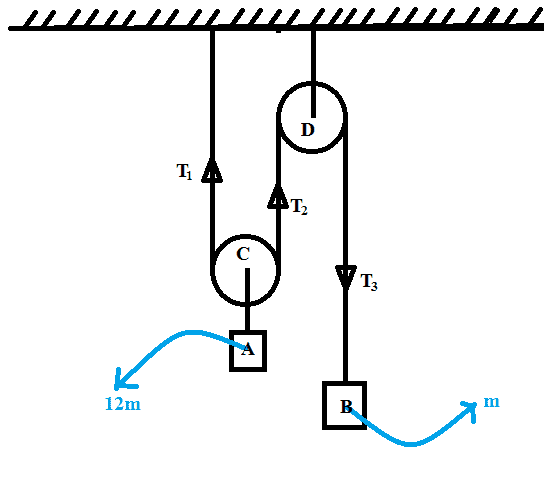
This is a frictionless ideal pulley.
Are T_1, T_2, T_3 equal? If so, why? Please explain in details?
 
Last edited by a moderator:
Physics news on Phys.org
Again, let's start with your own view – remembering that both pulleys are frictionless.
 
Philip Wood said:
Again, let's start with your own view – remembering that both pulleys are frictionless.
Probably, I have mistaken the direction of T_1 and T_2. They should be downward.
Then I straightened the cable.
Untitled5.png

So, I assume, T_1 + T_3 - T_2 = 0 .But 'why', I am not sure.
 
Right. Now we have something to go on.

Tensions aren't really forces, though they're closely related. Suppose A and B pull each other in a tug of war, with a rope which at a particular time has a tension of 200 N. That means that the rope pulls A with a force of 200 N, and pulls B with a force of 200 N. These forces are equal and opposite. So in your diagram in post 1, the arrows don't show tensions, but forces. Specifically the two left hand arrows show the forces that the rope exerts on the bottom pulley and the right hand arrow shows the force that the rope exerts on the top pulley. This could cause confusion. It's often best to draw separate diagrams for separate parts of the system showing the forces acting – so-called free body diagrams.

Now your question. The tension in the rope doesn't have a direction (in the same sense that a force has a direction). But it can move freely over the pulleys, and you are right to think that it can be regarded as straight from the point of view of comparing the tensions in the various sections of it. What do you conclude about these tensions? Note that the arrows you put on the straightened rope in post 3 should be removed, as we're dealing with tension, not force. Your equation is also wrong.
 
Philip Wood said:
Right. Now we have something to go on.

Tensions aren't really forces, though they're closely related. Suppose A and B pull each other in a tug of war, with a rope which at a particular time has a tension of 200 N. That means that the rope pulls A with a force of 200 N, and pulls B with a force of 200 N. These forces are equal and opposite. So in your diagram in post 1, the arrows don't show tensions, but forces. Specifically the two left hand arrows show the forces that the rope exerts on the bottom pulley and the right hand arrow shows the force that the rope exerts on the top pulley. This could cause confusion. It's often best to draw separate diagrams for separate parts of the system showing the forces acting – so-called free body diagrams.

Now your question. The tension in the rope doesn't have a direction (in the same sense that a force has a direction). But it can move freely over the pulleys, and you are right to think that it can be regarded as straight from the point of view of comparing the tensions in the various sections of it. What do you conclude about these tensions? Note that the arrows you put on the straightened rope in post 3 should be removed, as we're dealing with tension, not force. Your equation is also wrong.
Untitled4.png

So, now I think T_1 = T_2 = T_3. I explained the reason in the picture. Please check it whether I am right or Wrong.
 
You are right. The tension is the same (call it T) throughout the rope if the pulleys are frictionless. The rope therefore exerts an upward force of 2T on the left hand pulley, a downward force of 2T on the right hand pulley (which is counteracted by an equal and opposite force in the rope holding it to the ceiling) and an upward force of T on mass B.
 
  • Like
Likes   Reactions: arpon
Philip Wood said:
The tension is the same (call it T) throughout the rope if the pulleys are frictionless.
Just a word of caution. In the context of pulleys, 'frictionless' usually refers to the axle, not the contact with the rope. That being so, it is not sufficient (when the system is accelerating) for the pulleys to be frictionless. For the tension to be the same both sides, the pulleys would also need to be massless.
 

Similar threads

  • · Replies 7 ·
Replies
7
Views
2K
  • · Replies 18 ·
Replies
18
Views
944
  • · Replies 18 ·
Replies
18
Views
4K
  • · Replies 40 ·
2
Replies
40
Views
5K
  • · Replies 12 ·
Replies
12
Views
1K
  • · Replies 10 ·
Replies
10
Views
5K
Replies
4
Views
2K
  • · Replies 17 ·
Replies
17
Views
3K
  • · Replies 2 ·
Replies
2
Views
1K
  • · Replies 4 ·
Replies
4
Views
1K