Pulley system to balance the weight of a person

Join the discussion
Registration is free. Start your own thread to ask a follow-up.
7 replies · 2K views
lorenz0
Messages
151
Reaction score
28
Homework Statement
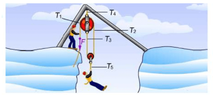
If the mass of the man to be saved is ##m##, the mass of the smaller pulley ##m_p## and the mass of the bigger pulley ##M_p##, find: ##T_1, T_2, T_3, T_4, T_5, F.##
Relevant Equations
##\vec{F}=m\vec{a}##
Since we are dealing with an ideal rope, we have that ##T_1=T_2=T_3=F and T_2+T_3=2F=(m+m_p)g\Leftrightarrow F=\frac{m+m_p}{2}g.##
##T_4=3F+(m+m_p+M_p)g=\frac{3}{2}(m+m_p)g+(m+m_p+M_p)g=(\frac{5}{2}m+\frac{5}{2}m_p+M_p)g## and ##T_5=mg-2F.##

Is this correct? If not, I woould appreciate a brief explanation on how to deal with these ideal-pulley ideal-rope systems since they seem quite counterintuitive to me.
 
Attachments
  • pulley.png
    pulley.png
    75.3 KB · Views: 225
Physics news on Phys.org
I agree that ##T_1 = T_2 = T_3## and that we can call this ##F##. As you say, the pulleys are ideal so all three tensions will match.

I agree that ##T_2 + T_3 = 2F##. Since those two tensions support the man plus the smaller pulley, it follows that ##2F = (m+m_p)g##. So yes, we can conclude that ##F=\frac{m+m_p}{2}g##

You will have to persuade me that ##T_4 = 3F + (m + m_p + M_p)g##. How did you arrive at that? I think you are double dipping there.
 
  • Like
Likes   Reactions: lorenz0, Steve4Physics and Lnewqban
@lorenz0, in addition to what @jbriggs444 has said, can I add this...

Presumably the system is in equilibrium (acceleration = 0).

Your equations/logic could be clearer if not joined together into a single line/paragraph.

The facts that ##T_1 = T_2 = T_3## and ##T_2+T_3=2F## lead to ##T_1 = F##. Can you see a simpler way to get this relationship directly?

All parts of the system are in equilibrium. You can draw a free body diagram for any part of the system. If you draw (or just imagine) a free body diagram for the upper pulley alone, it should help you.
 
  • Like
Likes   Reactions: Lnewqban and lorenz0
Steve4Physics said:
@lorenz0, in addition to what @jbriggs444 has said, can I add this...

Presumably the system is in equilibrium (acceleration = 0).

Your equations/logic could be clearer if not joined together into a single line/paragraph.

The facts that ##T_1 = T_2 = T_3## and ##T_2+T_3=2F## lead to ##T_1 = F##. Can you see a simpler way to get this relationship directly?

All parts of the system are in equilibrium. You can draw a free body diagram for any part of the system. If you draw (or just imagine) a free body diagram for the upper pulley alone, it should help you.
Drawing the free body diagram for the upper pulley alone, it seems that ##T_4=3F+M_Pg.## Is this correct?
 
Last edited:
lorenz0 said:
Drawing the free body diagram for the upper pulley alone, it seems that ##T_4=3F.## Is this correct?
No. You missed something this time.
 
jbriggs444 said:
No. You missed something this time.
The mass of the upper pulley, I guess.
 
  • Like
Likes   Reactions: jbriggs444
lorenz0 said:
Drawing the free body diagram for the upper pulley alone, it seems that ##T_4=3F.## Is this correct?
Pulley.jpg
 
lorenz0 said:
The mass of the upper pulley, I guess.
You mean the weight of the upper pulley. (Hopefully it's not a 'guess', as a free body diagram must include the body's weight.) Your Post #4 edited equation is now correct.

BTW, it's best to not significantly edit a post once someone has replied to it. Better to write a new Post making clear any changes you want. That can avoid confusion and messages at cross-purposes.
 
  • Like
Likes   Reactions: lorenz0 and Lnewqban