Tensor form of linear Hooke's law with E and v

  • Context: Engineering 
  • Thread starter Thread starter miraboreasu
  • Start date Start date
  • Tags Tags
    Tensor notation
Click For Summary
SUMMARY

The discussion focuses on deriving the tensor form of linear Hooke's law using Young's modulus (E) and Poisson's ratio (ν). The user seeks assistance in rewriting the vector-matrix form of the law into a tensor product format. Key equations established include the relationships for shear modulus (G) as G = E / (2(1 + ν)) and the Lame parameter (λ) as λ = Eν / ((1 + ν)(1 - 2ν)). The conversation emphasizes the need for clarity in transitioning from vector-matrix notation to tensor notation.

PREREQUISITES
  • Understanding of linear elasticity principles
  • Familiarity with tensor notation and operations
  • Knowledge of Young's modulus (E) and Poisson's ratio (ν)
  • Basic concepts of stress and strain in materials
NEXT STEPS
  • Research the derivation of the tensor form of Hooke's law
  • Study the application of tensor products in material science
  • Explore the relationship between Lame parameters and elastic moduli
  • Learn about the implications of Poisson's ratio on material behavior
USEFUL FOR

Material scientists, mechanical engineers, and students studying elasticity and continuum mechanics will benefit from this discussion.

miraboreasu
Messages
24
Reaction score
0
Homework Statement
Rewrite the linear Hooke's law with E and v
Relevant Equations
Linear Hooke's law
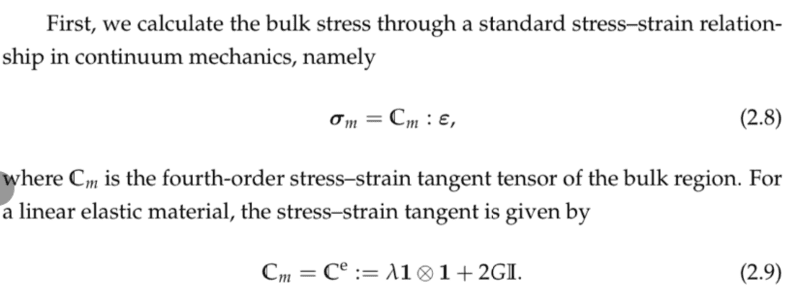
Actually, this is not homework, but I think I need help like homework. It was raised from the notice that there is no tensor form of linear Hooke's law in terms of Young's modulus E, and Poission's ratio, v. For example, if we use lame parameters, we have G, \lambda, like
1689866396660.png


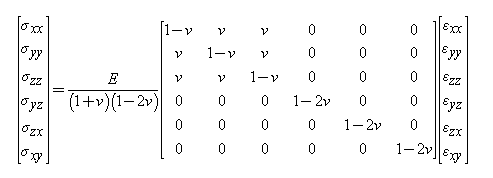
The linear Hooke's law (vector-matrix form) is
1689866818129.png

(https://physics.stackexchange.com/q...-materials-makes-stress-undefined-in-hookes-l)

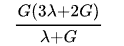
I tried to just use the relationship like:
E=
1689866498147.png


v =
1689866510947.png


but, it ends up with an equation with 2 roots (the first eq for get G= f (E)), so I think I need help about write the notation form directly from the vector-matrix form of the linear Hooke's law
 
Last edited:
Physics news on Phys.org
Start with $$\sigma_{xx}=\frac{E}{(1+\nu)(1-2\nu)}[(1-\nu)\epsilon_{xx}+\nu\epsilon_{yy}+\nu\epsilon_{zz}]$$Rewrite this as :$$\sigma_{xx}=\frac{E}{(1+\nu)(1-2\nu)}[(1-2\nu)\epsilon_{xx}+\nu(\epsilon_{xx}+\epsilon_{yy}+\epsilon_{zz})]$$$$=\frac{E}{(1+\nu)}\epsilon _{xx}+\frac{E\nu}{(1+\nu)(1-2\nu)}(\epsilon_{xx}+\epsilon_{yy}+\epsilon_{zz})$$$$=2G\epsilon_{xx}+\lambda (\epsilon_{xx}+\epsilon_{yy}+\epsilon_{zz})$$
 
Chestermiller said:
Start with $$\sigma_{xx}=\frac{E}{(1+\nu)(1-2\nu)}[(1-\nu)\epsilon_{xx}+\nu\epsilon_{yy}+\nu\epsilon_{zz}]$$Rewrite this as :$$\sigma_{xx}=\frac{E}{(1+\nu)(1-2\nu)}[(1-2\nu)\epsilon_{xx}+\nu(\epsilon_{xx}+\epsilon_{yy}+\epsilon_{zz})]$$$$=\frac{E}{(1+\nu)}\epsilon _{xx}+\frac{E\nu}{(1+\nu)(1-2\nu)}(\epsilon_{xx}+\epsilon_{yy}+\epsilon_{zz})$$$$=2G\epsilon_{xx}+\lambda (\epsilon_{xx}+\epsilon_{yy}+\epsilon_{zz})$$
Thank you, but sorry I didn't get it, how can I rewrite the vector-matrix form into the form like 2.9. I mean use tensor product, I, to represent the following
1689879602534.png
 
miraboreasu said:
Thank you, but sorry I didn't get it, how can I rewrite the vector-matrix form into the form like 2.9. I mean use tensor product, I, to represent the following
View attachment 329468
Look at my equation again. It’s too easy. You have:$$G=\frac{E}{2(1+\nu)}$$and $$\lambda=\frac{E\nu}{(1+\nu)(1-2\nu)}$$
 

Similar threads

  • · Replies 7 ·
Replies
7
Views
867
  • · Replies 5 ·
Replies
5
Views
3K
  • · Replies 18 ·
Replies
18
Views
3K
  • · Replies 3 ·
Replies
3
Views
2K
  • · Replies 7 ·
Replies
7
Views
3K
  • · Replies 1 ·
Replies
1
Views
2K
  • · Replies 7 ·
Replies
7
Views
2K
  • · Replies 1 ·
Replies
1
Views
3K
  • · Replies 4 ·
Replies
4
Views
1K
  • · Replies 3 ·
Replies
3
Views
7K