Math Amateur
Gold Member
MHB
- 3,920
- 48
I am reading Bruce N. Coopersteins book: Advanced Linear Algebra (Second Edition) ... ...
I am focused on Section 10.2 Properties of Tensor Products ... ...
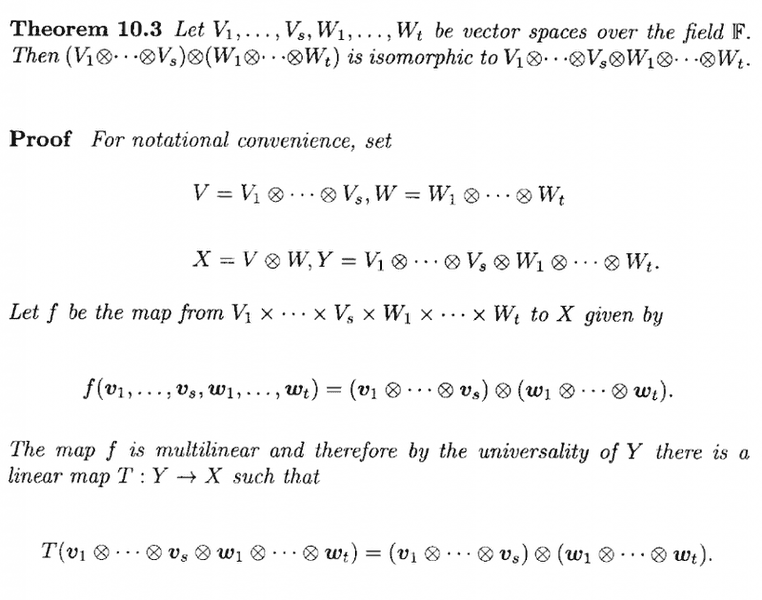
I need help with an aspect of the proof of Theorem 10.3 ... ... basically I do not know what is going on in the second part of the proof, after the isomorphism between ##X## and ##Y## is proven ... ... ... ...Theorem 10.3 reads as follows:
Question 1
In the above proof by Cooperstein, we read the following:" ... ... ... it follows that ##S## and ##T## are inverses of each other and consequently##X## and ##Y## are isomorphic. ... ... ""Surely, at this point the theorem is proven ... but the proof goes on ... ... ?
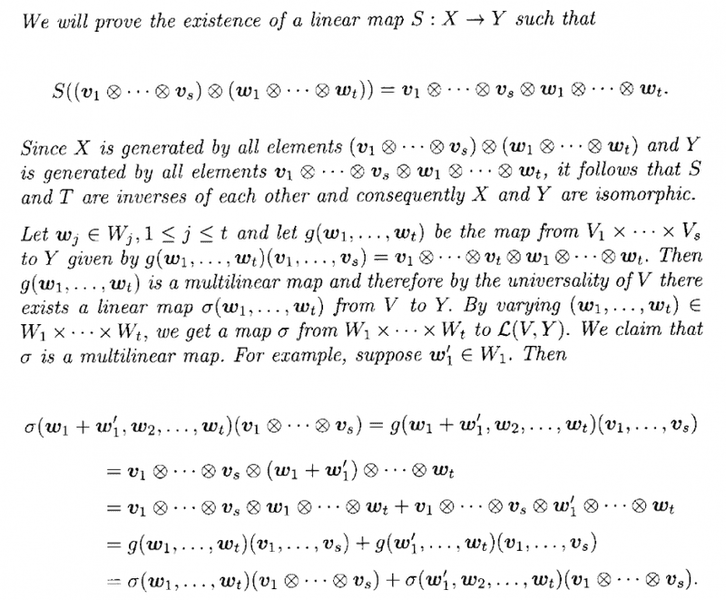
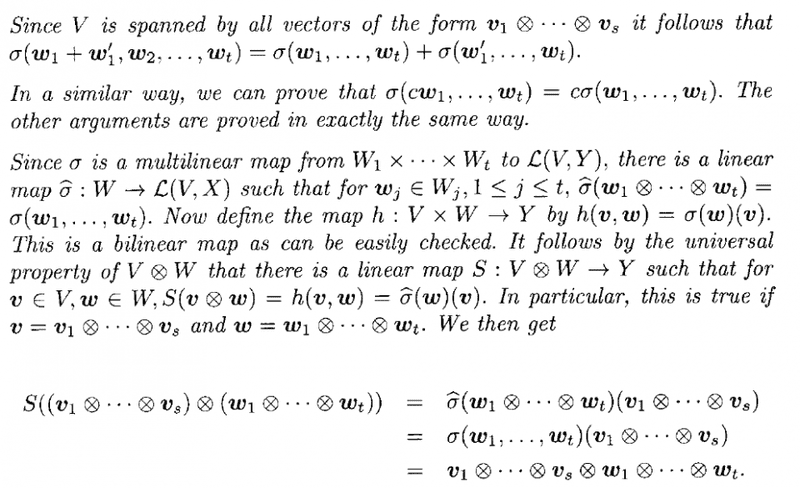
Can someone please explain what is going on in the second part of the proof ... ... ?Question 2
In the above proof we read:"... ... Then ##g (w_1, \ ... \ ... \ , w_t)## is a multilinear map and therefore by the universality of ##V## there exists a linear map ##\sigma (w_1, \ ... \ ... \ , w_t)## from ##V## to ##Y## ... ... "
My question is as follows:
What is meant by the universality of ##V##"and how does the universality of ##V## lead to the existence of the linear map ##\sigma## ... ... ?Hope someone can help ... ... Peter
I am focused on Section 10.2 Properties of Tensor Products ... ...
I need help with an aspect of the proof of Theorem 10.3 ... ... basically I do not know what is going on in the second part of the proof, after the isomorphism between ##X## and ##Y## is proven ... ... ... ...Theorem 10.3 reads as follows:
Question 1
In the above proof by Cooperstein, we read the following:" ... ... ... it follows that ##S## and ##T## are inverses of each other and consequently##X## and ##Y## are isomorphic. ... ... ""Surely, at this point the theorem is proven ... but the proof goes on ... ... ?
Can someone please explain what is going on in the second part of the proof ... ... ?Question 2
In the above proof we read:"... ... Then ##g (w_1, \ ... \ ... \ , w_t)## is a multilinear map and therefore by the universality of ##V## there exists a linear map ##\sigma (w_1, \ ... \ ... \ , w_t)## from ##V## to ##Y## ... ... "
My question is as follows:
What is meant by the universality of ##V##"and how does the universality of ##V## lead to the existence of the linear map ##\sigma## ... ... ?Hope someone can help ... ... Peter
Attachments


Last edited: