Tensor Products of Modules - Bland - Remark, Page 65

  • Context: Undergrad 
  • Thread starter Thread starter Math Amateur
  • Start date Start date
  • Tags Tags
    Modules Tensor
Click For Summary

Discussion Overview

The discussion revolves around understanding a remark made by Paul E. Bland in his book "Rings and Their Modules," specifically regarding the tensor products of modules. Participants seek clarification on the well-defined nature of a function ##g## and the properties of an R-balanced map ##h## as mentioned in Bland's text.

Discussion Character

  • Exploratory
  • Technical explanation
  • Conceptual clarification

Main Points Raised

  • Peter seeks clarification on Bland's remark about the difficulty in showing that the function ##g## is well-defined, particularly in the context of tensor products.
  • Andrew explains that for ##g## to be well-defined, it must yield the same output for elements in the same coset, which involves conditions on the mappings of elements from modules.
  • Peter summarizes Andrew's explanation, confirming his understanding that the well-definedness of ##g## means it maps equivalent cosets to the same output.
  • There is a question about why the map ##h = \rho' ( f \times id_N )## is considered an R-balanced map, with a request for demonstration of this property.

Areas of Agreement / Disagreement

Participants generally agree on the interpretation of Bland's remark regarding the well-definedness of the function ##g##, but the discussion about the R-balanced map ##h## remains unresolved, with no consensus on its properties yet.

Contextual Notes

Participants reference specific definitions and properties from Bland's text, indicating a reliance on the context provided in the book for their discussion.

Math Amateur
Gold Member
MHB
Messages
3,920
Reaction score
48
I am reading Paul E. Bland's book "Rings and Their Modules ...

Currently I am focused on Section 2.3 Tensor Products of Modules ... ...

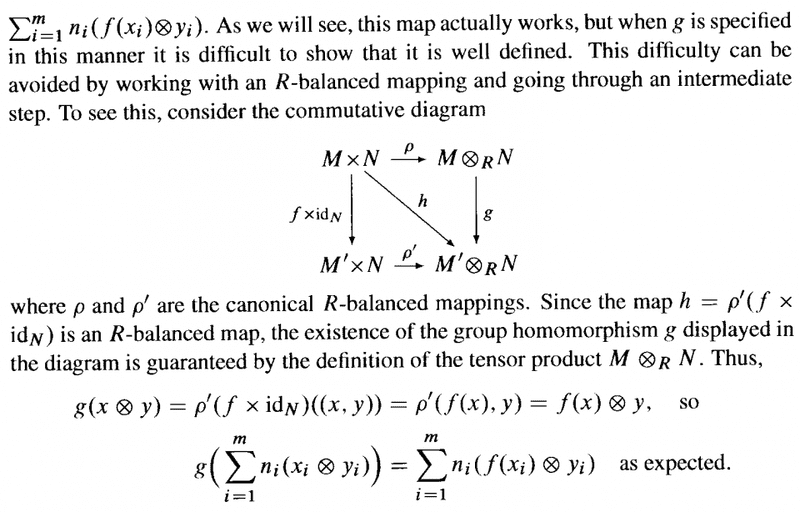
I need some help in order to fully understand the Remark that Bland makes on Pages 65- 66

Bland's remark reads as follows:

?temp_hash=1df732755830243c4f757b364fbfcd7a.png

?temp_hash=1df732755830243c4f757b364fbfcd7a.png

Question 1

In the above text by Bland we read the following:

"... ... but when ##g## is specified in this manner it is difficult to show that it is well defined ... ... "

What does Bland mean by showing ##g## is well defined and why would this be difficult ... ...Question 2

In the above text by Bland we read the following:

"... ... Since the map ##h = \rho' ( f \times id_N )## is an R-balanced map ... ... "Why is ##]h = \rho' ( f \times id_N )## an R-balanced map ... can someone please demonstrate that this is the case?
Hope someone can help ... ...

Peter

=============================================================================The following text including some relevant definitions may be useful to readers not familiar with Bland's textbook... note in particular the R-module in Bland's text means right R-module ...
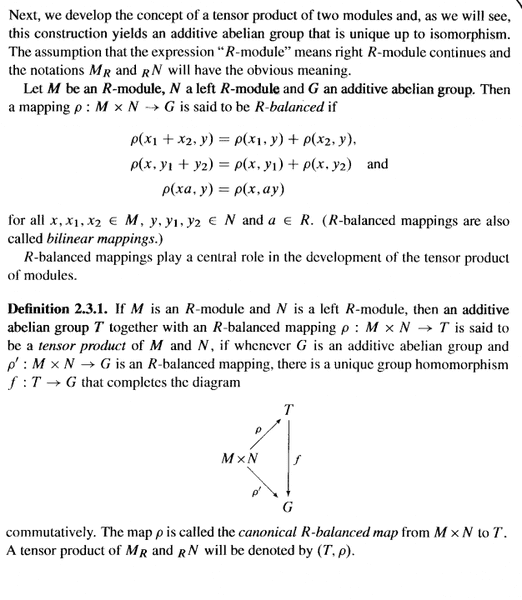
?temp_hash=3fa2237169f3e6505d73e5b77ac934e5.png
 

Attachments

  • Bland - 1 - REMARK - Page 65 ... ... Page 1.png
    Bland - 1 - REMARK - Page 65 ... ... Page 1.png
    15.7 KB · Views: 637
  • Bland - 2 - REMARK - Page 65 ... ... Page 2 ... ... .png
    Bland - 2 - REMARK - Page 65 ... ... Page 2 ... ... .png
    57.1 KB · Views: 733
  • Bland - R-Balanced Maps and Tensor Products.png
    Bland - R-Balanced Maps and Tensor Products.png
    34.9 KB · Views: 745
Last edited:
Physics news on Phys.org
Good morning MA. I wonder if you are affected by the wild weather this morning from the East Coast Low in the Tasman Sea.

In the example given, the purported definition of g is that g(x\otimes y)=f(x)\otimes y. If we think about what this means, it is saying that

$$g\Big(\chi_{(x,y)}+K\Big)=\chi_{(f(x),y)}+K'$$

where K and K' are the submodules of Z and Z' respectively that have the required 'zero' properties inherited from the modules M,M',N; and Z and Z' are the free R-modules generated by {\{\chi_{(u,v)}\ :\ u\in M\wedge v\in N\}} and {\{\chi_{(u,v)}\ :\ u\in M'\wedge v\in N\}} respectively.

For this to be well-defined, we require that, for any a,c\in M and b,d\in N such that (a,b) and (c,d) are in the same coset of K, it will be the case that (f(a),b)) and (f(c),d) are in the same coset of K'. Otherwise, g will not be a function because g\Big(\chi_{(a,b)}+K\Big)\neq g\Big(\chi_{(c,d)}+K\Big) even though \chi_{(a,b)}+K=\chi_{(c,d)}+K. Hence we have two different output values for a single input.

The argument involving the diagram appears to be a proof that g, thus defined, is indeed well-defined.
 
  • Like
Likes   Reactions: Math Amateur
Hi Andrew ... thanks for helping ///

I am currently in regional Victoria ... back in Tasmania soon ... weather wet and cold here but not wild like around Sydney and the NSW coastline ...

Regarding you post ... yes, understand ... so what you are saying is ... ... that when Bland talks about ##g## being "well defined" he means that if we choose a different element ... say, ##\sum_{ i = 1}^m n'_i ( x'_i \otimes y'_i )## in the same coset as ##\sum_{ i = 1}^m n_i ( x_i \otimes y_i )## ... ... then ##g## still maps onto ##\sum_{ i = 1}^m n_i ( f(x_i) \otimes y_i ) ## ... ... is that correct ...?
 
Yes, that's right.
 
  • Like
Likes   Reactions: Math Amateur
andrewkirk said:
Yes, that's right.
Thanks Andrew ...

Peter
 

Similar threads

  • · Replies 1 ·
Replies
1
Views
2K
Replies
37
Views
5K
  • · Replies 6 ·
Replies
6
Views
2K
Replies
3
Views
1K
  • · Replies 3 ·
Replies
3
Views
2K
  • · Replies 9 ·
Replies
9
Views
2K
Replies
4
Views
2K
Replies
1
Views
1K
  • · Replies 2 ·
Replies
2
Views
1K
  • · Replies 12 ·
Replies
12
Views
2K